Home
Class 11
PHYSICS
Method 3 of W Mass of a piston shown i...

Method 3 of W
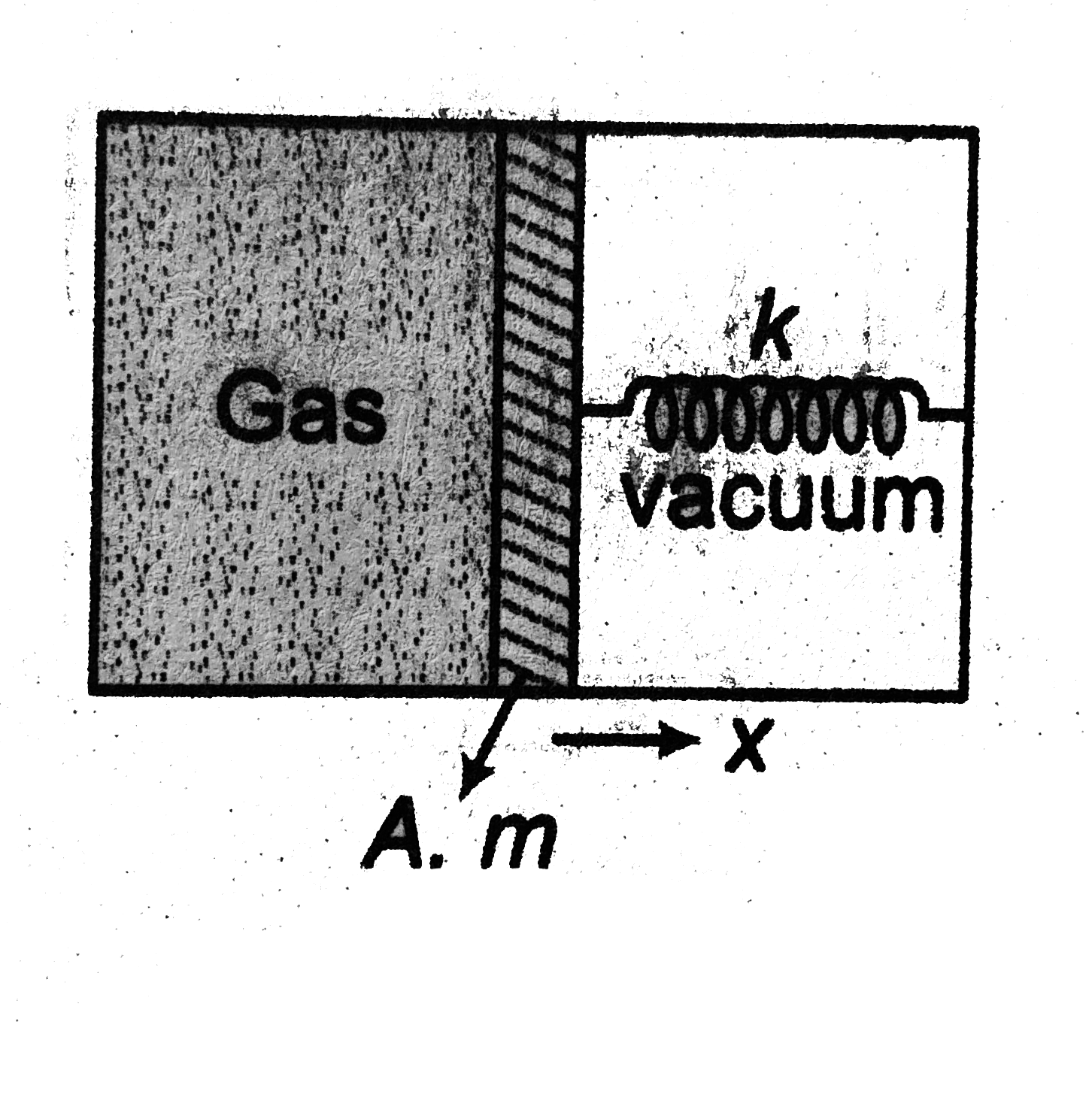
Mass of a piston shown in Fig. is m and area of cross-section is A. Initially spring is in its natural length. Find work done by the gas.

Text Solution

Verified by Experts

The correct Answer is:

A, B

In the given condition, work is done by the gas only against spring force `kx`. This force is a variable force. Hence,
`W=int_0^x(kx)dx=1/2kx^2`
Promotional Banner

Topper's Solved these Questions

  • LAWS OF THERMODYNAMICS

    DC PANDEY|Exercise Example Type 1|2 Videos
  • LAWS OF THERMODYNAMICS

    DC PANDEY|Exercise Example Type 2|1 Videos
  • LAWS OF MOTION

    DC PANDEY|Exercise Medical entrances gallery|39 Videos
  • MAGNETIC EFFECT OF CURRENT AND MAGNETISM

    DC PANDEY|Exercise Integer type Questions|10 Videos

Similar Questions

Explore conceptually related problems

2.00 mol of a monatomic ideal gas (U=1.5nRT) is enclosed in an adiabatic, fixed , vertical cylinder fitted with a smooth, light adiabatic piston.the piston is connected to a vertical spring of spring constant 200 N m^(-1) as shown in .the area of cross section of the cylinder is 20.0 cm^(2) . initially, the spring is at its natural length and the temperature of the gas is at its natural length and the temperature of the gas is 300 K. the atmosphere pressure is 100 kPa. the gas is heated sloewly for some time by means of an electric heater so as to move the poston up through 10 cm. find (a) the work done by the gas (b) the final temperature of the gas and (c ) the heat supplied by the heater.

A fixed container is fitted with a piston which is attached to a spring of spring constant k . The other and of the spring is attached to a rigid wall. Initially the spring is in its natural length and the length of container between the piston and its side wall is L . Now an dideal diatomic gas is slowly filled in the container so that the piston moves quasistatically. It pushed the piston by x so that the spring now is compressed by x . The total rotaional kinetic energy of the gas molecules in terms of the displacement x of the piston is (there is vacuum outside the container)

Find the maximum tension in the spring if initially spring at its natural length when block is released from rest.

A non conducting piston of mass m and area of cross section A is placed on a non conducting cylinder as shown in figure. Temperature, spring constant, height of the piston are given by T,K,h respectively. Initially spring is relaxed and piston is at rest. Find (a) Number of moles (b) Work done by gas to displane the piston by distance d when the gas is heated slowly. (c ) Find the final temperature

Two equal masses are attached to the two ends of a spring of spring constant k. The masses are pulled out symmetrically to stretch the spring by a length x over its natural length. The work done by the spring on each mass is

Mass m is connected with an ideal spring of natural length l whose other end is fixed on a smooth horizontal table. Initially spring is in its natural length l . Mass m is given a velocity 'v' perpendicular to the spring and released . The velocity perpendicular to the spring when its length l+x , will be

A block of mass m is placed on a smooth block of mass M = m with the help of a spring as shown in the figure. A velocity v_(0) is given to upper block when spring is in natural length. Find maximum compression in the spring.

Two equal masses are attached to the two end of a spring of force constant k the masses are pulled out symmetrically to stretch the spring by a length 2x_(0) over its natural length. Find the work done by the spring on each mass.

A bar of mass m and length l is hanging from point A as shown in the figure . If the Young's modulus of elasticity of the bar is Y and area of cross - section of the wire is A, then the increase in its length due to its own weight will be

DC PANDEY-LAWS OF THERMODYNAMICS-Level 2 Subjective
  1. Method 3 of W Mass of a piston shown in Fig. is m and area of cross-...

    Text Solution

    |

  2. Two moles of helium gas undergo a cyclic process as shown in Fig. Assu...

    Text Solution

    |

  3. 1.0 k-mol of a sample of helium gas is put through the cycle of operat...

    Text Solution

    |

  4. The density (rho) versus pressure (p) graph of one mole of an ideal mo...

    Text Solution

    |

  5. An ideal gas goes through the cycle abc. For the complete cycle 800J o...

    Text Solution

    |

  6. A cylinder of ideal gas is closed by an 8kg movable piston of area 60c...

    Text Solution

    |

  7. Three moles of an ideal gas (Cp=7/2R) at pressure p0 and temperature T...

    Text Solution

    |

  8. Two moles of helium gas(lambda=5//3) are initially at temperature 27^@...

    Text Solution

    |

  9. An ideal monoatomic gas is confined in a cylinder by a spring-loaded p...

    Text Solution

    |

  10. An ideal diatomic gas (gamma=7/5) undergoes a process in which its int...

    Text Solution

    |

  11. For an ideal gas the molar heat capacity varies as C=CV+3aT^2. Find th...

    Text Solution

    |

  12. One mole of an ideal monatomic gas undergoes the process p=alphaT^(1//...

    Text Solution

    |

  13. One mole of a gas is put under a weightless piston of a vertical cylin...

    Text Solution

    |

  14. An ideal monatomic gas undergoes a process where its pressure is inver...

    Text Solution

    |

  15. The volume of one mode of an ideal gas with adiabatic exponent gamma i...

    Text Solution

    |

  16. Two moles of a monatomic ideal gas undergo a cyclic process ABCDA as s...

    Text Solution

    |

  17. Pressure p, volume V and temperature T for a certain gas are related b...

    Text Solution

    |

  18. An ideal gas has a specific heat at constant pressure Cp=(5R)/(2). The...

    Text Solution

    |

  19. Three moles of an ideal gas being initially at a temperature Ti=273K w...

    Text Solution

    |
