Home
Class 12
PHYSICS
A uniformly charged thin ring has radius...

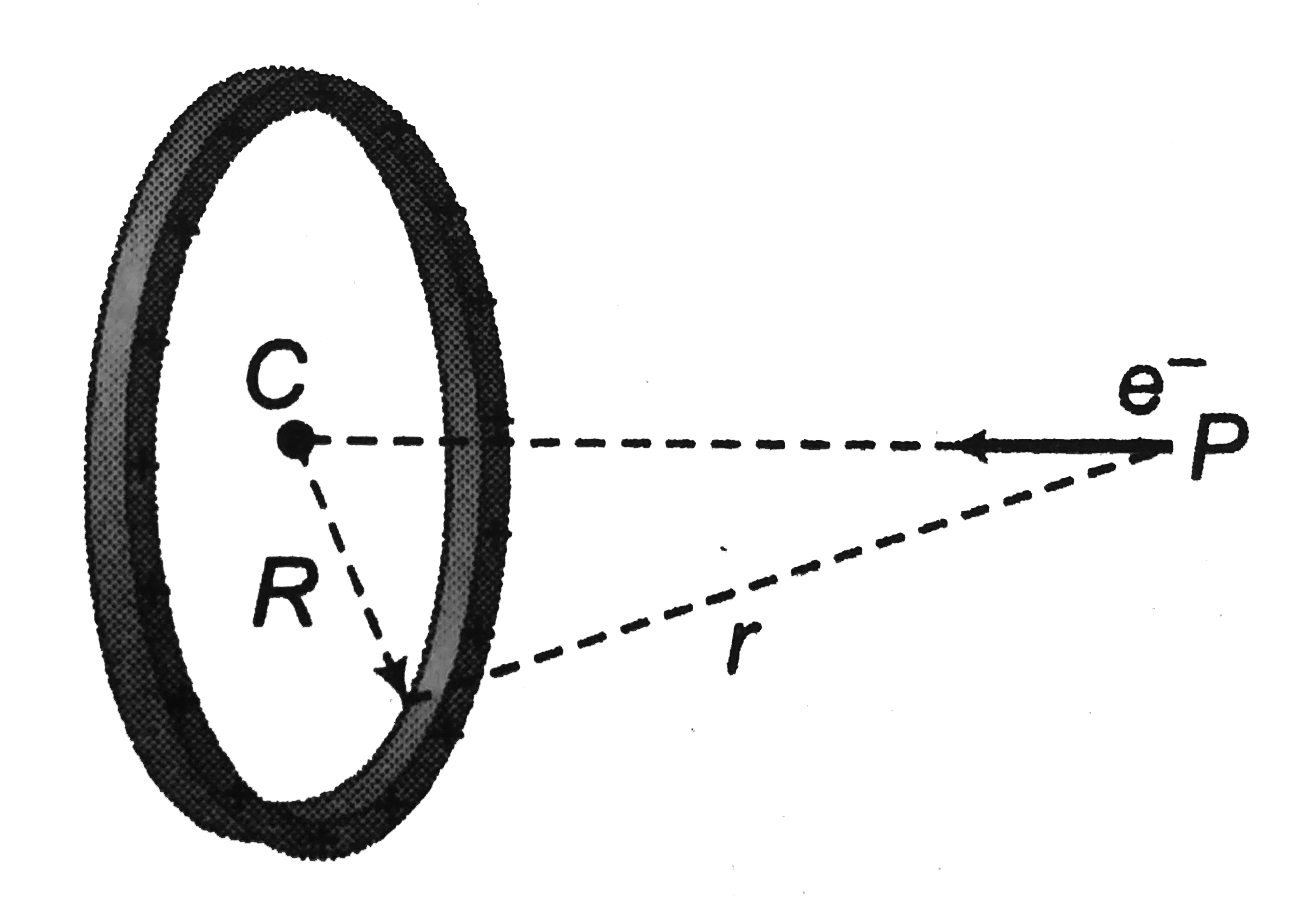
A uniformly charged thin ring has radius `10.0 cm` and total charge `+12.0muC`. An electron is placed on the ring's axis a distance `25.0 cm` from the centre of the ring and is constrained to stay on the axis of the ring. The electron is then released from rest.
a. describe the subsequent motion of the electron
b. find the speed of the electron when it reaches the centre of the ring

Text Solution

Verified by Experts

The correct Answer is:
A, D

a. The eletron will be attracted towards the centre of C of the ring. At C net force is zero, but on reaching C electron has some kinetic enegy and due to inertia it crosses C, but on the other side it is further attracted towards C. Hence, motion of electron is oscillatory about point C.
b. As the electron approaches C,its speed (hence, kinetic energy) increases due to force of attraction towards the centre C. this increase in knetic energy is at the cost of electrostatic potential energy. Thus,
`1/2mv^2=U_i-U_f`
`=U_p-U_c=(-e)[V_P-V_C]` .........i
Here, V is the potential due to ring
`V_P=1/(4piepsilon_0).q/r` (q=charge on ring)
`=((9xx10^9)(12xx10^-9))/(sqrt((10)^2+(25)^2)xx10^-2)=401V`
`V_C=1/(4piepsilon_0).q/R`
`=((9xx10^9)(12xx10^-9))/(10xx10^-2)=1080V`
Substituting the proper values inn eqn i we have
`1/2xx9.1xx10^-31xxv^2=(-1.6xx10^-19)(401-1080)`
`=v=15.45xx10^6m//s`
Promotional Banner

Topper's Solved these Questions

  • ELECTROSTATICS

    DC PANDEY|Exercise Exercise 24.1|4 Videos
  • ELECTROSTATICS

    DC PANDEY|Exercise Exercise 24.2|9 Videos
  • ELECTROSTATICS

    DC PANDEY|Exercise Example Type 8|3 Videos
  • ELECTROSTATIC POTENTIAL AND CAPACITORS

    DC PANDEY|Exercise (C) Chapter exercises|50 Videos
  • GRAVITATION

    DC PANDEY|Exercise All Questions|120 Videos

Similar Questions

Explore conceptually related problems

A uniformly charged thin ring has radius 10.0 cm and total charge +12.0 nC . An electron is placed on the ring's axis a distance 25.0 cm from the centre of the ring and is constrained to stay on the axis of the ring. The electron is then released from rest, then (i) describe the subsequent motion of the electron (ii) find the speed of the electron when it reaches the centre of the ring.

A ring has radius 30cm and a charge of 2nC .The electric potential on the axis of the ring at a distance of 40cm from its centre will be

Potential on the axis of ring of radius 3R and at distance 4R from centre of ring is (charge on the ring is Q )

A charge Q is uniformly on a ring of radius R . Find the electric potential on the axis of ring at distance x from the centre of the ring. Sketch variation of potential with respect to x .

An electron released on the axis of a positively charged ring at a large distance from the centre will

A ring of radius R carries a uniformly distributed charge +Q. A point charge -q is placed on the axis of the ring at a distance 2R from the centre of the ring and released from rest. The particle executes a ismple harmonic motion along the axis of the ring.

An electric dipole is kept on the axis of a uniformly charged ring at distance d from the centre of the ring. The direction of the dipole moment is along the axis. The dipole moment is p , charge of the ring is Q & radius of the ring is R . The force on the dipole is

Which statement is true :- (i) A ring of radius R carries a uniformly distributed charge +Q. A point charge -q is placed on the axis of the ring at a distance 2R from the centre of the ring and released from rest. The particle executes a smiple harmonic motion along the axis of the ring. (ii) Electrons move from a region of higher potential to that of lower potential

DC PANDEY-ELECTROSTATICS-Level 2 Single Correct
  1. A point charge q1=9.1muC is held fixed at origin. A second point charg...

    Text Solution

    |

  2. A point charge q1 =-5.8muC is held stationary at the origin. A second ...

    Text Solution

    |

  3. A uniformly charged thin ring has radius 10.0 cm and total charge +12....

    Text Solution

    |

  4. Two points A and B are 2 cm apart and a uniform electric field E acts ...

    Text Solution

    |

  5. An alpha particle with kinetic energy 10 Me V is heading toward a stat...

    Text Solution

    |

  6. Three point charges 1C, 2C and 3C are placed at the corners of an equi...

    Text Solution

    |

  7. Consider a spherical surface of radius 4 m cenred at the origin. Point...

    Text Solution

    |

  8. The intensity of an electric field depends only on the coordinates x a...

    Text Solution

    |

  9. Find the electric field caused by a disc of radius a with a uniform su...

    Text Solution

    |

  10. A non-conducting disc of radius a and uniform positive surface charge ...

    Text Solution

    |

  11. Four point charges +8muC,-1muC,-1muC and , +8muC are fixed at the poin...

    Text Solution

    |

  12. Potential difference beween centre and surface of the sphere of radius...

    Text Solution

    |

  13. A positively charged disc is placed on a horizontal plane. A charged ...

    Text Solution

    |

  14. The curve represents the distribution of potential along the staight l...

    Text Solution

    |

  15. A point charge q1=q is placed at point P. Another point charge q2=-q i...

    Text Solution

    |

  16. The variation of electric field between two charge q1 and q2 along the...

    Text Solution

    |

  17. A charge q is placed at O in the cavity in a spherical uncharged condu...

    Text Solution

    |

  18. A uniform electric field of 400 V/m is directed at 45^@ above the x-ax...

    Text Solution

    |

  19. Initially the spheres A and B are at potentials VA and VB. Find the po...

    Text Solution

    |

  20. A particle of mass m and charge q is fastened to one end of a string o...

    Text Solution

    |

