Home
Class 12
PHYSICS
Four point charges +8muC,-1muC,-1muC and...

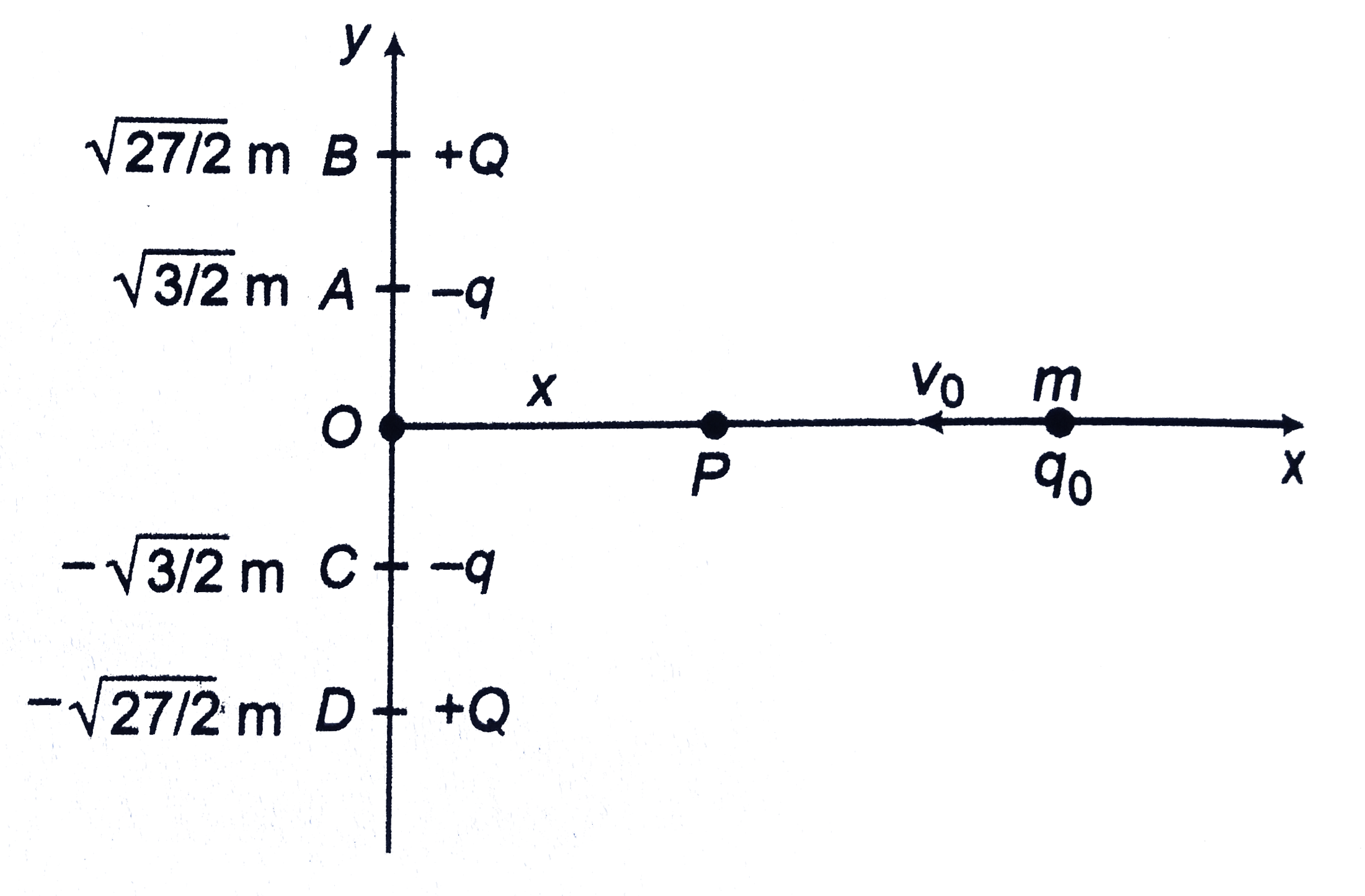
Four point charges `+8muC,-1muC,-1muC` and , `+8muC` are fixed at the points `-sqrt(27//2)m,-sqrt(3//2)m,+sqrt(3//2)m`
and `+sqrt(27//2)m` respectively on the y-axis. A particle of mass `6xx10^(-4)kg` and `+0.1muC` moves along the x-direction. Its speed at `x=+ infty` is `v_(0)`. find the least value of `v_(0)` for which the particle will cross the origin. find also the kinetic energy of the particle at the origin in tyhis case. Assume that there is no force part from electrostatic force.

Text Solution

Verified by Experts

The correct Answer is:
A, C, D

In the figure
`q=muC=10^-6C`
`q_0=+0.1muC=10^-7C`
`m=6xx10^-4kg`
and `Q=8muC=8xx10^-6C`
Let `P` be any point at a distance x from origin O.
`Then
`AP=CP=sqrt(3/2)+x^2`
`BP=DP=sqrt(27/2+x^2)`
Electric potential at point P will be
`V=(2kQ)/(BP)-(2kq)/(AP)`
where , `k=1/(4piepsilon_0)=9xx10^-9Nm^2//C^2`
`V=2xx9xx10^9[(8xx10^-6)/(sqrt(27/2+x^2))-10^(-6)/(sqrt((3/2+x^2)))]`
`V=1.8xx10^4[8/(sqrt(27/2+x^2))-1/(sqrt((3/2+x^2)))]`...........i
`:.` Electric field at P is
`E=-(dV)/(dx)=-1.8xx10^4[(8)(-1/2)(27/2+x^2)^(-3//2)-(1)(-1/2)(3/2+x^2)^(-3//2)](2x)`
`E=0` on x-axis where
`8/((27/2+x^2)^(3//2))=1/((3/+x^2)^/(3//2)`
`(27/2+x^2)=((4))^(3/2+x^2)`
This equation gives `x=+-sqrt(5/2)m`
The least value of kinetic energy of the particle at infinity should be enough to take the particle upto `x=+sqrt(5/2)m` because
at `x=+sqrt(5/2)m,E=0implies` Electrosatic force on charge `q_0` is zero or `F_e=0`
for `xltsqrt(5/2)`m, E is is attractive (towards negative x-axis)
Now, from eqn i potential at `x=sqrt(5/2)m`
`V=1.8xx10^4[8/sqrt(27/2+5/2)-1/sqrt(3/2+5/2)`
`V=2.7xx10^4V`
Applying energy conservation at `x=oo` and `x=sqrt(5/2)m`
`1/2mv_0^2=q_0V`
`:. v_0=sqrt((2q_0V)/m)`
Substituting the values `v_0=sqrt((2xx10^-7xx2.7xx10^4)/(6xx10^-4))`
`v_0=3m/s`
`:.` Minimum value of `v_0` is `3/m/s`.
From eqn i potential at origin `(x=0)` is
`V_0=1.8xx10^4[8/(sqrt27/2)-1/sqrt(3/2)]=2.4xx10^4V`
Let T be the kinetic energy of the particle at origin.
Applying energy conservation at `x=0` and at `x=oo`
T+q_0V_0=1/2mv_0^2`
But `1/2mv_0^2=v_0V` [from eqn ii]
`:. T=q_0(V-V_0)`
`T+(10^-7)(2.7xx10^4-2.4xx10^4)`
`T=3xx10^-4J`
Promotional Banner

Topper's Solved these Questions

  • ELECTROSTATICS

    DC PANDEY|Exercise Exercise 24.1|4 Videos
  • ELECTROSTATICS

    DC PANDEY|Exercise Exercise 24.2|9 Videos
  • ELECTROSTATICS

    DC PANDEY|Exercise Example Type 8|3 Videos
  • ELECTROSTATIC POTENTIAL AND CAPACITORS

    DC PANDEY|Exercise (C) Chapter exercises|50 Videos
  • GRAVITATION

    DC PANDEY|Exercise All Questions|120 Videos

Similar Questions

Explore conceptually related problems

Four point charges q, -2q, -q and 2q are placed at points (0,0,0) m , (sqrt(2), 0,0) m, (sqrt(2), sqrt(2),0)m " and " (0, sqrt(2) , 0) m respectively . The electric field at point ((1)/(sqrt2), (1)/(sqrt2),0) m " is " (q=1muC)

Three point charges 1muC ,1muC " and " -2muC are placed at points having coordinates (0,1,0)cm, (1,0,0) cm and (0,0,0)cm respectively. The magnitude of electric dipole moment of the system is

Electric charges of +10 muC,+5 muC,-3 muC and +8 muC are placed at the corners of a square of side sqrt(2) m, the potential at the centre of the square is

A particle of mass m=5 kg is moving with a uniform speed v=3 sqrt(2) in the XOY plane along the line Y=X+4 . The magnitude of the angular momentum of the particle about the origin is

two point charges 2 muC and -4 muC are situated at points (-2m, 0m) and (2m, 0m) respectively. Find out potential at point C( 4m, 0m) and D (0 m, sqrt(5) m) .

Two point charges 3 muC and 2.5 muC are placed at point A (1, 1, 2)m and B (0, 3, -1)m respectively. Find out electric field intensity at point C(3, 3, 3)m.

DC PANDEY-ELECTROSTATICS-Level 2 Single Correct
  1. Find the electric field caused by a disc of radius a with a uniform su...

    Text Solution

    |

  2. A non-conducting disc of radius a and uniform positive surface charge ...

    Text Solution

    |

  3. Four point charges +8muC,-1muC,-1muC and , +8muC are fixed at the poin...

    Text Solution

    |

  4. Potential difference beween centre and surface of the sphere of radius...

    Text Solution

    |

  5. A positively charged disc is placed on a horizontal plane. A charged ...

    Text Solution

    |

  6. The curve represents the distribution of potential along the staight l...

    Text Solution

    |

  7. A point charge q1=q is placed at point P. Another point charge q2=-q i...

    Text Solution

    |

  8. The variation of electric field between two charge q1 and q2 along the...

    Text Solution

    |

  9. A charge q is placed at O in the cavity in a spherical uncharged condu...

    Text Solution

    |

  10. A uniform electric field of 400 V/m is directed at 45^@ above the x-ax...

    Text Solution

    |

  11. Initially the spheres A and B are at potentials VA and VB. Find the po...

    Text Solution

    |

  12. A particle of mass m and charge q is fastened to one end of a string o...

    Text Solution

    |

  13. A charged particle of mass m and charge q is released from rest the po...

    Text Solution

    |

  14. A charge +Q is uniformly distributed in a spherical volume of radius R...

    Text Solution

    |

  15. Two identical coaxial rings each of radius R are separated by a distan...

    Text Solution

    |

  16. A uniform electric field exists in x-y plane. The potential of points ...

    Text Solution

    |

  17. Two fixed charges -2Q and +Q are located at points (-3a,0) and (+3a,0)...

    Text Solution

    |

  18. A particle of mass m and charge -q is projected from the origin with a...

    Text Solution

    |

  19. A particle of charge -q and mass m moves in a circle of radius r aroun...

    Text Solution

    |

  20. A small ball of masss m and charge +q tied with a string of length l, ...

    Text Solution

    |

