Home
Class 12
PHYSICS
Two charges +Q each are fixed at points ...

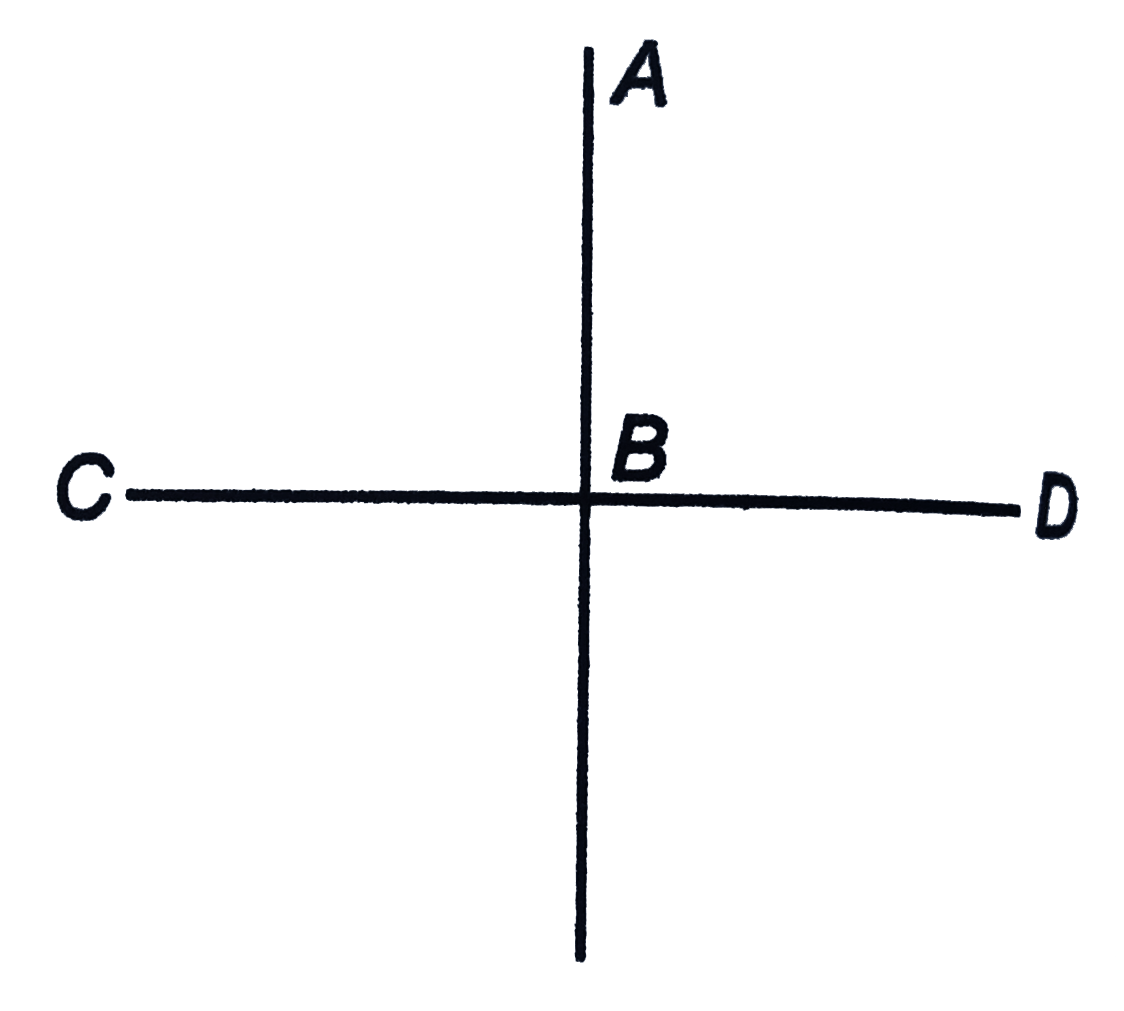
Two charges `+Q` each are fixed at points C and D. Line AB is the bisector line of CD. A third charge `+q` is moves from A to B, then from B to C

A

From A to B electrostatic potential energy wil decrese

B

from A to B electrostastic potential ennergy wil increase

C

From B to C electrostatic potential energy will increase

D

From B to C electrostatic potential energy will decrease

Text Solution

Verified by Experts

The correct Answer is:

B, C

Along the line `AB` charge `q` is at unstable equililbrium position at B (when displaced from B along `AB` net force on it is away from B, whereas force at B is zero). Hence potential energy at B is maximum.
Along `CD` equilibrium of q is stable. Hence, potential energy at B is minimum along `CD`.
Promotional Banner

Topper's Solved these Questions

  • ELECTROSTATICS

    DC PANDEY|Exercise Exercise 24.1|4 Videos
  • ELECTROSTATICS

    DC PANDEY|Exercise Exercise 24.2|9 Videos
  • ELECTROSTATICS

    DC PANDEY|Exercise Example Type 8|3 Videos
  • ELECTROSTATIC POTENTIAL AND CAPACITORS

    DC PANDEY|Exercise (C) Chapter exercises|50 Videos
  • GRAVITATION

    DC PANDEY|Exercise All Questions|120 Videos

Similar Questions

Explore conceptually related problems

Assertion: Two charges -q each are fixed points A and B. When a third chrge -q is moves from A to B, electrical potential energy first decreases than increases, Reason: Along the line joining A and B, third charge is stable equilibrium position at centre.

Two charge +aq and -q are kept apart. Then , at any point on the right bisector of line joining the two charge

A two point charges 4q and -q are fixed on the x - axis x=-d/2 and x = d/2 , respectively. If a third point charge 'q' is taken from the origin to x = d along the semicircle as shown in the figure, the energy of the charge will

Two charge +q and -q are kept apart.then at any point on the right beisector of line joining the two charges

Two equal positive charges Q are fixed at points (a, 0) and (-a,0) on the x-axis. An opposite charge -q at rest is relased from point (0, a) on the y-axis. The charge -q will

A charge (-q) and another charge (Q) are kept at two points A and B respectively. Keeping the charge (+Q) fixed at B , the charge (-q) at A is moved to another point C such that ABC forms an equilateral triangle of side l . The net work done in moving teh charge (-q) is

Charges 2q and 8q are placed at the end points A and B repsectively of a 9 cm long straight line. A third charge q is placed at a point C of AB such that the potential energy of the system is minimum . The distance of C from A is

A positive charge +Q is fixed at a poibt A. Another positively charged particle of mass m and charge +q is projected from a point B with velocity u as shown in (Fig. 3.103). Point B is at a large distance from A and at distance d from the line A C. The initial velocity is parallel to the line A C. The point C is at a very large distance from A. Find the minimum distance (in meter) of +q from +Q during the motion. Take Q q = 4 pi epsilon_0 m u^2 d and d (sqrt(2) - 1) m . .

DC PANDEY-ELECTROSTATICS-Level 2 Single Correct
  1. Two concentric spherical shells have charges +q and -q as shown in fig...

    Text Solution

    |

  2. A rod is hinged (free to rotate) ast its centre O as shown in figue. T...

    Text Solution

    |

  3. Two charges +Q each are fixed at points C and D. Line AB is the bisect...

    Text Solution

    |

  4. There are two concentric spherical shell of radii r and 2r. Initially,...

    Text Solution

    |

  5. There are two concentric spherical shell of radii r and 2r. Initially,...

    Text Solution

    |

  6. There are two concentric spherical shell of radii r and 2r. Initially,...

    Text Solution

    |

  7. A sphere of charges of radius R carries a positive charge whose volume...

    Text Solution

    |

  8. A sphere of charges of radius R carries a positive charge whose volume...

    Text Solution

    |

  9. A sphere of charges of radius R carries a positive charge whose volume...

    Text Solution

    |

  10. A sphere of charges of radius R carries a positive charge whose volume...

    Text Solution

    |

  11. A solid metallic sphere of radius a is surrounded by a conducting sphe...

    Text Solution

    |

  12. A solid metallic sphere of radius a is surrounded by a conducting sphe...

    Text Solution

    |

  13. A solid metallic sphere of radius a is surrounded by a conducting sphe...

    Text Solution

    |

  14. A 4.00 kg block carrying a charge Q = 50.0muC is connected to a spring...

    Text Solution

    |

  15. A particle of mass m and charge -Q is constrained to move along the ax...

    Text Solution

    |

  16. Three identical conducting plain parallel plates, each of area A are h...

    Text Solution

    |

  17. A long non-conducting, massless rod of length L pivoted at its centre ...

    Text Solution

    |

  18. The electric potential varies in space according to the relation V = 3...

    Text Solution

    |

  19. A simple pendulum with a bob of mass m = 1 kg, charge q = 5muC and str...

    Text Solution

    |

  20. There are two concentric spherical shell of radii r and 2r. Initially,...

    Text Solution

    |
