Home
Class 12
PHYSICS
Two point charge Q(a) and Q(b) are posit...

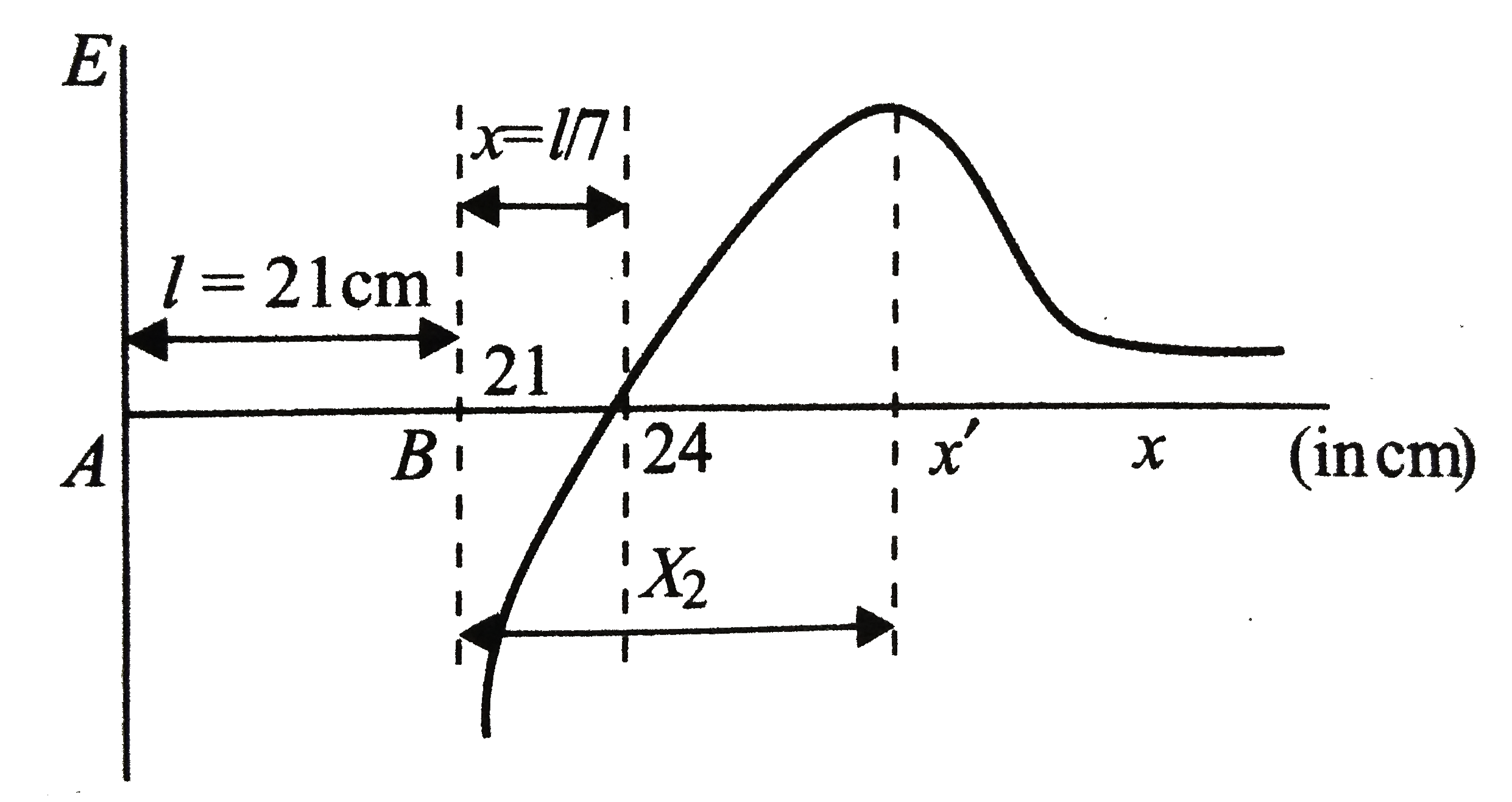
Two point charge `Q_(a)` and `Q_(b)` are positional at point A and B. The field strength to the right of charge `Q_(b)` on the line that passes through the two charges varies according to a law represented schematically in fig. (without employing a definite scale). The field strength is assumed to be positive if its direction coincides with the positive direction of the x-axis. The distance between the charges is `l=21 cm`.

(a) Find the sign of the charges.
(b) Find the ration between the absolute value of charge `Q_(a)` and `Q_(b)`.
(c ) Find the coordinate x of the point where the field strength is maximum.

Text Solution

Verified by Experts

The correct Answer is:

A, B, C

Over charge `Q_2` field intensity is infinite along negatve `x` -axis. Therefore `Q_2` is negative.
Beyon `xgt(l+a)`, field intensity is positive. Therefore `Q_1` is positive
b. At `x=l+a`, field intensity is zero.
`:. (kQ_1)/((l+a)^2)=(kQ_2)/a^2` or `|Q_1/Q_2|=((l+a)/a)^2`
c. Intensity at distance `x` from charge `2` would be
`E=(kQ_1)/((x+l)^2-(kQ_2)/x^2`
For `E` to be maximum `(dE)/(dx)=0`
or `-(2kQ_1)/((x+l)^3)+(2kQ_2)/x^3=0`
or `(1+l/x)^3=Q_1/Q_2=((l+a)/a)^2`
or `1+l/x=((l+a)/a)^(2//3))`
or 1+l/x=((l+a)/a)^(2//3)`
or `x=l/(((l+a)/a)^(2//3)-1)`
or `b=l/(((l+1)/a)^(2//3)-1)`
Promotional Banner

Topper's Solved these Questions

  • ELECTROSTATICS

    DC PANDEY|Exercise Exercise 24.1|4 Videos
  • ELECTROSTATICS

    DC PANDEY|Exercise Exercise 24.2|9 Videos
  • ELECTROSTATICS

    DC PANDEY|Exercise Example Type 8|3 Videos
  • ELECTROSTATIC POTENTIAL AND CAPACITORS

    DC PANDEY|Exercise (C) Chapter exercises|50 Videos
  • GRAVITATION

    DC PANDEY|Exercise All Questions|120 Videos

Similar Questions

Explore conceptually related problems

Two point charge Q_(a) and Q_(b) are positional at point A and B. The field strenght to the right of charge Q_(b) on the line that passes therough the two charges varies according to a law represented schematically in fig. (without employing a definite scale). The field strength is assumed to be positive if its direction coincedes with the positive direction of the x-axis. The distance between the charges is l=21 cm . (a) Find the sign of the charges. (b) Find the ration between the absolute value of charge Q_(a) and Q_(b) . (c ) Find the coordinate x of the point where the field strenght is maximum.

Two point charges Q_(1) and Q_(2) are positioned at points I and 2. The field intensity to the right of the charge Q_(2) on the line that passes through the two charges varies according to a law that is represented in the figure. The field intensity is assumed to be positive if its direction coincides with the positive direction on the x-axis. The distance between the charges is l. (a) Find the sign of each charge (b) Find the ratio of the absolute values of the charges |(Q_(1))/(Q_(2))| (c) Find the value of b where the field intensity is maximum [(a) Q_(2) is negative and Q_(1) is positive (b) ((l +a)/(a))^(2) , (c) (l)/(((l+a)/(a))^(2//3)-1)]

Two point-like charges a and b whose strengths are equal in absolute value are positioned at a certain distance from each other. Assuming the field strength is positive in the direction coinciding with the positive direction of the r axis, determine the signs of the charges for each distribution of the field strength between the charges shown in Figures (a), (b), (c), and (d).

The positions of two point charges q_(1) and q_(2) are vecr_(1) and vecr_(2) , respectively. Find the position of the point where the net field is zero due to thses charges.

Two fixed charges 4Q (positive) and Q (negative) are located at A and B the distance AB being 3m

The product of positive charge and distance between the two charges is

Two equal negative charges are fixed at points and on y-axis. A positive charge Q is released from rest at the point on the x-axis. The charge Q will:

Two equal like charges are positioned at a certain distance from each other. How do the electric field strength and the potential vary along the axis that passes through the midpoint of the distance between the charges at right angles to the line connecting the charges?

Two point charges+ q and-q are placed at distanced apart. What are the points at which the resultant field is parallel to the line joining the two charges ?

DC PANDEY-ELECTROSTATICS-Level 2 Single Correct
  1. A sphere of charges of radius R carries a positive charge whose volume...

    Text Solution

    |

  2. A solid metallic sphere of radius a is surrounded by a conducting sphe...

    Text Solution

    |

  3. A solid metallic sphere of radius a is surrounded by a conducting sphe...

    Text Solution

    |

  4. A solid metallic sphere of radius a is surrounded by a conducting sphe...

    Text Solution

    |

  5. A 4.00 kg block carrying a charge Q = 50.0muC is connected to a spring...

    Text Solution

    |

  6. A particle of mass m and charge -Q is constrained to move along the ax...

    Text Solution

    |

  7. Three identical conducting plain parallel plates, each of area A are h...

    Text Solution

    |

  8. A long non-conducting, massless rod of length L pivoted at its centre ...

    Text Solution

    |

  9. The electric potential varies in space according to the relation V = 3...

    Text Solution

    |

  10. A simple pendulum with a bob of mass m = 1 kg, charge q = 5muC and str...

    Text Solution

    |

  11. There are two concentric spherical shell of radii r and 2r. Initially,...

    Text Solution

    |

  12. Two point charge Q(a) and Q(b) are positional at point A and B. The fi...

    Text Solution

    |

  13. A conducting sphere S1 of radius r is attached to an insulating handle...

    Text Solution

    |

  14. Two fixed, equal, positive charges, each of magnitude 5xx10^-5 coul ar...

    Text Solution

    |

  15. A positive charge Q is uniformly distributed throughout the volume of ...

    Text Solution

    |

  16. A point charge –q revolves around a fixed charge +Q in elliptical orbi...

    Text Solution

    |

  17. The region between two concentric spheres of radii 'a' and 'b', respec...

    Text Solution

    |

  18. A nonconducting ring of mass m and radius R, with charge per unit leng...

    Text Solution

    |

  19. A rectangular tank of mass m(0) and charge Q is placed over a smooth h...

    Text Solution

    |

  20. In a region an electric field is setu!l with its strength E = 15 N//C ...

    Text Solution

    |
