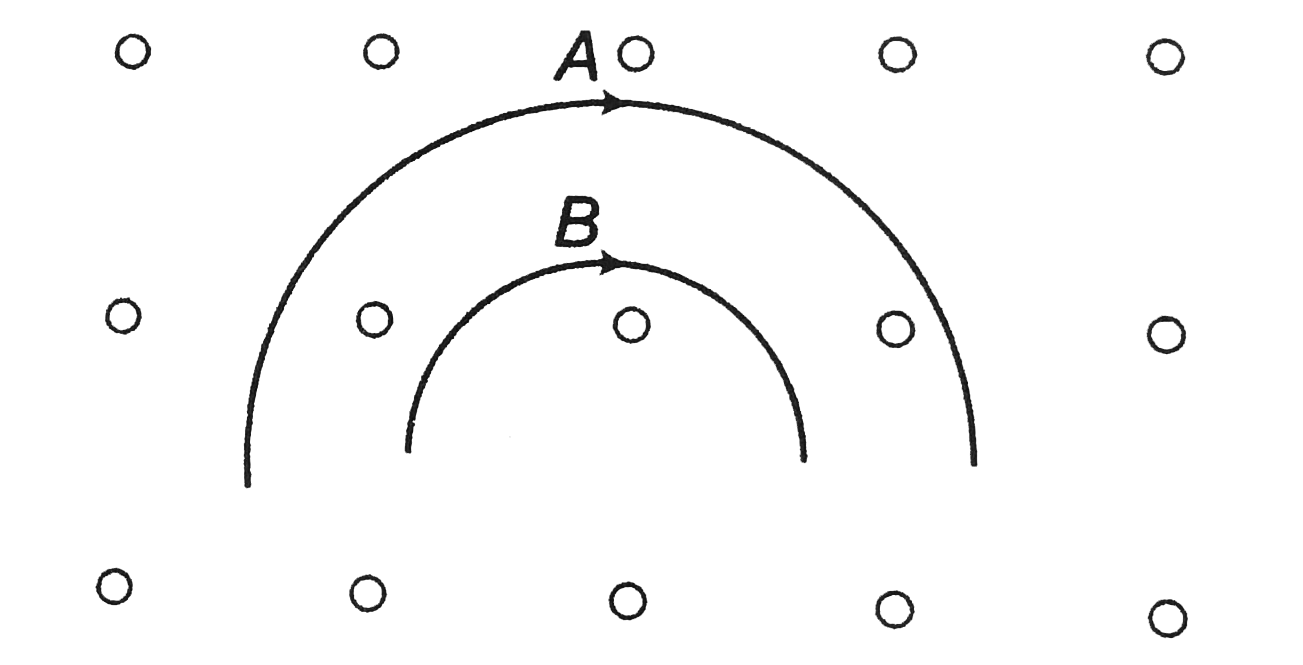
Two particles `A` and `B` of masses `m_A` and `m_B` respectively and having the same charge are moving ina plane. A uniform magnetic field exists perpendicular to this plane. The speeds of the particles are `v_A` and `v_B` respectively and the trajectories are as shown in the figure. Then,
A
`m_Av_Altm_Bv_B`
B
`m_Av_Agtm_Bv_B`
C
`m_Altm_B and v_Altv_B`
D
`m_A=m_B and v_A=v_B`
Text Solution
Verified by Experts
The correct Answer is:
B
Radius of the circle `=(mv)/(Bq)` `or radius propmv ` if `B` and `q` are same. `(Radius)_Agt(Radius)_B` `m_V V_Agtm_Bv_B` `:.` correct option is `b`
Topper's Solved these Questions
MAGNETICS
DC PANDEY|Exercise Exercise|160 Videos
MAGNETICS
DC PANDEY|Exercise INTRODUCTORY EXERCISE|1 Videos
MAGNETIC FIELD AND FORCES
DC PANDEY|Exercise Medical entrance s gallery|59 Videos
MAGNETISM AND MATTER
DC PANDEY|Exercise Medical gallery|1 Videos
Similar Questions
Explore conceptually related problems
Two particles A and B of masses m_(A)andm_(B) respectively and having the same charge are moving in a plane. A uniform magnetic field exists perpendicular to this plane. The speeds of the particles are v_(A)andv_(B) respectively and the trajectories are as shown in the figure. Then -
Two particles A and B of masses m_(A) and m_(B) respectively and having the same charge are moving in a plane . The speeds of the particles are v_(A) and v_(B) respectively and the trajectories are as shown in the figure. Then
A charge particle is moving in a plane perpendicular to uniform magnetic field, then
A particle of mass m, charge e and velocity v moving in a magnetic field B perpendicular to the motion of particle. The radius of its path is:
In a region of space a uniform magnetic field perpendicular to the plane of the page and directed towards reader exists. A particle has a trajectory as shown in fig. The particle is-
If a charged particle is a plane perpendicular to a uniform magnetic field with a time period T Then
A charged particle is moving in a magnetic field of strength B perpendicular to the direction of the field. If q and m denote the charge and mass of the particle respectively, then the frequency of rotation of the particle is