A device called a toroid (figure) is often used to create an almost uniform magetic fiedl in some enclosed area. The device consists of a conducting wire wraped around a ring (a torus) made of a non conducting material. For a toroid having `N` closely spaced turns of wire, calculate the magnetic field in the region occupied by the torus, a distasnce `r` from the centre.
A device called a toroid (figure) is often used to create an almost uniform magetic fiedl in some enclosed area. The device consists of a conducting wire wraped around a ring (a torus) made of a non conducting material. For a toroid having `N` closely spaced turns of wire, calculate the magnetic field in the region occupied by the torus, a distasnce `r` from the centre.
Text Solution
Verified by Experts
To calculate this field we must evaluate `ointB.dI` over the circle of radius `r`. By symmetry we see that the magnitude of the field is constant on this circle and tangent to it.
so, `oint B.dI=Bl=B(2pir)`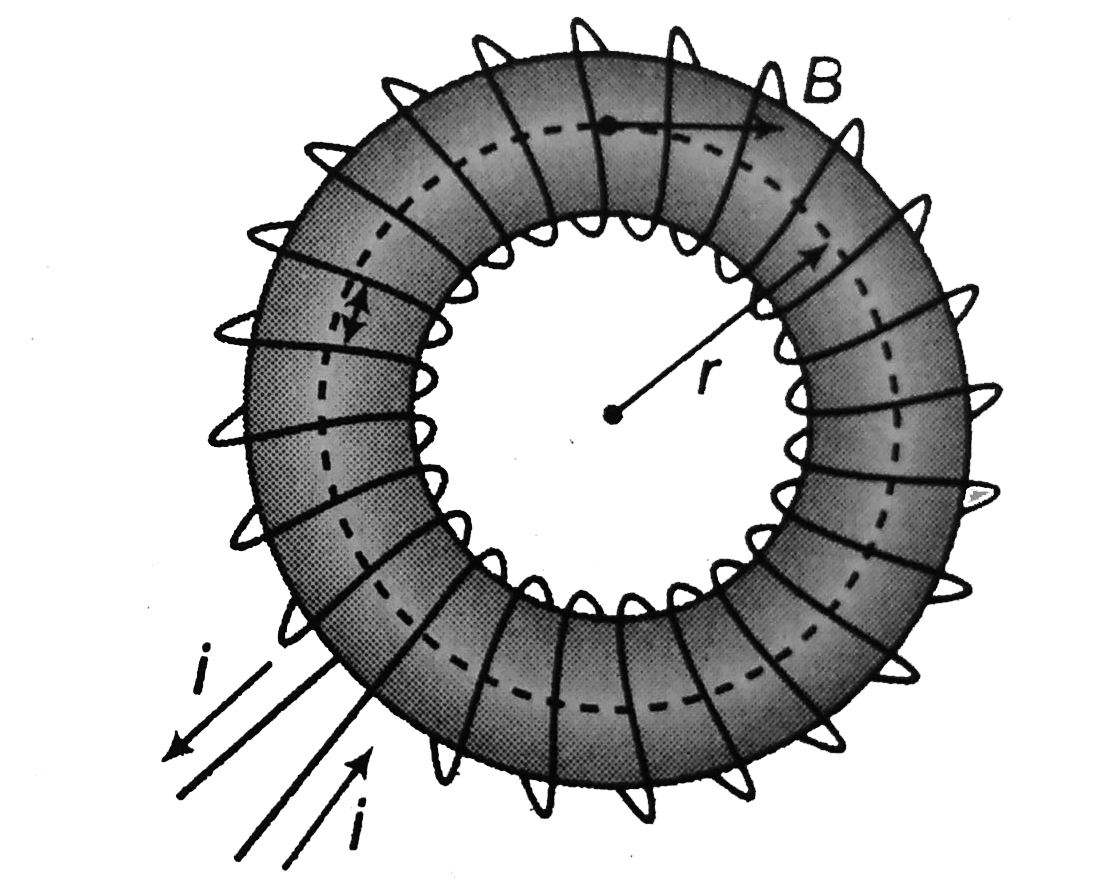
Furthermore, the circular closed path surrounds `N` loops of wire each of which carries a current `i` . Therefore, right side of Eq. i is `mu_0 Ni` in this case
`:. oint B.dI=mu_0i_("net")`
or `B(2pir)=mu_0Ni`
or `B=(mu_0Ni)/(2pir)`
this result shows that `Bprop1/r`
and hence is non uniform in the region occupied by torus. However, if `r` is very large compared with the cross sectional radius of the torus, then the field is approximately uniform inside the torus.In that case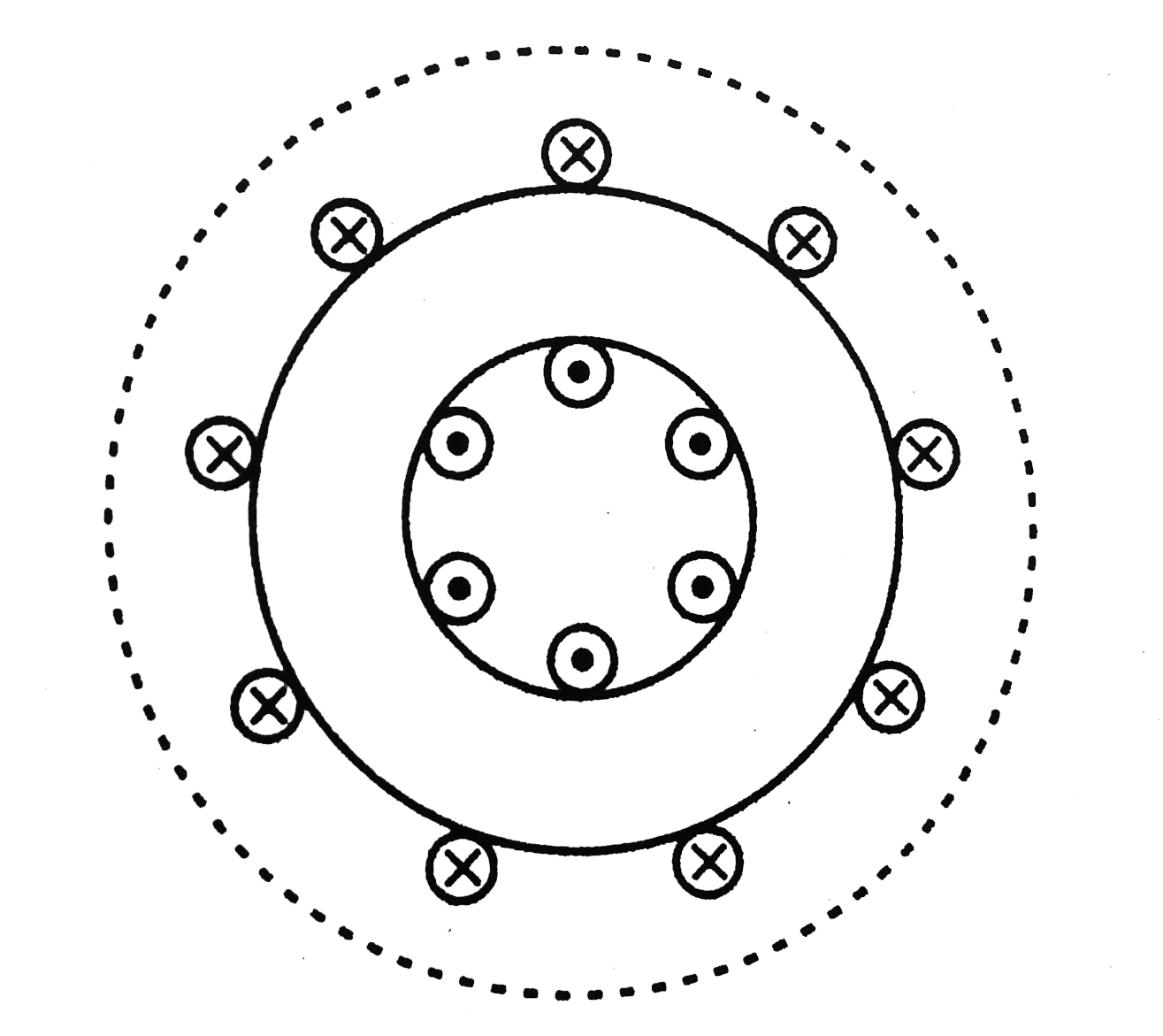
`N/(2pir)=n="number of turns per unit length of torus"`
`:. B=mu_0ni`
so, `oint B.dI=Bl=B(2pir)`
Furthermore, the circular closed path surrounds `N` loops of wire each of which carries a current `i` . Therefore, right side of Eq. i is `mu_0 Ni` in this case
`:. oint B.dI=mu_0i_("net")`
or `B(2pir)=mu_0Ni`
or `B=(mu_0Ni)/(2pir)`
this result shows that `Bprop1/r`
and hence is non uniform in the region occupied by torus. However, if `r` is very large compared with the cross sectional radius of the torus, then the field is approximately uniform inside the torus.In that case
`N/(2pir)=n="number of turns per unit length of torus"`
`:. B=mu_0ni`



Topper's Solved these Questions
Similar Questions
Explore conceptually related problems
PQRS is a square region of side 2a in the plane of paper. A uniform magnetic field B, directed perpendicular to the plane of paper and into its plane is confined within this square region. A square loop of side 'a' and made of a conducting wire of resistance R is moved at a constant velocity vec(v) from left to right in the plane of paper as shown. Obviously, the square loop will enter the magnetic field at some time and then leave it after some time. During the motion of loop, whenever magnetic flux through it changes, emf will be induced resulting in induced current. Let the motion of the square loop be along x-axis and let us measure x coordinate of the centre of square loop from the centre of the square magnetic field region (taken as origin). Thus, x coordinate will be positive if the centre of square loop is to the right of the origin O (centre of magnetic field) and negative if centre is to the left. External force required to maintain constant velocity of the loop for x = -(9)/(5) a will be
PQRS is a square region of side 2a in the plane of paper. A uniform magnetic field B, directed perpendicular to the plane of paper and into its plane is confined within this square region. A square loop of side 'a' and made of a conducting wire of resistance R is moved at a constant velocity vec(v) from left to right in the plane of paper as shown. Obviously, the square loop will enter the magnetic field at some time and then leave it after some time. During the motion of loop, whenever magnetic flux through it changes, emf will be induced resulting in induced current. Let the motion of the square loop be along x-axis and let us measure x coordinate of the centre of square loop from the centre of the square magnetic field region (taken as origin). Thus, x coordinate will be positive if the centre of square loop is to the right of the origin O (centre of magnetic field) and negative if centre is to the left. For x = a//4 (i) magnetic flux through the loop, (ii) induced current in the loop and (iii) external force required to maintain constant velocity of the loop, will be
PQRS is a square region of side 2a in the plane of paper. A uniform magnetic field B, directed perpendicular to the plane of paper and into its plane is confined within this square region. A square loop of side 'a' and made of a conducting wire of resistance R is moved at a constant velocity vec(v) from left to right in the plane of paper as shown. Obviously, the square loop will enter the magnetic field at some time and then leave it after some time. During the motion of loop, whenever magnetic flux through it changes, emf will be induced resulting in induced current. Let the motion of the square loop be along x-axis and let us measure x coordinate of the centre of square loop from the centre of the square magnetic field region (taken as origin). Thus, x coordinate will be positive if the centre of square loop is to the right of the origin O (centre of magnetic field) and negative if centre is to the left. For x = -9a//5 , magnitude of induced current and its direction as seen from above will be: