Home
Class 12
PHYSICS
A magnet suspended at 30^@ with magnetic...

A magnet suspended at `30^@` with magnetic meridian makes an angle of `45^@` with the horizontal. What shall be the actual value of the angle of dip?

Text Solution

Verified by Experts

In a vertical plane at `30^@` from the magnetic meridian, the horizontal component is
`H'=Hcos30^@`
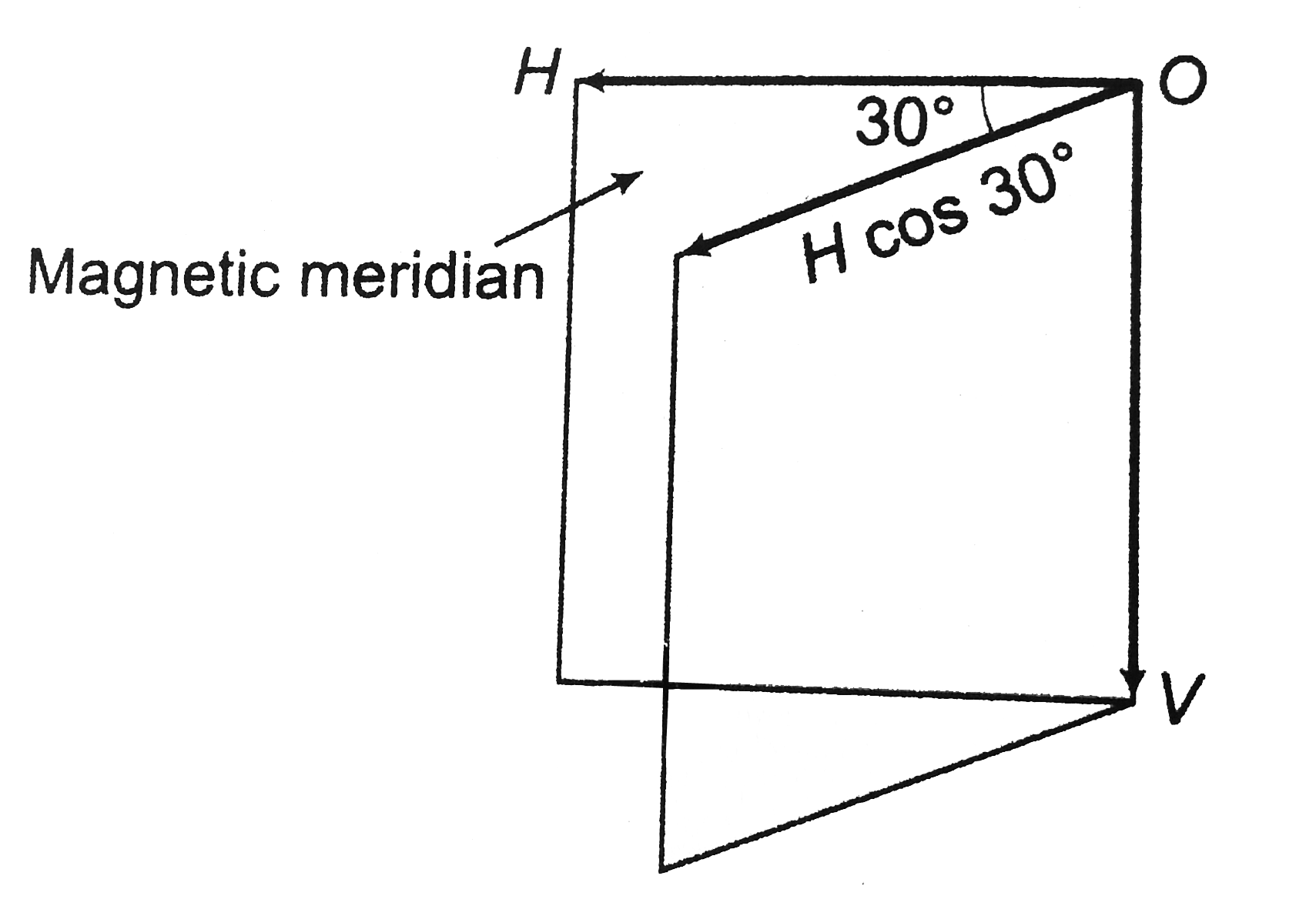
While verticale component is still `V`. Therefore, apparent dip will be given by
`tantheta'=V/H'=V/(Hcos30^@)`
`But, V/H=tantheta(where theta=true angle of dip)`
`: tantheta'=(tantheta)/(cos30^@)`
`:. theta=tan^-1[tantheta'cos30^@]`
`=tan^-1[(tan45^@)(cos30^@)]`
`=41^@`

Promotional Banner

Topper's Solved these Questions

  • MAGNETICS

    DC PANDEY|Exercise Exercise|160 Videos
  • MAGNETICS

    DC PANDEY|Exercise INTRODUCTORY EXERCISE|1 Videos
  • MAGNETIC FIELD AND FORCES

    DC PANDEY|Exercise Medical entrance s gallery|59 Videos
  • MAGNETISM AND MATTER

    DC PANDEY|Exercise Medical gallery|1 Videos

Similar Questions

Explore conceptually related problems

If a dip needle is suspended at an angle 30° to the magnetic meridian, it makes an angle of 45^@ with the horizontal. The real dip is

If a magnet is suspended at an angle 30∘ to the magnetic meridian and in thisplane the dip needle makes an angle of 60∘ with the horizontal. The true value of dip is

A freely suspended bar magnet makes an angle of 60^@ with the horizontal component and 45^@ with the magnetic meridian of a place. Calculate the angle of dip for that place.

If a magnet is suspended at an angle 30^(@) to the magnetic meridian and in this plane the dip needle makes an angle of 60^(@) with the horizontal. The true value of dip is:

The real angle of dip, if a magnet is suspended at an angle of 30^(@) to the magnetic meridian and the dip needle makes an angle of 45^(@) with horizontal, is:

At an angle of 30^(@) to the magnetic meridian, the apparent dip is 45^(@) . Find the true dip:

A dip circle lies initially in the magnetic meridian. If it is now rotated through angle theta in the horizontal plane, then tangent of the angle of dip is changed in the ratio:

A magnetic needle free to rotate in a fixed vertical plane stays in a direction making an angle of 60^@ with the horizontal. If the dip at that plane is 37^@ , find the angle of the fixed vertical plane with the meridian.
