Home
Class 12
PHYSICS
Two long parallell wires carrying curren...

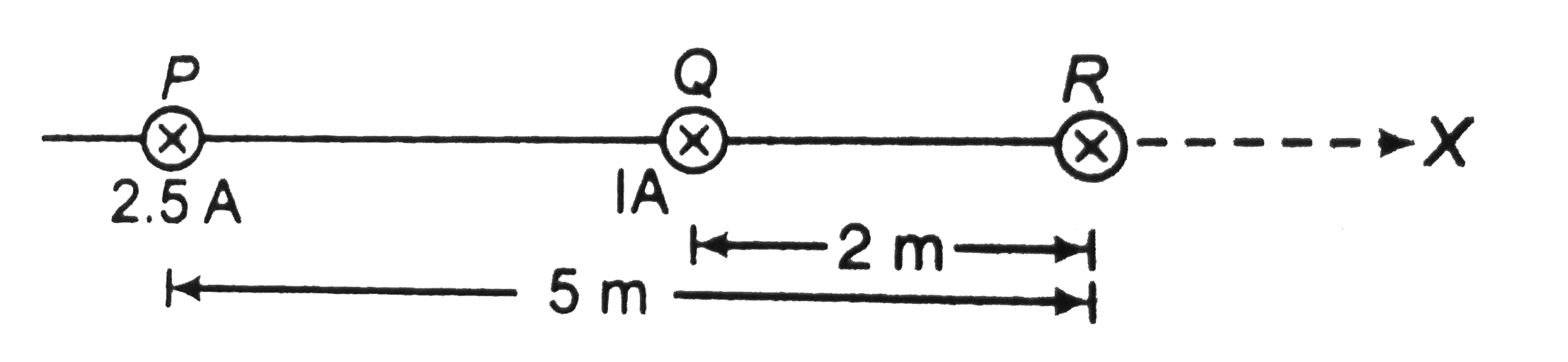
Two long parallell wires carrying currents `2.5 A` and `I` (ampere) in the same directon (directed into theplane of the paper) are held at `P` and `Q`, respectively such that they are perpendicular to the plane of paper. The points `P` and `Q` are located at distance of `5 m` and `2m` respectively from a collinear point `R` (see figure).

a. An electron moving with a velocity of `4xx10^5` m/s along the positive x-directionn experieces a force of magnitude `3.2xx10^-20` `N` at the point `R`. Find the volume of `I`.
b. Find all the positions at which a third long paralle wire carryig a current of magnitude `2.5 AS` may be placed, so that the magnetic induction at `R ` is zero.

Text Solution

Verified by Experts

a. Magnetic field at `R` due to both the wires `P` and `Q` will be downwards as shown in figure.
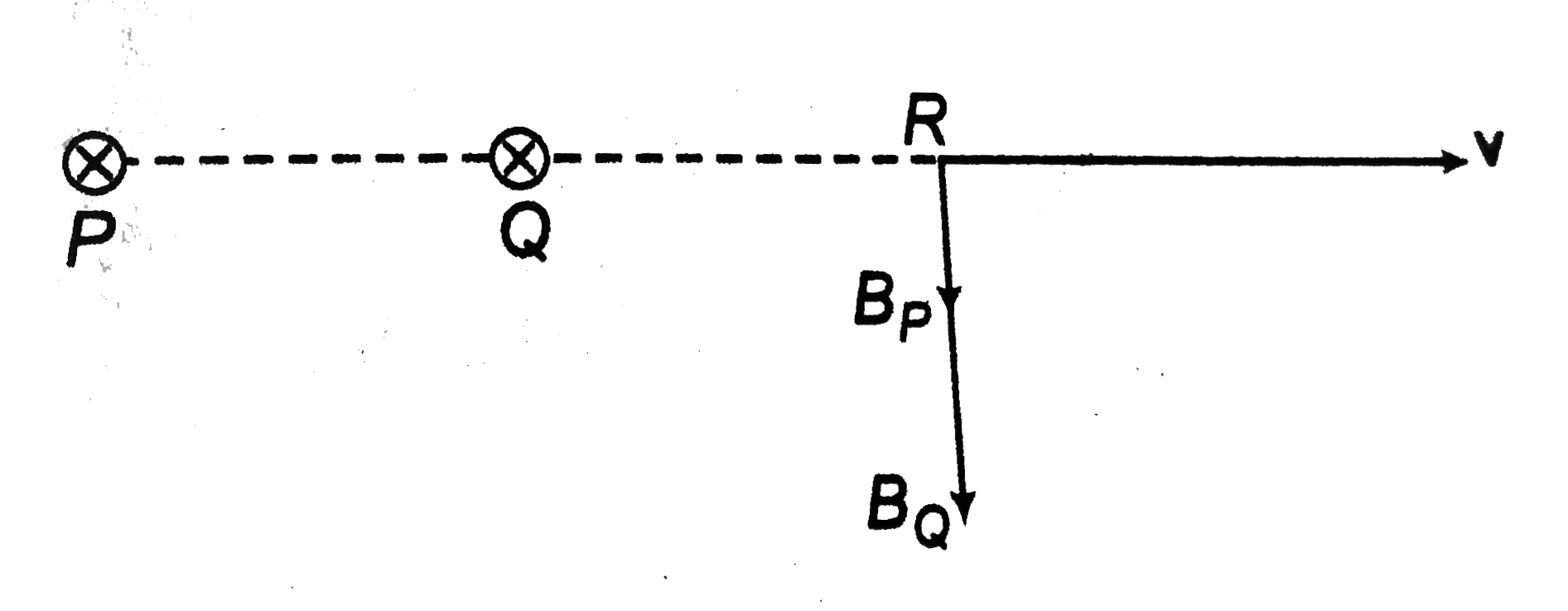
Therefore, net field at `R` will be sum of these two
`B=B_p+B_Q`,
`=mu_0/(2pi) I_P/5+mu_0/(2pi) I_Q/2=mu_0/(2pi)(2.5/5+I/2)`
`=mu_0/(4pi)(I+1)=10^-7(I+1)`
Net force on the electron will be

`F_m=(Bqvsin90^@)`
or `(3.2xx10^-20)=(10^-7)(I+1)(1.6xx10^I-19)(4xx10^5)`
or `I+1=5`
`:. I=4A`
b. Net field at `R` due to wires `P` and `Q` is
`B=10^-7(I+1)T`
`=5xx10^-7T`
Magnetic field due to third wire carrying a current of `2.5 A` should be `5xx10^-7` `T` is upward. direction, so that net field sat `R` becomes zero. Let distance of this wire from `R` be `r`. Then
`mu_0/(2pi)2.5/r=5xx10^-7`
or `((2xx10^-7)(2.5))/r=5xx10^-7m`
`r=1m`
So, the third wire can be put at `M` or `N` as shown in figure.
If it is placed at `M`, then current in it should be outwads and if placed at `N`, then current be inwards.
Promotional Banner

Topper's Solved these Questions

  • MAGNETICS

    DC PANDEY|Exercise Exercise|160 Videos
  • MAGNETICS

    DC PANDEY|Exercise INTRODUCTORY EXERCISE|1 Videos
  • MAGNETIC FIELD AND FORCES

    DC PANDEY|Exercise Medical entrance s gallery|59 Videos
  • MAGNETISM AND MATTER

    DC PANDEY|Exercise Medical gallery|1 Videos

Similar Questions

Explore conceptually related problems

Two long parallel wires carrying current 2.5 amperes and I ampere in the same direction ( directed into the plane of the paper) are held at P and Q respectively such that they are perpendicular to the plane of paper. The points P and Q are located at a distance of 5 metres and 2 metres respectively from a collinear point R ( see figure) (i) An electron moving with a velocity of 4xx10^(5) m//s along the positive x- direction experiences a force of magnitude 3.2xx10^(-20) N at the point R . Find the value of I . (ii) Find all the positions at which a third long parallel wire carrying a current of magnitude 2.5 amperes may be placed so that the magnetic induction at R is zero.

In the adjoining diagram, P and Q are parallel wires carrying currents of 2.5 A and I respectively directed at right angles to the plane of paper inwards. An electron moving with velocity 4xx10^(5)m//s in positive x - direction experiences a force of 3.2xx10^(-20)N at point R. The value of i will be

Two long parallel wires are 30 cm apart carrying currents 10 A and 15 A respectively in the same direction. The force acting over a length of 5 m of the wires is

Two long parallel conductors carry currents i_(1)=3A and i_(2)=3A both are directed into the plaane of paper. The magnitude of resultant magnetic field at point 'P' , is

Two long parallel wires placed 0.08 m apart, carry currents 3 A and 5 A in the same direction. what is the distance from the conductor carrying the larger current to the point where the resultant magnetic field is zero?

Two long parallel wires carry equal current I flowing in the same direction are at a distance 2d apart. The magnetic field B at a point lying on the perpendicular line joining the wires and at a distance x from the midpoint is

Two particles p and q located at distances r_p and r_q respectively from the centre of a rotating disc such that r_p gt r_q .

Two infinitely long wires each carrying current I along the same direction are made into the geometry as shown in the figure. The magnetic field at the point P is

