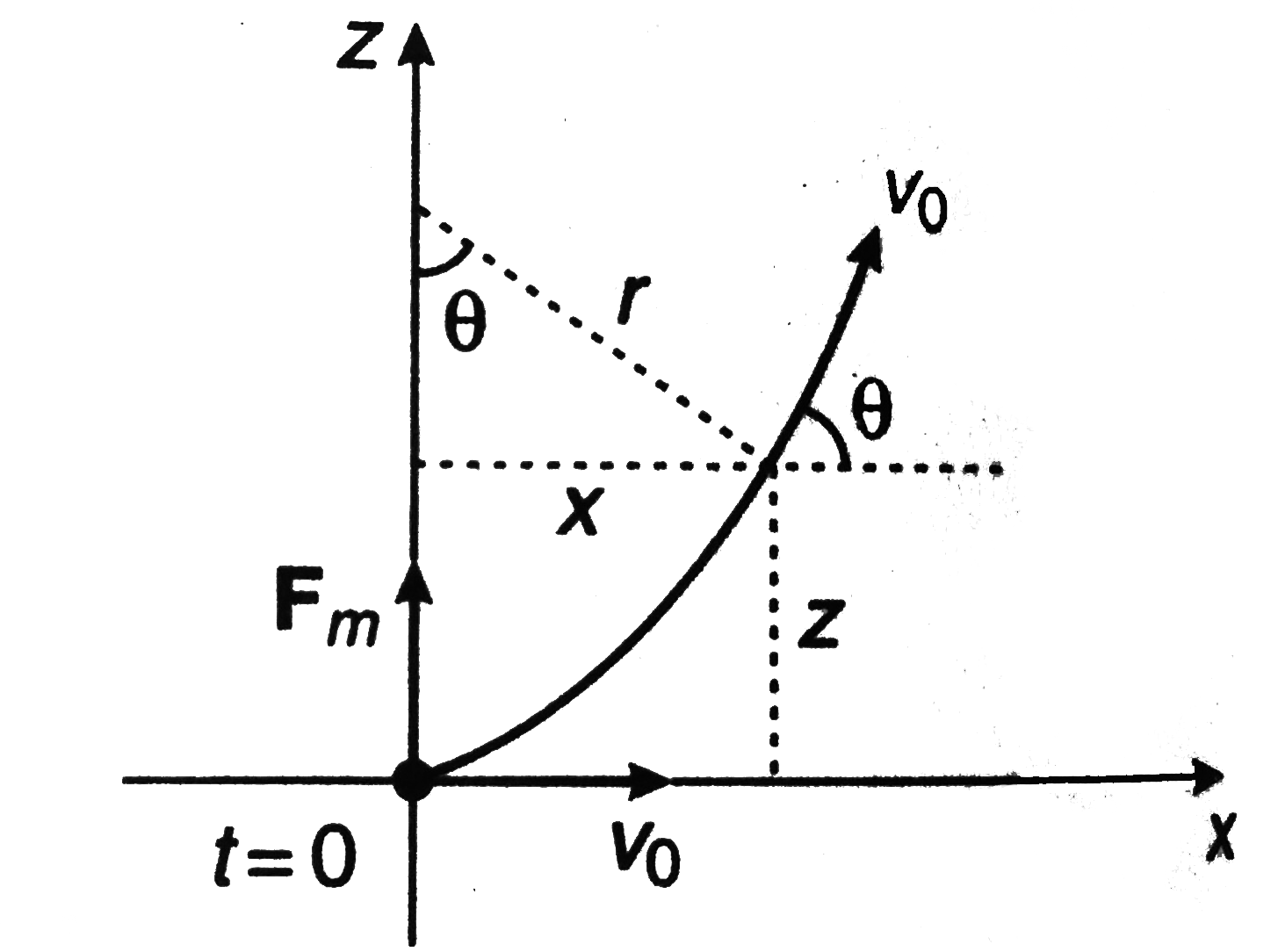
Consider a particel of charge `q` and mass `m` released from the origin with velocity `v=v_0hati` into a region of uniform electric and magnetic fields parallel to `y`-axis i.e. `E=E_0hatj` and `B=B_0hatj`. The electric field accelerates the particle in `y`-direction i.e. `y`-component of velocity goes on increasing with acceleration
`a_y=F_y/m=F_e/m=(qE_0)/m` .........i
The magnetic field rotates the particle in a circle in xy-plane (perpendicular to magnetic field). The resultant path of the particle is a helix with increasing pitch. The axis of the plans is parallell to y-axis. Velocity of the particle at time t would be
`v(t)=v_xhati+v_yhatj+v_zhatk`
`Here, v_y=a_yt(qE_0)/mt`
and `v_x^2+v_z^2=constant=v_0^2`
`theta=omegat=(Bq)/mt`
`v_x=v_0costheta=v_0cos(Bqt)/(m)`
and `v_z=v_0sintheta=v_0sin((Bqt)/m)`
`:. v(t)=v_0cos((Bqt)/m)hati+((qE_0)/mt)hatj+v_0sin ((Bqt)/m)hatk`
Similarly, position vector of particle at time t can be given by
`r(t)=xhati+yhatj+zhatk`
Here `y=1/2n a_yt^2=1/2((qE_0)/m)t^2`
`x=rsintheta=((mv_0)/(Bq))sin((Bqt)/m)`
and `z=(1-costheta)=((mv_0)/(Bq))[{1-cos((Bqt)/m)}]`
`:. r (t)-((mv_0)/(Bq))sin((Bqt)/m)hati+1/2((qE_0)/m)t^2hatj+((mv_0)/(Bq))[{1-cos((Bqt)/m)}]hatk`