When `E_|_B` and the particle is released at rest from origin.
When `E_|_B` and the particle is released at rest from origin.
Text Solution
Verified by Experts
Consider a particle of charge `q` and mass `m` emitted at origin with zero initial velocity into a regionof uniform electric and magnetic fields. The field `E` is acting along `x`-axis and field `B` along `y`=axis, i.e.
`E=E_0hatj`
and `B=B_0hatj`
Electric fiedl will provide the particle an acceleration (and therefore a velocity component `O`) in `x`-direction and the magnetic field will rotate the particle in `xy`-plane (perpendicular to `B`).
Hence, at any instant of time its velocity (and hence, position) will have only `x` and `y` components. Let at time t its veloicty be
`v=v_xhati+v_zhatk`
Net force on it at this instant is
`F=F_e+F_m=qE+q(vxxB)`
`=q[E_0hati+(v_xi+v_zhatk)xx(B_0hatj)]`
or `F=q(E_0-v_zB0)hati+qv_xB_0hatk`
`:. a=F/m=axhati+a_zhatk`
`where a_x=q/m(E_0-v_zB_0)` .............i
and `a_z q/m v_xB_0` ..........ii
Differenting eqn i w.r.t time we have
`(d^2v_x)/(dt^2)=(qB_0)/m((dv_z)/(dt))`
But, `(dv_z)/(dt)=a_z=(qB_0)/m v_x`
`:. (d^2v_x)/(dt^2)=-((qB_0)/m)^2v_x`........iii
comparing this equation with the differential equation of SHM `((d^2y)/(dt)^2=-omega^2y),` we get
`omega=(qB_0)/m`
and the general solution of eq. iii is
`v_x=(A sin(omegat+phi)`........iv
At time `t=0, v_x=0`, hence `phi=0`
Again `(dv_x)/(dt)=Aomegacosomegat) (as phi=0)`
From eqn i `a_x(qE_0)/m at t=0, as v_z=0 at t=0`
`:. Aomega=(qE_0)/m or A=(qE_0)/(omegam)`
Substituting `omega=(qB_0)/m`, we get `A=E_0/B_0`
Therefore eq. iv becomes
where `v_x=E_0/B_0 sinomegat`
`omega=(qB_0)/m`
Now substituting value of `v_x` in eqn ii we get
`(dv_z)/(dt)=(qE_0)/misnomegat`
`:. int_0^v_zdv_z=(qE_0)/m int_)^tsinomegat dt`
`or v_z=(qE_0)/(omegam) (1-cosomegat)`
Substituting `omega=(qB_0)/m` , we get
`v_z=E_0/B_0(1-cosomegat) `
on integrating equation for v_x and u_z and knowng that at `t=0, x=0` and `z=0` we get
`x=E_0/(B_0omega)(1-cosomegat)`
`z=E_0/(B_0omega) (omegat-sinomegat)`
These eqution are the equation for a cycloid which is defined as the path generated by the point on the circumference of a wheel rolling on a ground.
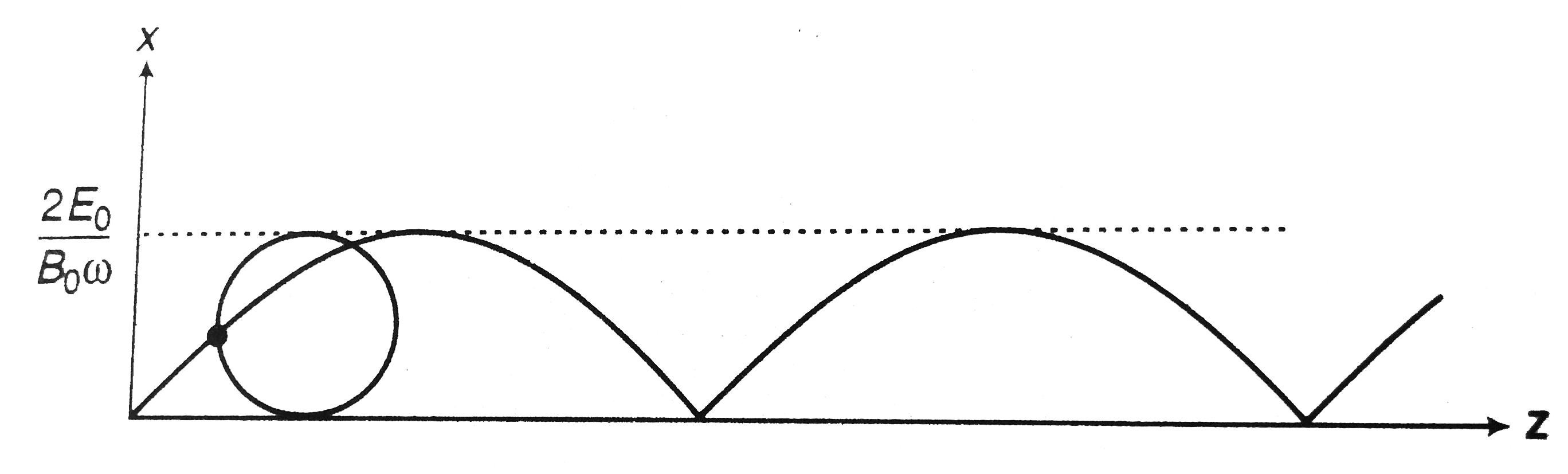
In the present case, the radius of the rolling wheel is `E_0/(B_0omega)` the maximum displacement along `x`- direction is `(2E_0)/(B_0omega)`. The `x`-displacement becomes zero at `t=9`, `2pi/omega, 4pi/omega`, etc.
`E=E_0hatj`
and `B=B_0hatj`
Electric fiedl will provide the particle an acceleration (and therefore a velocity component `O`) in `x`-direction and the magnetic field will rotate the particle in `xy`-plane (perpendicular to `B`).
Hence, at any instant of time its velocity (and hence, position) will have only `x` and `y` components. Let at time t its veloicty be
`v=v_xhati+v_zhatk`
Net force on it at this instant is
`F=F_e+F_m=qE+q(vxxB)`
`=q[E_0hati+(v_xi+v_zhatk)xx(B_0hatj)]`
or `F=q(E_0-v_zB0)hati+qv_xB_0hatk`
`:. a=F/m=axhati+a_zhatk`
`where a_x=q/m(E_0-v_zB_0)` .............i
and `a_z q/m v_xB_0` ..........ii
Differenting eqn i w.r.t time we have
`(d^2v_x)/(dt^2)=(qB_0)/m((dv_z)/(dt))`
But, `(dv_z)/(dt)=a_z=(qB_0)/m v_x`
`:. (d^2v_x)/(dt^2)=-((qB_0)/m)^2v_x`........iii
comparing this equation with the differential equation of SHM `((d^2y)/(dt)^2=-omega^2y),` we get
`omega=(qB_0)/m`
and the general solution of eq. iii is
`v_x=(A sin(omegat+phi)`........iv
At time `t=0, v_x=0`, hence `phi=0`
Again `(dv_x)/(dt)=Aomegacosomegat) (as phi=0)`
From eqn i `a_x(qE_0)/m at t=0, as v_z=0 at t=0`
`:. Aomega=(qE_0)/m or A=(qE_0)/(omegam)`
Substituting `omega=(qB_0)/m`, we get `A=E_0/B_0`
Therefore eq. iv becomes
where `v_x=E_0/B_0 sinomegat`
`omega=(qB_0)/m`
Now substituting value of `v_x` in eqn ii we get
`(dv_z)/(dt)=(qE_0)/misnomegat`
`:. int_0^v_zdv_z=(qE_0)/m int_)^tsinomegat dt`
`or v_z=(qE_0)/(omegam) (1-cosomegat)`
Substituting `omega=(qB_0)/m` , we get
`v_z=E_0/B_0(1-cosomegat) `
on integrating equation for v_x and u_z and knowng that at `t=0, x=0` and `z=0` we get
`x=E_0/(B_0omega)(1-cosomegat)`
`z=E_0/(B_0omega) (omegat-sinomegat)`
These eqution are the equation for a cycloid which is defined as the path generated by the point on the circumference of a wheel rolling on a ground.
In the present case, the radius of the rolling wheel is `E_0/(B_0omega)` the maximum displacement along `x`- direction is `(2E_0)/(B_0omega)`. The `x`-displacement becomes zero at `t=9`, `2pi/omega, 4pi/omega`, etc.



Topper's Solved these Questions
Similar Questions
Explore conceptually related problems
If magnetic field in space is 1Thati , electric field is 10 N//Chati , no gravitational field is present and a charged particle is released from rest from origin, it will
Assertion: Uniform electric and magnetic field are applied along Y-axis andZ-axis respectively. Kinetic energy of particle released at rest from origin depends only on the y-coordinate of particle. Reason: Work done by the magnetic force is zero. Kinetic energy gained by the particle is only due to electric force
Electric field strength bar(E)=E_(0)hat(i) and magnetic induction bar(B)=B_(0)hat(i) exists in a region. A charged particle 'q' is released from rest at origin. Work done by both the fields is after certain time is
Assertion : A charge particle is released particle is released from rest in magnetic field then it will move in circular path. Reason : Work done by magnetic field is non zero.
Electric field and magnetic field in a region of space are given by vec E = E_(0) hat I " and " vec B = - B_(0) hat k , respectively. A positively charged particle (+q) is released from rest at the origin. When the particle reaches a point P(x, y, z) , then it attains kinetic energy K that is equal to
A particle of mass 0.3 kg is subjected to a force F = - kx , Where = 15 Nm^(-1) . What will be its initial acceleration when particle is released from a point 20 cm away from origin ?
Let A, B and C be points in a vertical line at height h, (4h)/(5) and (h)/(5) and from the ground. A particle released from rest from the point A reaches the ground in time T. The time taken by the particle to go from B to C is T_(BC) . Then (T)/(T_(BC)) ^(2) =
A proton is fixed at origin. Another proton is released from rest, from a point at a distance r from origin. Taking charge of portion as e and mass as m , find the speed of the proton (i) at a distance 2r from origin (ii) at large distance from origin.
A positively charged particle is released from rest in a uniform electric field. The electric potential energy of the charge.