A matel wire PQ of mass 10g lies at rest on two horizontal metal rails separated by 4.90 cm . A vertically downward magnetic field of magnitude 0.800 T exists in the space. The resistance of the circuit is slowly decreased and it is found that when the resistance goes below`20.0 Omega`, the wire PQ starts sliding on the rails. Find the coefficient of friction.
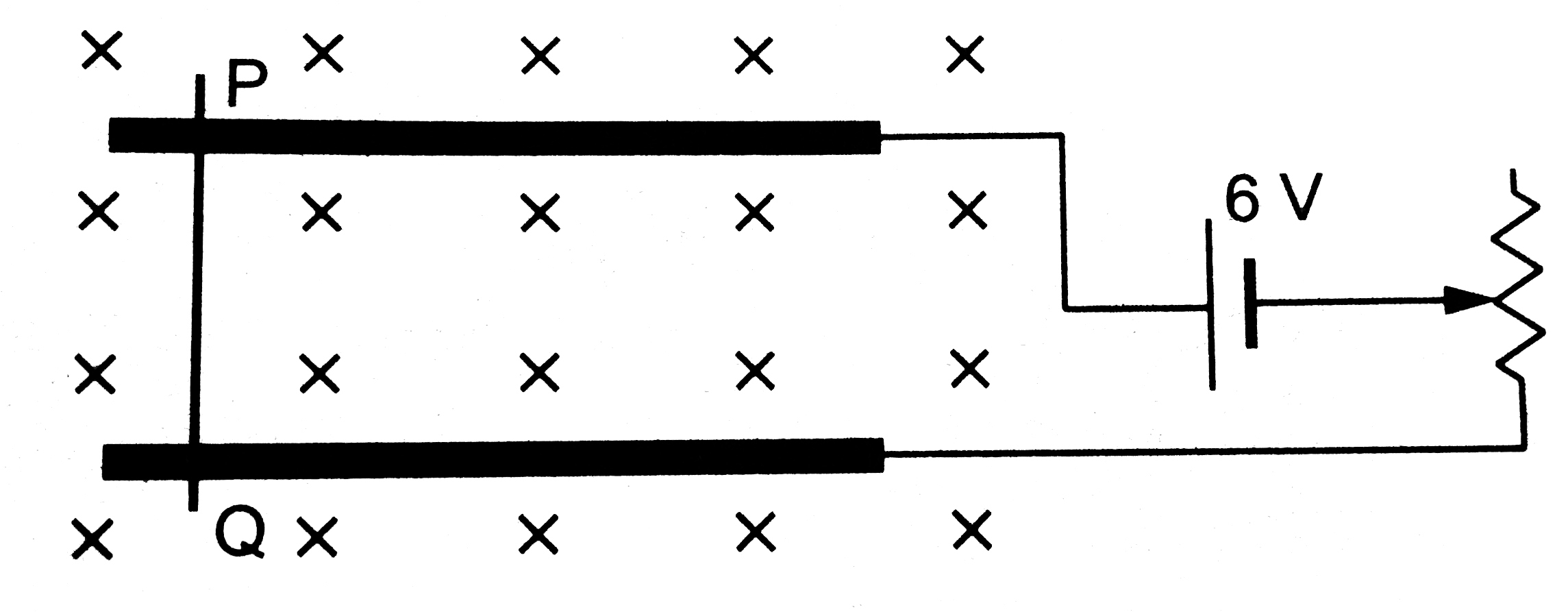
A matel wire PQ of mass 10g lies at rest on two horizontal metal rails separated by 4.90 cm . A vertically downward magnetic field of magnitude 0.800 T exists in the space. The resistance of the circuit is slowly decreased and it is found that when the resistance goes below`20.0 Omega`, the wire PQ starts sliding on the rails. Find the coefficient of friction.
Text Solution
Verified by Experts
Wire `PQ` begins to slide when magnetic force is just equal to the force of friction i.e.
`mumg=ilBsintheta (theta=90^@)`
here `i=E/R=6/20=0.3A`
`:. mu==(ilB)/(mg)=((0.3)(4.9xx10^I-2)(0.8))/((10xx10^-3)(9.8))`
`=0.12`
`mumg=ilBsintheta (theta=90^@)`
here `i=E/R=6/20=0.3A`
`:. mu==(ilB)/(mg)=((0.3)(4.9xx10^I-2)(0.8))/((10xx10^-3)(9.8))`
`=0.12`



Topper's Solved these Questions
Similar Questions
Explore conceptually related problems
A metal wire PQ of mass 10 gm lies on two horizontal metal rails separated by 4.90 cm (figure).A vertically downward magnetic field of magnitude 0.800 T exists in the space.The resistance of the circuit is slowly decreased and it is found that when the resistance goes below 20.0 Omega the wire PQ starts sliding on the rails.Find the coefficient of friction.Neglect magnetic force acting on wire PQ due to metal rails (g=9.8 m//g^(2))
A metal wire PQ of mass 10g lies at rest on two horizontal metal rails separated by 5cm as shown in Fig. A vertically downward magnetic field of magnitude 0.80T exist in the space. The resistance of the circuit is slowly decreased and it is found that when the resistance goes below 20.0Omega the wire PQ starts sliding on the rails. The coefficient of friction between wires and rails is found. The coefficient of friction between wires and rails is found to be n//25 . find n
Consider the situation shown in the figure. The wire PQ has mass m , resistance r and can slide 0n the smooth, horizontal parallel rails separated by a distance l . The resistance of the rais is negiligible. A uniform magnetic field B exists in the reactangular region and a resistance R connects the rail outside the field region. At t=0 , the wire PQ is pushed toward right with a speed v_(0) . Find (a) the current in the loop at an instant when the speed of the wire PQ is v (b) the acceleration of the wire as this instant (c) the velocity v as a function of x (d) the maximum distance the wire will move (e) the velocity as a function of time
A uniform wire of mass m and length I can freely slide on a pair of parallel, frictionless, horizontal rails placed in a vertical constant magnetic field B (as shown in figure ). The rails are connected by a capacitor of capacitance C. The electric resistance of the circuit is zero. A constant horizontal force F acts on the middle point of wire begining t = 0 ,and the wire is at rest t = 0. At t = 0 , electric current in the circuit is
A uniform wire of mass m and length I can freely slide on a pair of parallel, frictionless, horizontal rails placed in a vertical constant magnetic field B (as shown in figure ). The rails are connected by a capacitor of capacitance C. The electric resistance of the circuit is zero. A constant horizontal force F acts on the middle point of wire begining t = 0 ,and the wire is at rest t = 0. At t= 0 , acceleration of wire is
In Fig. 30-37, a metal rod is forced to move with constant velocity vecv along two parallel metal rails, connected with a strip of metal at one end. A magnetic field of magnitude B = 0.125 T points out of the page. ( a) If the rails are separated by L = 25.0 cm and the speed of the rod is 38.0 emfs, what emf is generated? (b) If the rod has a resistance of 18.0 Omega and the rails and connector have negligible resistance, what is the current in the rod? (c) At what rate is energy being transferred to thermal energy? (d) What is the magnitude of the leftward force that causes the rod to move?
Magadh express takes 16 hors to cover the distance of 960km between patna and Gaziabad. The rails are separated by 130 cm and the vertical component of the earth's magnetic field is 4.0 X 10^(-5) T. (a) Find the average emf induced across the witdh of the train. (b) If the leakage resistance between the rails is 100 Omega, find the retarding force on the train due to magnetic field.
A metal wire of mass m slides without friction on two horizontal rails spaced distance d-apart as shown in figure. The rails are situated in a uniform magnetic field B, directed vertically upwards, and a battery is sending a current I through them. Find the velocity of the wire as a function of time, assuming it to be at rest initially.
A conducting rod of mass 200 gm and length 10 cm can slide without friction on two long, horizontal rails. A uniform magnetic field of magnitude 5 m T exists in the region as shown. A source S is used to maintain a constant current 2 A through the rod. If motion of the rod starts from the rest, find its speed (in cm/s) after 10 s from the start of the motion