A particle of charge `q` and mass `m` is projected from the origin with velocity `v=v_0 hati` in a non uniformj magnetic fiedl `B=-B_0xhatk`. Here `v_0` and `B_0` are positive constants of proper dimensions. Find the maximum positive x coordinate of the particle during its motion.
A particle of charge `q` and mass `m` is projected from the origin with velocity `v=v_0 hati` in a non uniformj magnetic fiedl `B=-B_0xhatk`. Here `v_0` and `B_0` are positive constants of proper dimensions. Find the maximum positive x coordinate of the particle during its motion.
Text Solution
Verified by Experts
Magnetic field is along negative z-direction. So in the coordinate axes sonw in figure, it is perpendicular to paper inwards. Mgnetic force on the particle at origin is along positive y-directio. So, it will rotat in xy-plane as shown. The path is not a perfect circle as the magnetic field is non uniform. Speed of the particle in magnetic field remains constant. Magnetic force is always perpendiculr to velocity. Let at point P(x,y) its velocity vector makes an angle theta with positive x-axis. The magnetic force `F_m` will be angle `theta` with positive y-direction.So,
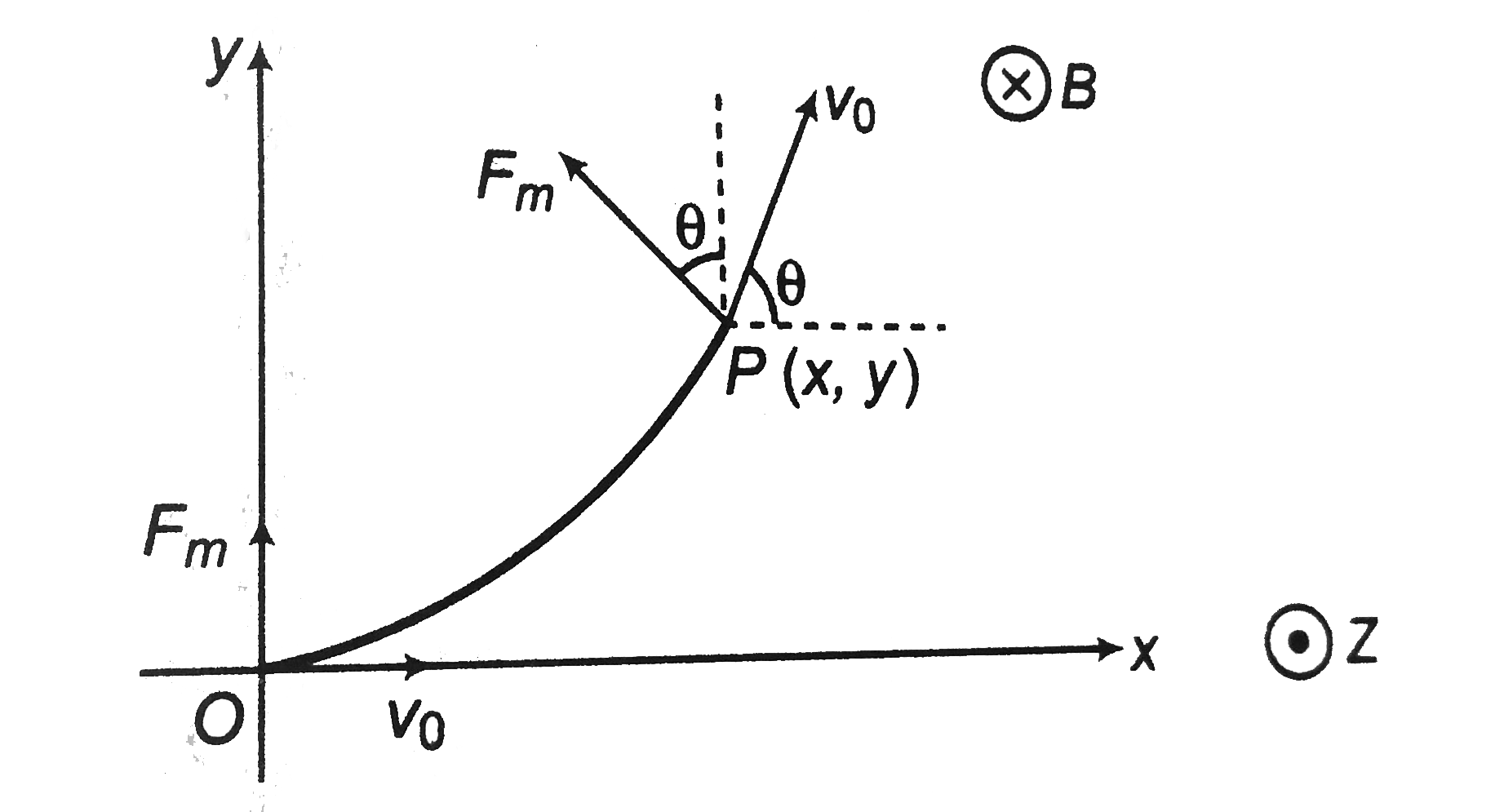
`a_y=(F_m/m)costheta`
`:. (dv_y)/(dt)=((B_0x)(qv_)costheta)0/m [F_m=Bqv_0sin90^@]`
`:. ((dv_(y))/(dx)).((dx)/(dt))=(B_0qx)/m(v_0costheta)`
`Here, (dx)/(dt)=v_x=v_0costheta`
`:. (dv_y)/(dx)=((B_0q)/(m))x`
`:. int_0^(v_0) dv_y=((B_0q)/m)int_0^(x_max) xdx`
`:. v_0=((B_0q)/m)(x_(max)^2)/(2)`
`:. x_(max)=sqrt((mv_02)/(B_0q))`
`a_y=(F_m/m)costheta`
`:. (dv_y)/(dt)=((B_0x)(qv_)costheta)0/m [F_m=Bqv_0sin90^@]`
`:. ((dv_(y))/(dx)).((dx)/(dt))=(B_0qx)/m(v_0costheta)`
`Here, (dx)/(dt)=v_x=v_0costheta`
`:. (dv_y)/(dx)=((B_0q)/(m))x`
`:. int_0^(v_0) dv_y=((B_0q)/m)int_0^(x_max) xdx`
`:. v_0=((B_0q)/m)(x_(max)^2)/(2)`
`:. x_(max)=sqrt((mv_02)/(B_0q))`



Topper's Solved these Questions
Similar Questions
Explore conceptually related problems
A particle of mass m and charge + q is projected from origin with velocity vec(V)=V_(0)hati in a magnetic field vec(B)=-(B_(0)x)hatk. Here V_(0) and B_(0) are positive constants of proper dimensions. Find the radius of curvature of the path of the particle when it reaches maximum positive x co-ordinate.
A particle of specific charge alpha is projected from origin with velocity v=v_0hati-v_0hatk in a uniform magnetic field B=-B_0hatk . Find time dependence of velocity and position of the particle.
A particle of charge 'q' and mass 'm' is projected from the origin with velocity (u_0hati+v_0 hatj) in a gravity free region where uniform electric field -E_0hati and uniform magnetic field -B_0hati exist. Find the condition so that the particle would return to origin at least for once .
A particle of specific charge 'alpha' is projected from origin at t=0 with a velocity vec(V)=V_(0) (hat(i)-hat(k)) in a magnetic field vec(B)= -B_(0)hat(k) . Then : (Mass of particle =1 unit)
A charged particle (q.m) released from origin with velocity v=v_(0)hati in a uniform magnetic field B=(B_(0))/(2)hati+(sqrt3B_(0))/(2)hatJ . Maximum z-coordinate of the particle is
A particle of charge q and mass m released from origin with velocity vec(v) = v_(0) hat(i) into a region of uniform electric and magnetic fields parallel to y-axis. i.e., vec(E) = E_(0) hat(j) and vec(B) = B_(0) hat(j) . Find out the position of the particle as a functions of time Strategy : Here vec(E) || vec(B) The electric field accelerates the particle in y-direction i.e., component of velocity goes on increasing with acceleration a_(y) = (F_(y))/(m) = (F_(e))/(m) = (qE_(0))/(m) The magnetic field rotates the particle in a circle in x-z plane (perpendicular to magnetic field) The resultant path of the particle is a helix with increasing pitch. Velocity of the particle at time t would be vec(v) (t) = v_(x) hat(i) + v_(y) hat(j) + v_(z) hat(k)
A charged particle (q.m) released from origin with velocity v=v_(0)hati in a uniform magnetic field B=(B_(0))/(2)hati+(sqrt3B_(0))/(2)hatJ . When z-co-ordinate has its maximum value
A particle of charge per unit mass alpha is released from origin with velocity vec v = v_0 hat i in a magnetic field vec B = -B_0 hat k for x le sqrt 3/2 v_0/(B_0 alpha) and vec B = 0 for x gt sqrt 3/2 v_0/(B_0 alpha) The x-coordinate of the particle at time t(gt pi/(3B_0 alpha)) would be
A particle of charge per unit mass alpha is released from origin with a velocity vecv=v_(0)hati in a magnetic field vec(B)=-B_(0)hatk for xle(sqrt(3))/2 (v_(0))/(B_(0)alpha) and vec(B)=0 for xgt(sqrt(3))/2 (v_(0))/(B_(0)alpha) The x -coordinate of the particle at time t((pi)/(3B_(0)alpha)) would be
A portion is fired from origin with velocity vec(v) = v_(0) hat(j)+ v_(0) hat(k) in a uniform magnetic field vec(B) = B_(0) hat(j) . In the subsequent motion of the proton