Home
Class 12
PHYSICS
For the ciruit shown in figure E=50V, R1...

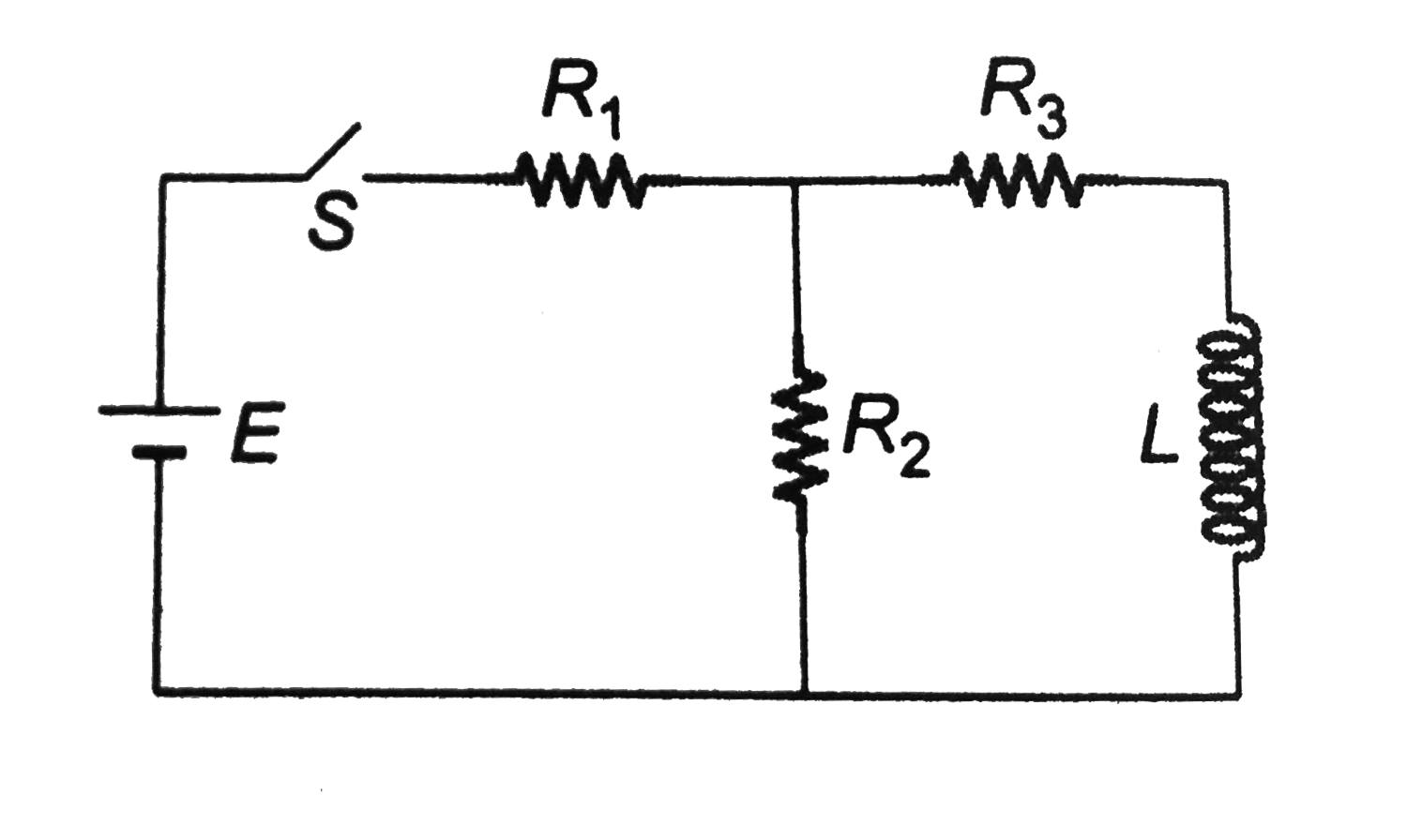
For the ciruit shown in figure `E=50V`, `R_1=10Omega, R_2=20Omega, R_3=30Omega` and `L=2.0 mH`. Find

a. Immediately after switch `S` is closed
b. A long time after `S` is closed.
c. Immediaately after S is reopened
d. A long time after `S` is reopened.

Text Solution

Verified by Experts

a. Resistance offered by inductor immediately after switch is closed will be infinite.
Therefore current through `R_3` will be zero and
current through `R_1`= current through `R_2=E/(R_1+R_2)`
`=50/(10+20)=5/3A`
b. After long time of closing the switch, resistance offered by inductor will be zero.
In that case `R_2` and `R_3` are in parallel, and the resultant of these two is then in series with `R_1`. Hence
`R_("net")=R_1+(R_2R_3)/(R_2+R_3)`
`=10+((20)(30))/(20+30)=22Omega`
Current though the battery (for thorugh `R_1)`
`E/(R_("net"))=50/22A`
This current will distribute in `R_2` and `R_3` in invedrse ratio of resistance. Hence
Current through `R_2=(50/22)(R_3/(R_2+R_3))`
`=(50/22)(20/(30+20))=15/11A`
c. Immediately after switch is reopened, the current through `R_1` will become zero.
But current thorgh `R_2` will be eqwual to the steady state current through `R_3`, which is equal to
`(50/22-15/11)A=0.91`
d. A long after S is reopened, current through all resistors will be zero.
Promotional Banner

Topper's Solved these Questions

  • ELECTROMAGNETIC INDUCTION

    DC PANDEY|Exercise Example Type 4|2 Videos
  • ELECTROMAGNETIC INDUCTION

    DC PANDEY|Exercise Example Type 5|2 Videos
  • ELECTROMAGNETIC INDUCTION

    DC PANDEY|Exercise Example Type 2|2 Videos
  • CURRENT ELECTRICITY

    DC PANDEY|Exercise Medical entrances gallery|97 Videos
  • ELECTROMAGNETIC WAVES

    DC PANDEY|Exercise Sec C|22 Videos

Similar Questions

Explore conceptually related problems

In figure, xi=100 V,R_(1)=10 Omega,R_(2)=20 Omega, R_(3)=30 Omega and L= 2H . Find i_(1) & i_(2) (a)imeediately after switch S_(w) is closed (b)a long time after ( c)immediately after S_(w) is opended again (d)a long time later.

Find the values of i_(1) and i_(2) (i) immediately after the switch S is closed. (ii) long time later, with S closed. (iii) immediately after S is open. (iv) long time after S is opned.

In the circuit shown in adjoining fig E =10V, R_(1)=1 Omega R_(2)=2 Omega, R_(3)=3 Omega and L=2H . Calculate the value of current i_(1), i_(2) and i_(3) immidiately after key S is closed :-

For the circuit shown E=50 V R_(1)=10 Omega , R_(2)= 20 Omega, R_(3) = 30 Omega L = 2.0 mH . The current through R_(1) and R_(2) are ________ . And _______ immediate after the switch is closed.

Initally switch S_(1) is closed, after a long time, S_(1) is opened and S_(2) is closed. Find the heat produced in coil after long time.

In the circuit shown in figure, E = 120 V, R_1 = 30.0Omega, R_2 = 50.0 Omega and L=0.200H . Switch S is closed at t = 0 . Just after the switch is closed. (a) What is the potential difference V_(ab) across the inductor R_1 ? (b) Which point, a or b , is at higher potential? (c) What is the potential difference V_(cd) across the inductor L ? (d) Which point, c or d , is at a higher potential? The switch is left closed for a long time and then is opened. Just after the switch is opened (e) What is the potential difference V_(ab) across the resistor R_1 ? (f) Which point a or b, is at a higher potential? (g) What is the potential difference V_(cd) across the inductor L ? (h) Which point, c or d , is at a higher potential?

In the circuit as shown in figure the switch is closed at t = 0 . A long time after closing the switch

In Fig. 30-41, E = 100 V, R_(1) = 10.0 Omega, R_(2) = 20.0 Omega , R_(3) = 31.0 Omega , and L = 2.00 H. Immediately after switch S is closed, what are (a) i_(1) and (b) i_(2) ? (Let currents in the indicated directions have positive values and currents in the opposite directions have negative values.) A long time later, what are (c) i_(1) and (d) i_(2) ? The switch is then reopened. Just then, what are (e) i_(1) and (f) i_(2) ? A long time later, what are (g) i_(1) and (h) i_(2) ?
