Home
Class 12
PHYSICS
An inductor of inductance L=400 mH and ...

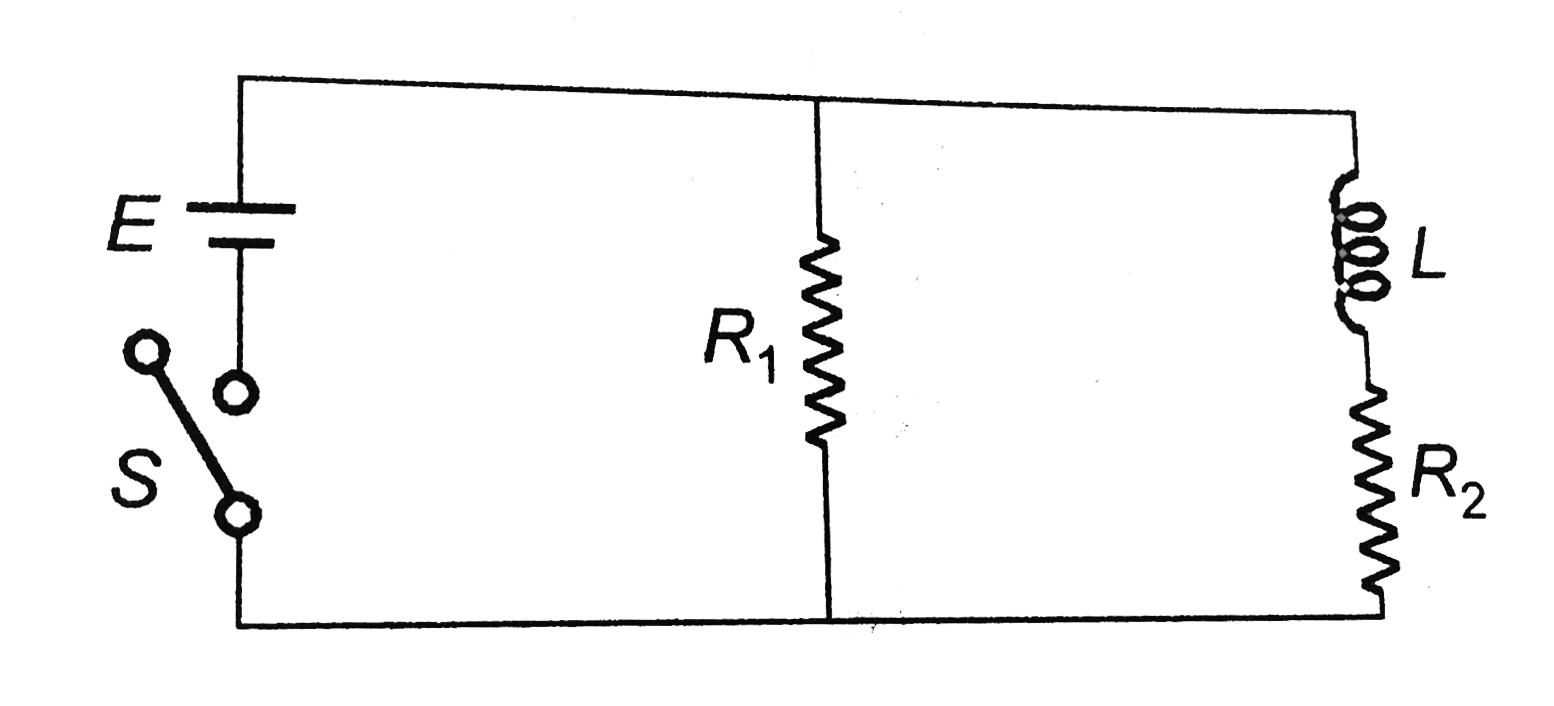
An inductor of inductance `L=400 mH` and resistors of resistances `R_1=2Omega` and `R_2=2Omega` are connected to a battery of emf `E=12 V` as shown in the figure. The internal resistance of the battery is negligible. The switch S is closed at time `t=0`.

What is the potential dro across `L` s a function of time? After the steady state is reached, the switch is opened. What is the direction ad the magnitude of current throough `R_1` as a function of time?

Text Solution

Verified by Experts
a. Given `R_1=R_2=2Omega, E=12V` and `L=400mH =0.4H`.
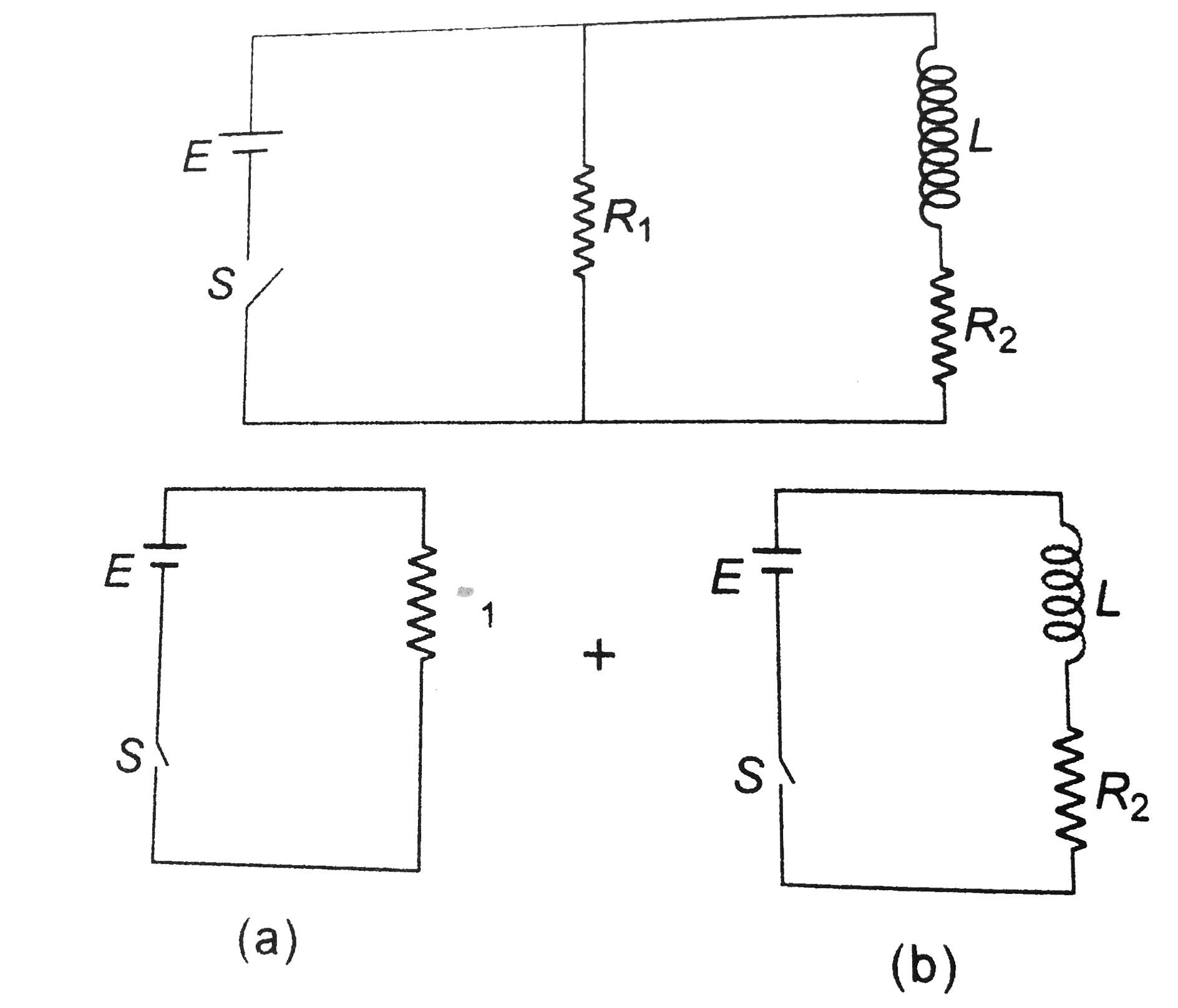
Two parts of the circuit are in parallel with applied battery.
So, the givne circuit can be broken as

Now refere Figure b
This is a simple `L-R` circuit, whose time constant
`tau_L=L/R_2=0.4/2=0.2s`
and steady state current
`i_0=E/R_2=12/2=6A`
Therefoe if switch `S` is closed at time `t=0`, then current in the circuit at any time `t` will be given
`i(t)=(1-e^(-t//tau)L)`
`i(t) =6(1-e^(-t//0.2))`
`= 6 (1-e^(-5t)) =i`
Therefore, potential drop across `L` at any time `t` is
`V=|L(di)/(dt)|=L(30e^(-5t))=(0.4)(30)e^(-5t) or V=12e^(-5t) "volt"`
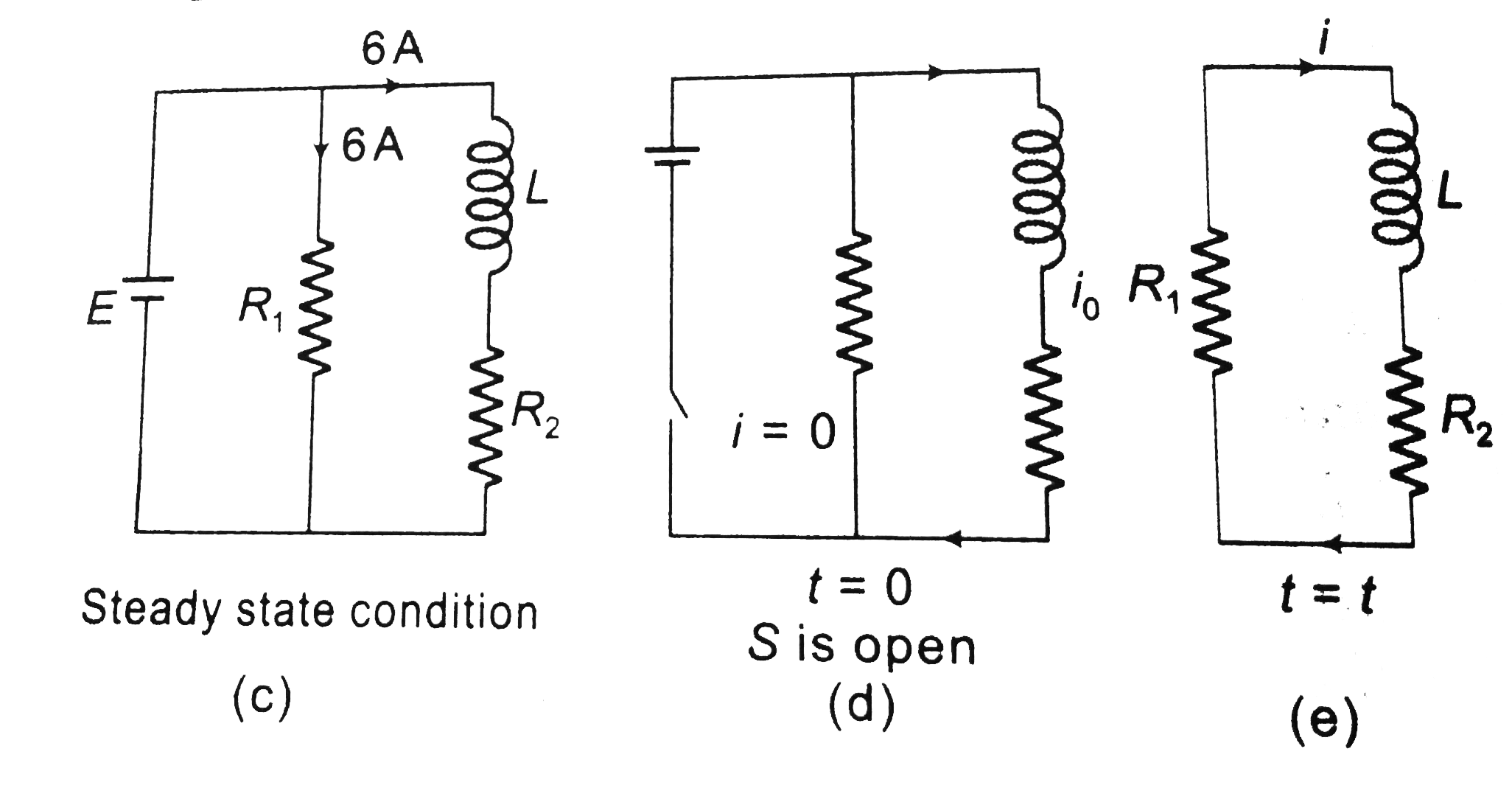
b. The steady state current in `L` or `R_2` is
`i_0=6A`
Now, as soon as the switch is opened, current in `R_1` is reduced to zero immediately. But in L and `R_2` it decreases exponentially. the situtation is as follows:

Refer figure
Time constant of this circuit would be
`tau'_L^=L/(R_1+R_2)=0.4/((2+2))=0.1s`
`:.` Current through `R_1` at time t is
`i=i_0e^(-t//tauL')=6e^(-t//0.1)`
`or i=6^(-10t)A`
Direction of current in `R_1` is as shown in figure or clockwise.
Promotional Banner

Topper's Solved these Questions

  • ELECTROMAGNETIC INDUCTION

    DC PANDEY|Exercise Example Type 4|2 Videos
  • ELECTROMAGNETIC INDUCTION

    DC PANDEY|Exercise Example Type 5|2 Videos
  • ELECTROMAGNETIC INDUCTION

    DC PANDEY|Exercise Example Type 2|2 Videos
  • CURRENT ELECTRICITY

    DC PANDEY|Exercise Medical entrances gallery|97 Videos
  • ELECTROMAGNETIC WAVES

    DC PANDEY|Exercise Sec C|22 Videos

Similar Questions

Explore conceptually related problems

An inductor of inductance L=400 mH and resistor of resistance R_(1) = 2(Omega) and R_(2) = 2 (Omega) are connected to a battery of emf E = 12 Vas shown in the figure. The internal resistance of the battery is negligible. The switch S is closed at time t =0. What is the potential drop across L as a function of time? After the steady state is reached, the switch is opened. What is the direction and the magnitude of current through R_(1) as a function of time?

An inductor of inductance L = 400 mH and resistors of resistance R_(1) = 2Omega and R_(2) = 2Omega are connected to a battery of emf 12 V as shown in the figure. The internal resistance of the battery is negligible. The switch S is closed at t = 0 . The potential drop across L as a function of time is

An inductor of inductance L=400mH and resistors of resistances R_(1)=2 Omega and R_(2)=2 Omega are connected to a battery of emf 12 V as shown in figure.The internal resistance of the battery is negligible.The switch S is closed at t=0 .The potential drop across L as a function of time is:

A 4 m long wire of resistance 8Omega is connected in series with a battery of emf 2V and a resistor of 7Omega . The internal resistance of the battery is 1Omega . What is the potential gradient along the wire ?

A 4mu F capacitor is connected to a battery of emf 24V. Through a resistance of 5 M Omega and a switch which is kept open initially. Internal resistance of the battery is negligible. Switch is closed at t=0. Potential difference across capacitor and resistor at t=0 are respectively.

Three capacitors (of capacitances C , 2C and 3C ) and three resistors (of resistance R , 2R and 3R ) are connected with a battery and switch S as shown in the figure. When switch S is open, charges on the capacitors are shown. Switch S is closed at t=0 sec . The time constant of the circuit will be