Home
Class 12
PHYSICS
The conducting rod ab shown in figure ma...

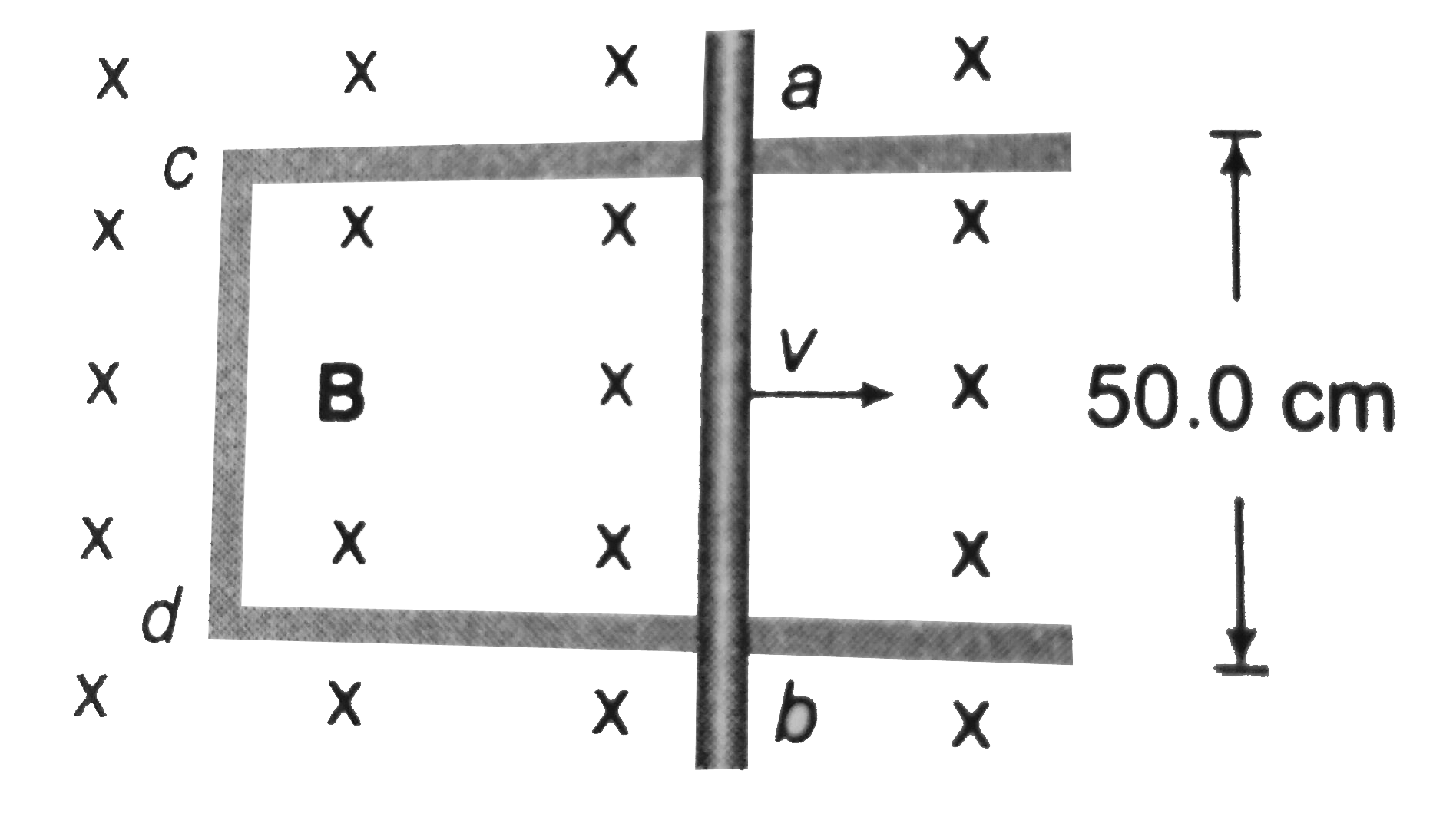
The conducting rod `ab` shown in figure makes contact with metal rails `ca` and `db`. The apparatus is in a uniform magnetic field `0.800 T`, perpendicular to the plane of the figure.

(a) Find the magnitude of the emf induced in the rod when it is moving toward the right with a speed `7.50 m//s`.
(b) In what direction does the current flow in the rod?
(c) If the resistance of the circuit abdc is `1.50 Omega` (assumed to be constant), find the force (magnitude and direction) required to keep the rod moving to the right with a constant speed of `7.50 m//s`. You can ignore friction.
(d) Compare the rate at which mechanical work is done by the force `(Fu)` with the rate at which thermal energy is developed in the circuit `(I^2R)`.

Text Solution

Verified by Experts

The correct Answer is:

A, B

a. `e=Bvl=0.8xx7.5xx0.5=3V`
b. Current will flow in anti clockwise direction, as magnetic field in `ox` direction passing through the closed loop is increasing. Therefore, induced current will produce magnetic field in `o.` direction.
c. `F=F_m=ilB=e/R lB= ((Bvl)/R)Bl=(B^2l^2)/Rv`
`=((0.8)^2(0.5)^2)/1.5xx7.5=0.8N`
d. `Fv=0.8xx7.5=6w`
`i^2R=((Bvl)/R)^2R=(B^2l^2)/R.v^2`
`=((0.8)^2(0.5)^2)/1.5xx(7.5)^2=6W`
So we can see that both rates are equal.
Promotional Banner

Topper's Solved these Questions

  • ELECTROMAGNETIC INDUCTION

    DC PANDEY|Exercise Check point|60 Videos
  • ELECTROMAGNETIC INDUCTION

    DC PANDEY|Exercise Taking it together|119 Videos
  • ELECTROMAGNETIC INDUCTION

    DC PANDEY|Exercise SUBJECTIVE TYPE|1 Videos
  • CURRENT ELECTRICITY

    DC PANDEY|Exercise Medical entrances gallery|97 Videos
  • ELECTROMAGNETIC WAVES

    DC PANDEY|Exercise Sec C|22 Videos

Similar Questions

Explore conceptually related problems

Figure shows a conducting rod PQ in contact with metal rails RP and SQ , which are 0.25 m apart in a uniform magnetic field of flux density 0.4T acting perpendicular to the plane of the paper. Ends R and S are connected through a 5 Omega resistance. What is the emf when the rod moves to the right with a velocity of 5ms^(-1) ? What is the magnitude and direction of the current through the 5 Omega resistance? If the rod PQ moves to the left with the same speed, what will be the new current and its direction?

A wire is bent in the form of a V shape and placed in a horizontal plane.There exists a uniform magnetic field B perpendicular to the plane of the wire. A uniform conducting rod starts sliding over the V shaped wire with a constant speed v as shown in the figure. If the wire no resistance, the current in rod wil

In the figure shown as uniform magnetic field |B|=0.5T is perpendicular to the plane of circuit. The sliding rod of length l=0.25 m moves uniformly with constant speed v=4ms^-1 . If the resistance of the sllides is 2Omega , then the current flowing through the sliding rod is

A conducting wire is moving towards right in a magnetic field B . The direction of induced current in the wire is shown in the figure. The direction of magenetic field will be

As shown in figure, a metal rod completes the circuit. The circuit area is perpendicular to a magnetic field with B = 0.15 T . If the resistance of the total circuit is 3 Omega , how large a force is needed to move the rod as indicated with a constant speed of 2 m/s?

A conducting rod PQ of length L = 1.0 m is moving with a uniform speed v = 2.0 m s^(-1) in a uniform magnetic field B = 4.0 T directed into the plane of the paper. A capacitor of capacity C = 10muF is connected as shown in , then

A conducting rod PQ of length 5 m oriented as shown in figure is moving with velocity (2 m//s)hat(i) without any rotation in a uniform magnetic field (3hat(j)+4hat(k)) Tesla. Emf induced in the rod is

A conducting rod of length l is rotating with constant angular velocity omega about point O in a uniform magnetic field B as shown in the figure . What is the emf induced between ends P and Q ?

DC PANDEY-ELECTROMAGNETIC INDUCTION-Level 2 Subjective
  1. A rectangular loop with a sliding connector of length l is located in ...

    Text Solution

    |

  2. A rod of length 2a is free to rotate in a vertical plane, about a hori...

    Text Solution

    |

  3. In the circuit arrangement shown in figure, the switch S is closed at ...

    Text Solution

    |

  4. In the circuit shown, switch S is closed at time t = 0. Find the curre...

    Text Solution

    |

  5. In the circuit shown in figure, E = 120 V, R1 = 30.0Omega, R2 = 50.0 O...

    Text Solution

    |

  6. Two capacitors of capacitances 2C and C are connected in series with a...

    Text Solution

    |

  7. A 1.00 mH inductor and a 1.00muF capacitor are connected in series. Th...

    Text Solution

    |

  8. In the circuit shown in the figure, E = 50.0 V, R = 250 Omega and C = ...

    Text Solution

    |

  9. The conducting rod ab shown in figure makes contact with metal rails c...

    Text Solution

    |

  10. A non-conducting ring of mass m and radius R has a charge Q uniformly ...

    Text Solution

    |

  11. Two parallel long smooth conducting rails separated by a distance l ar...

    Text Solution

    |

  12. A circuit containing capacitors C1 and C2, shown in the figure is in t...

    Text Solution

    |

  13. Initially, the capacitor is charged to a potential of 5 V and then con...

    Text Solution

    |

  14. A rod of mass m and resistnce R sldes on frictionless and resistancele...

    Text Solution

    |

  15. Two metal bars are fixed vertically and are connected on the top by a ...

    Text Solution

    |

  16. A conducting light string is wound on the rim of a metal ring of radiu...

    Text Solution

    |

  17. A conducting frame abcd is kept in a vertical plane. A conducting rod ...

    Text Solution

    |

  18. A rectangular loop with a sliding conductor of length l is located in ...

    Text Solution

    |

  19. A conducting circular loop of radius a and resistance per unit length ...

    Text Solution

    |

  20. U-frame ABCD and a sliding rod PQ of resistance R, start moving with v...

    Text Solution

    |
