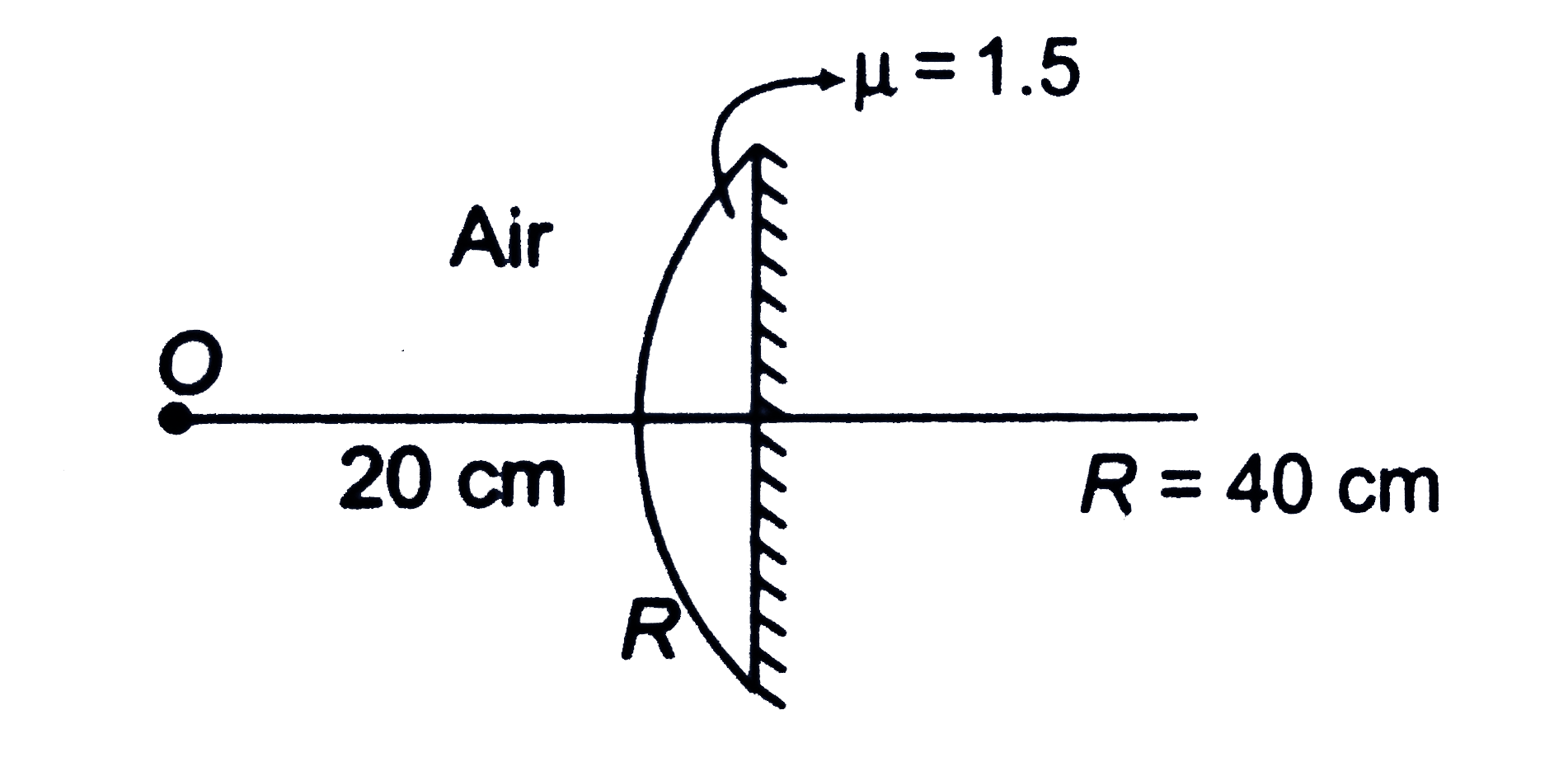
Find focal length of the system as shown if figure. Find image position.
Text Solution
Verified by Experts
The correct Answer is:
+40 cm
(a) `mu_1=1, mu_2=1.5, R_1=R=+40cm and R_2=oo` Using the formula, `1/f=(2(mu_2//mu_1))/R_2-(2(mu_2//mu_1-1))/R_1` `=(2(1.5))/oo-(2(1.5-1))/40` or `f=-40cm` Thus, the given system behaves like a concave mirror of focal length `40cm.` (b) Using the mirror formula, we have ` :. 1/v+1/u=1/f` `1/v+1/-20=1/-40` `:. v=+40cm` Therefore, image will be formed at a distance of `40cm` to the right hand side of the given system.
Topper's Solved these Questions
REFRACTION OF LIGHT
DC PANDEY|Exercise Solved Example|15 Videos
REFRACTION OF LIGHT
DC PANDEY|Exercise Exercise 31.1|3 Videos
REFRACTION OF LIGHT
DC PANDEY|Exercise Example Type 10|1 Videos
REFLECTION OF LIGHT
DC PANDEY|Exercise Subjective|9 Videos
SEMICONDUCTORS
DC PANDEY|Exercise Subjective|12 Videos
Similar Questions
Explore conceptually related problems
Find the focal length of the lens as shown in figure.
Find the focal length of the lens shown in Fig.
Find focal length of the system shown in figure from left hand side.
Find the focal length fo the lens shown in the figure.
Focal length of the mirror shown in figure is 20cm. Find the image position and its velocity.
Find the focal length of equivalent system shown in Figure.
Find the focal length of the lens shown in the Fig..
Find the capacitance of the system shown in figure.
Find the capacitance of the system shown in figure.
Focal length of the convex lens shown in figure is 20cm. Find the image position and image velocity.