Home
Class 12
PHYSICS
A cubical block of glass of refractive i...

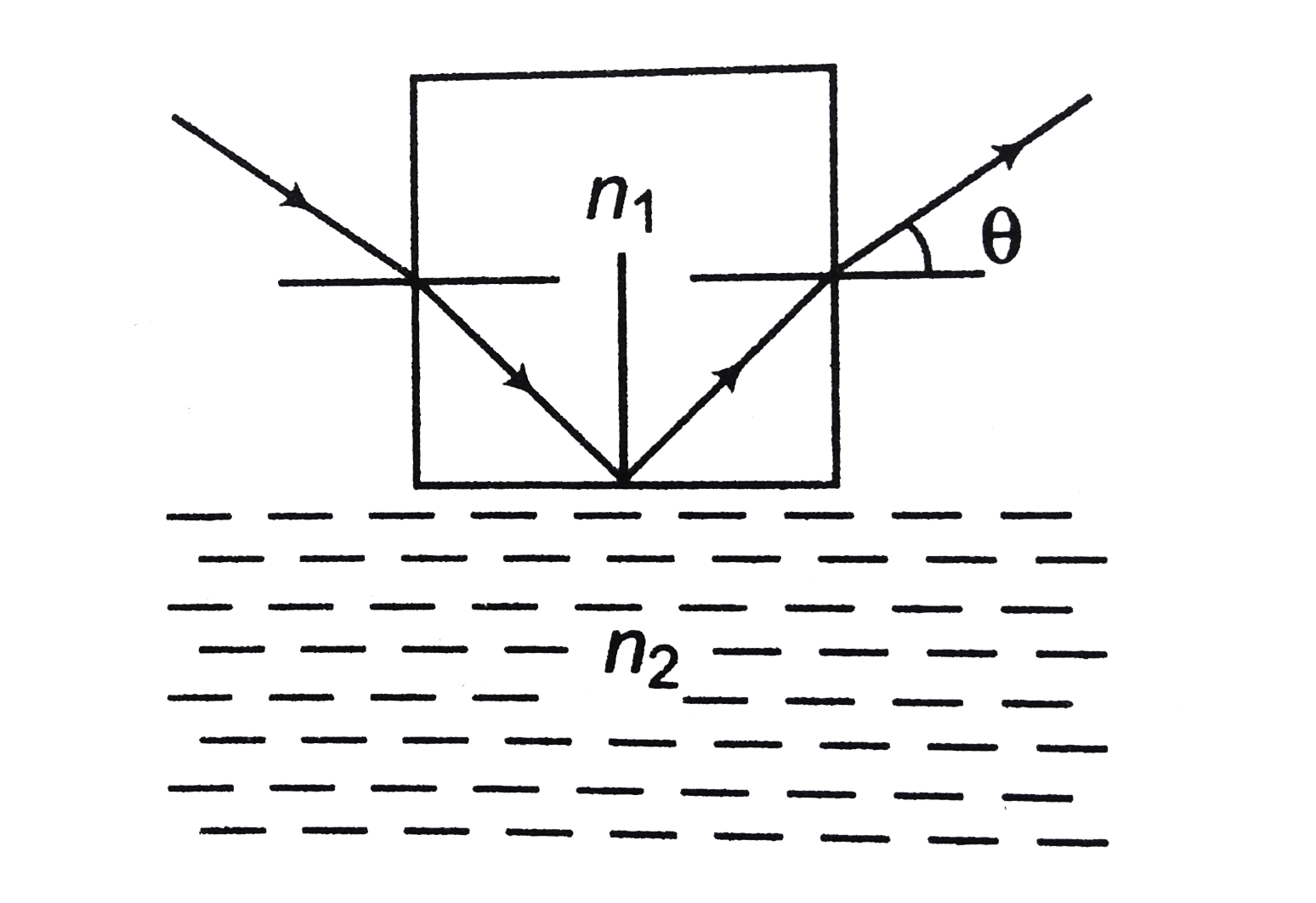
A cubical block of glass of refractive index `n_1` is in contact with the surface of water of refractive index `n_2.` A beam of light is incident on vertical face of the block. After refraction a total internal reflection at the base and refraction at the opposite face take place. The ray emerges at angle `theta` as shown. The value of `theta` is given by

A

`sin thetaltsqrt(n_1^2-n_2^2)`

B

`cos theta lt sqrt(n_1^2-n_2^2)`

C

`sin theta lt 1/sqrt(n_1^2-n_2^2)`

D

`cos theta lt 1/sqrt(n_1^2-n_2^2)`

Text Solution

Verified by Experts

The correct Answer is:
A

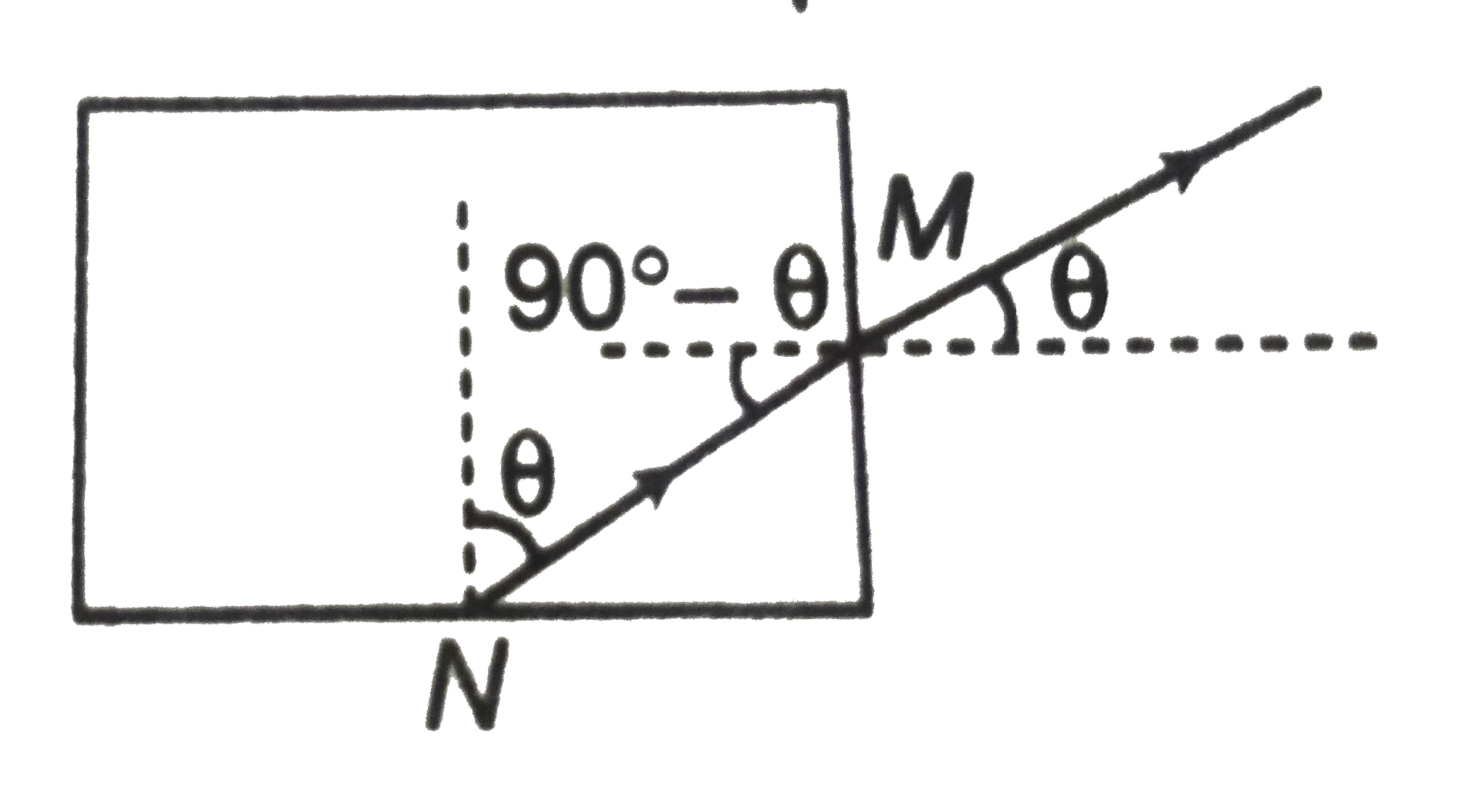
Applying Snell's law at point M, we get
`n_1=sin theta /(sin(90^@-theta_C)) or sin theta=n_1cos theta_C`
`=n_1sqrt(1-sin^2 theta_C)=n_1sqrt(1-(n_2^2)/(n_1^2))=sqrt(n_1^2-n_2^2)`

If angle of `theta` is less than this value, then angle of
incidence at N will be greater than `theta_C`. Hence , TIR
will take place at N.
Promotional Banner

Topper's Solved these Questions

  • REFRACTION OF LIGHT

    DC PANDEY|Exercise Single Correct Option|3 Videos
  • REFRACTION OF LIGHT

    DC PANDEY|Exercise more than one correct option|1 Videos
  • REFRACTION OF LIGHT

    DC PANDEY|Exercise Subjective Questions|8 Videos
  • REFLECTION OF LIGHT

    DC PANDEY|Exercise Subjective|9 Videos
  • SEMICONDUCTORS

    DC PANDEY|Exercise Subjective|12 Videos

Similar Questions

Explore conceptually related problems

A ray of light is incident on the surface of a glass plate of index of refraction 1.55 at the polarizing angle. Calculate the angle of refraction.

A ray of light is incident on the surface of plate of glass of refractive index 1.5 at the polarising angle. The angle of refraction of the ray will be

A glass prims ABC (refractive index 1.5) , immersed in water (refrective index 4/3 ). A ray of light is incident normally one face AB. If it is totally reflected at the face AC, then

A glass prism of refractive index 1.5 is immersed in water (refractive index 4/3). A light beam incident normally on the face AB is totally reflected to reach the face BC , Fig. if : .

A glass prism of refractive index 1.5 is immersed in water (refractive index 4/3). A light beam incident normally on the face AB is totally reflected to reach on the face BC if.

A ray of light is incident on the surface of a glass plate of refractive index 1.6 at polarzing angle. Calculate the angles of reflection and refraction.

An equilateral glass prism of refractive index 1.5 is immersed in water. Find the angle of deviation produced when a ray of light is incident at 42^(@) on one face of the prism. (Refractive index of water = 1.33)

For a given incident ray as shown in Fig., the condition of total internal reflection of ray will be satisfied if the refractive index of the block will be. .

A rectengular glass slab ABCD of refractive index n_1 is immersed in water of refractive index n_2(n_1gtn_2) . A ray of light is incident at the surface AB of the slab as shown. The maximum value of the angle of incidence alpha_max such that the ray comes out only from the other surface CD is given by

DC PANDEY-REFRACTION OF LIGHT-Level 2 Single Correct
  1. The maximum value of refractive index of a prism which permits the tra...

    Text Solution

    |

  2. A glass slab of thickness 4 cm contains the same number of waves as 5 ...

    Text Solution

    |

  3. If the optic axis of convex and concave lenses are separated by a dist...

    Text Solution

    |

  4. A light source S is placed at the centre of a glass sphere of radius R...

    Text Solution

    |

  5. A sphere (mu=4/3) of radius 1 m has a small cavity of diameter 1 cm at...

    Text Solution

    |

  6. An equi-convex lens of mu=1.5 and R=20 cm is cut into two equal parts ...

    Text Solution

    |

  7. As shown in the figure, region BCDEF and ABFG are of refractive index ...

    Text Solution

    |

  8. A point object O is placed at a distance of 20 cm from a convex lens o...

    Text Solution

    |

  9. A point object is placed at a distance of 20 cm from a thin plano-con...

    Text Solution

    |

  10. A flat glass slab of thickness 6 cm and index 1.5 is placed in front o...

    Text Solution

    |

  11. Distance of an object from the first focus of an equi-convex lens is 1...

    Text Solution

    |

  12. A cubical block of glass of refractive index n1 is in contact with the...

    Text Solution

    |

  13. A concave mirror of focal length 2 cm is placed on a glass slab as sho...

    Text Solution

    |

  14. Two refracting media are separated by a spherical interfaces as shown ...

    Text Solution

    |

  15. A concavo-convex lens has refractive index 1.5 and the radii of curvat...

    Text Solution

    |

  16. A convex spherical refracting surfaces separates two media glass and ...

    Text Solution

    |

  17. An object is moving towards a converging lens on its axis. The image i...

    Text Solution

    |

  18. Two diverging lenses are kept as shown in figure. The final image form...

    Text Solution

    |

  19. In the figure shown , a point object O is placed in air on the princip...

    Text Solution

    |

  20. In the figure, a point object O is placed in air. A spherical boundry ...

    Text Solution

    |

