Home
Class 12
PHYSICS
Light of wavelengthlambda = 500 nm falls...

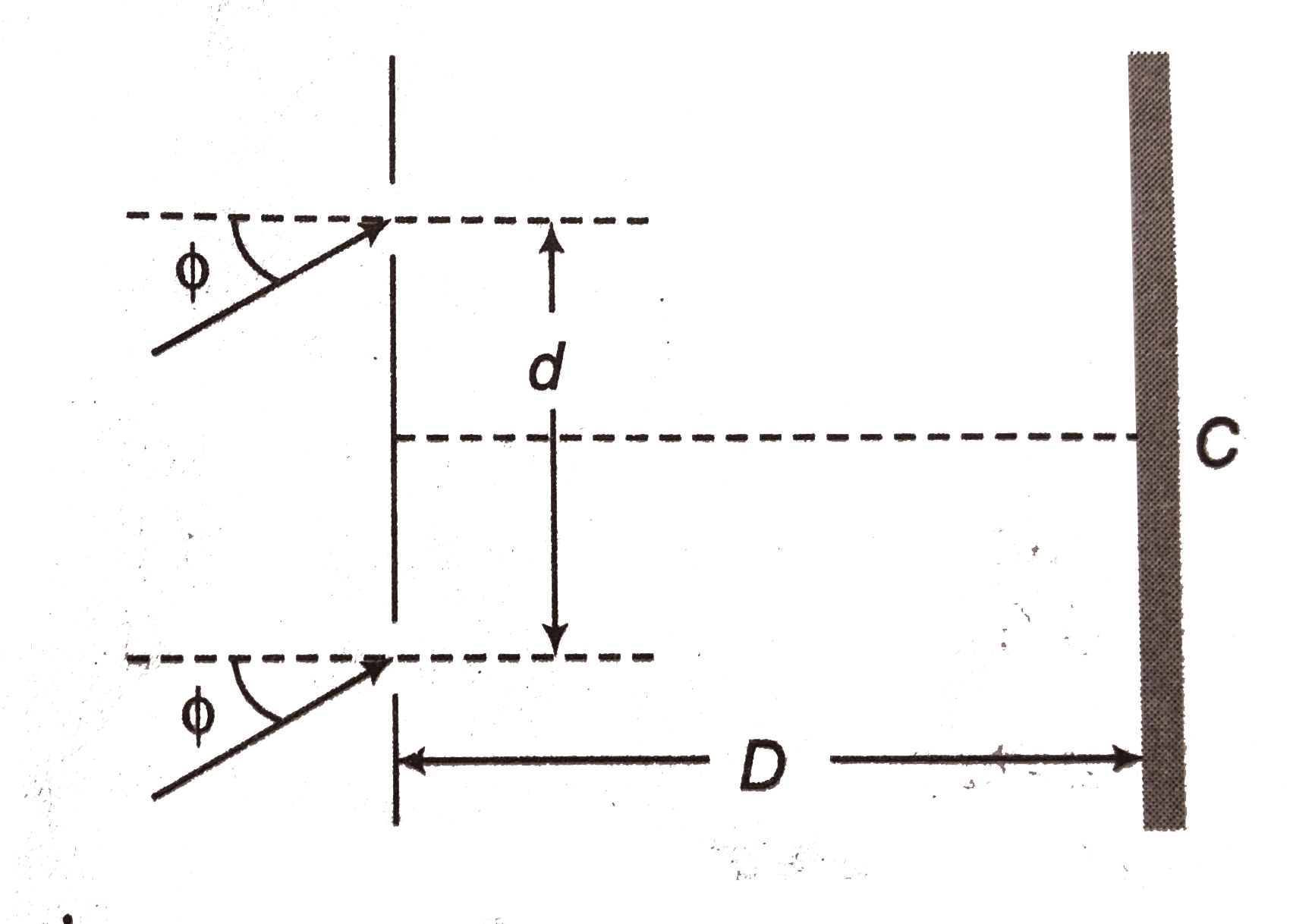
Light of wavelength`lambda = 500 nm` falls on two narrow slits placed a distance d = ` 50 xx 10^-4` cm
apart, at an angle `phi= 30^@` relative to the slits as shown in figure. On the lower slit a transparent slab of thickness 0.1 mm and refractive index `3/2` is placed. The interference pattern is observed at a distance D=2m from the slits. Then, calculate

(a) position of the central maxima.
(b) the order of maxima at point C of screen .
(c)how many fringes will pass C, if we remove the transparent slab from the lower slit?

Text Solution

Verified by Experts
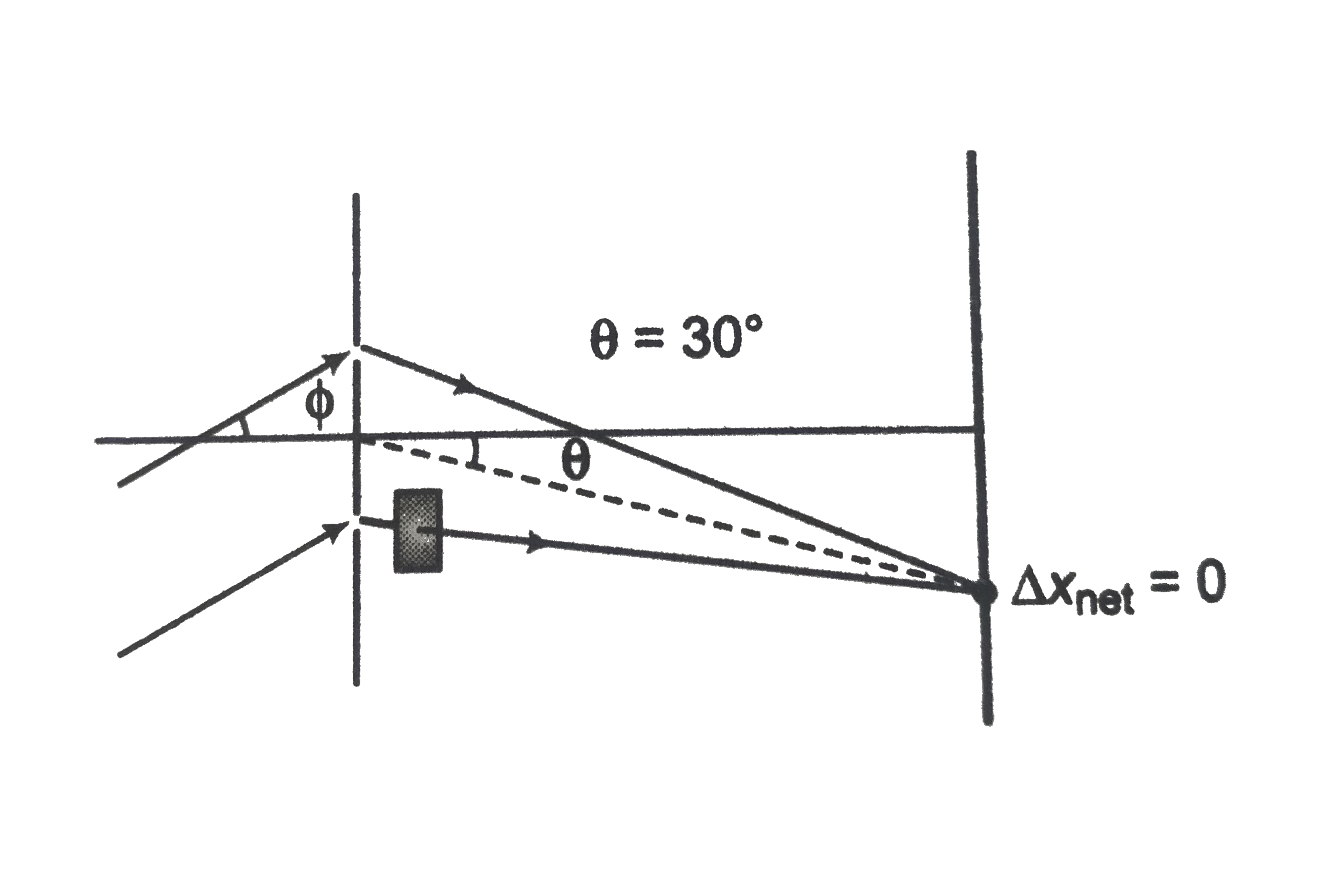
(a) `d sin phi = Deltax_1`
`=(50 xx 10^(-4)) sin 30^@`

`= 2.5 xx 10^(-3)` cm
` Deltax_2 = (mu -1)t`
`=(3/2 -1) (0.01)`
` = 5.0 xx 10^-3 cm`
` Deltax_2 - Deltax_1 = 2.5 xx 10^(-3) cm = Deltax_1` (also)
`:.` Central maxima will be obtained at `theta = 30^@` below C.
(b) At `C DeltaX_("net") = 2.5 xx 10^(-3) cm = nlambda`
`:. n=(2.5 xx 10^-3)/lambda`
`=(2.5 xx 10^-3)/(500 xx 10^-7)`
`= 50 `
(c) Number of fringes that will pass if we remove the slab
`=("Path difference due to slab")/lambda`
` (5xx 10^-3)/(500 xx 10^-7)`
= 100.
Promotional Banner

Topper's Solved these Questions

  • INTERFERENCE AND DIFFRACTION OF LIGHT

    DC PANDEY|Exercise Level 2 Comprehensionn Based|4 Videos
  • GRAVITATION

    DC PANDEY|Exercise All Questions|120 Videos
  • MAGNETIC FIELD AND FORCES

    DC PANDEY|Exercise Medical entrance s gallery|59 Videos

