Home
Class 12
PHYSICS
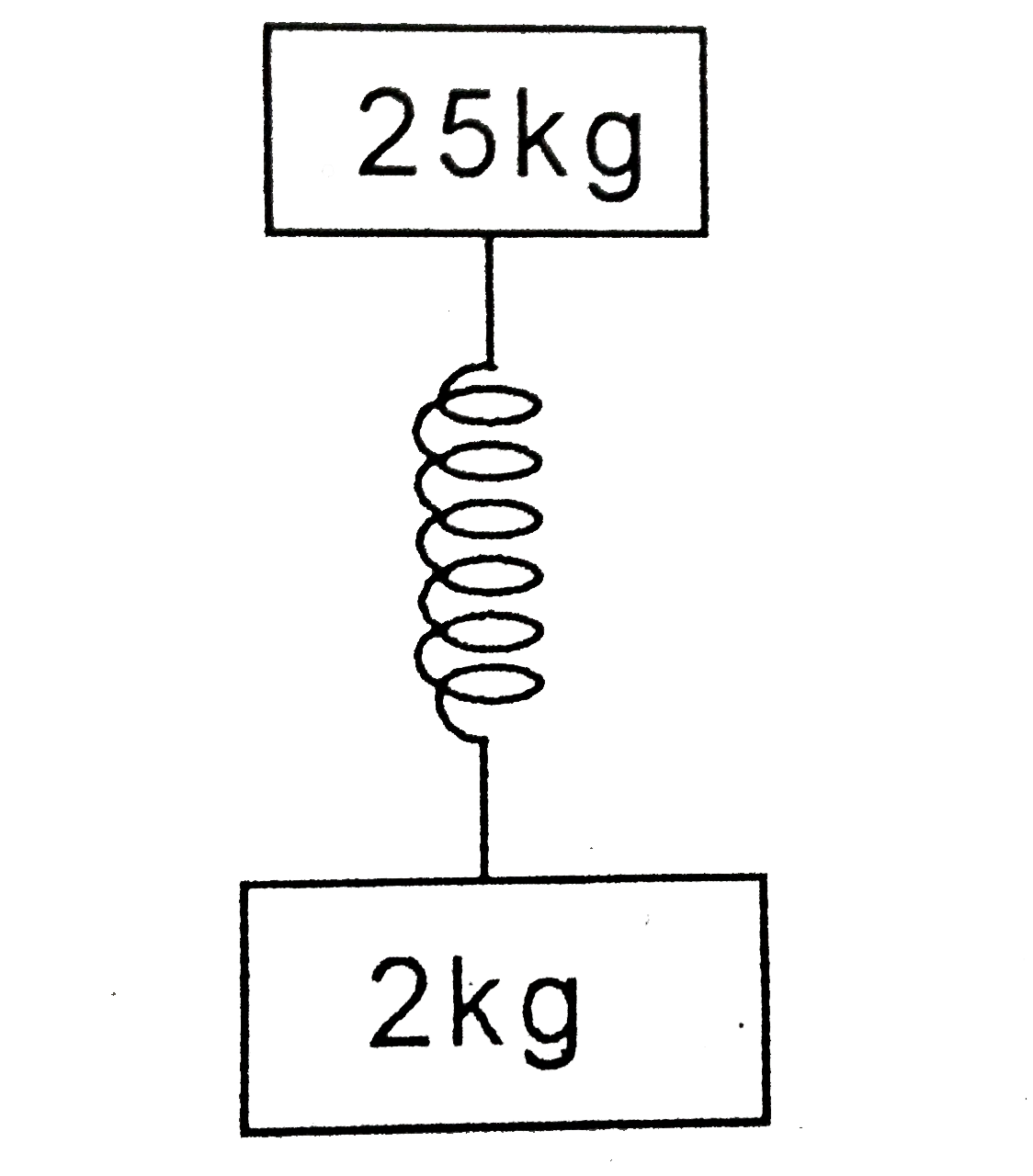
Initialy spring in its natural length no...

Initialy spring in its natural length now a block at mass 0.25 kg is released then find out maximum force by system on floor ?

A

15 N

B

20 N

C

25 N

D

30 N

Text Solution

Verified by Experts

The correct Answer is:
C


Work - energy theory on (25) kg
`(1)/(2)Kx^(2)=mgx`
`K_(x)=2mg`
`K_(x)=2xx.25xx10`
`= 5 N`
= 25 N
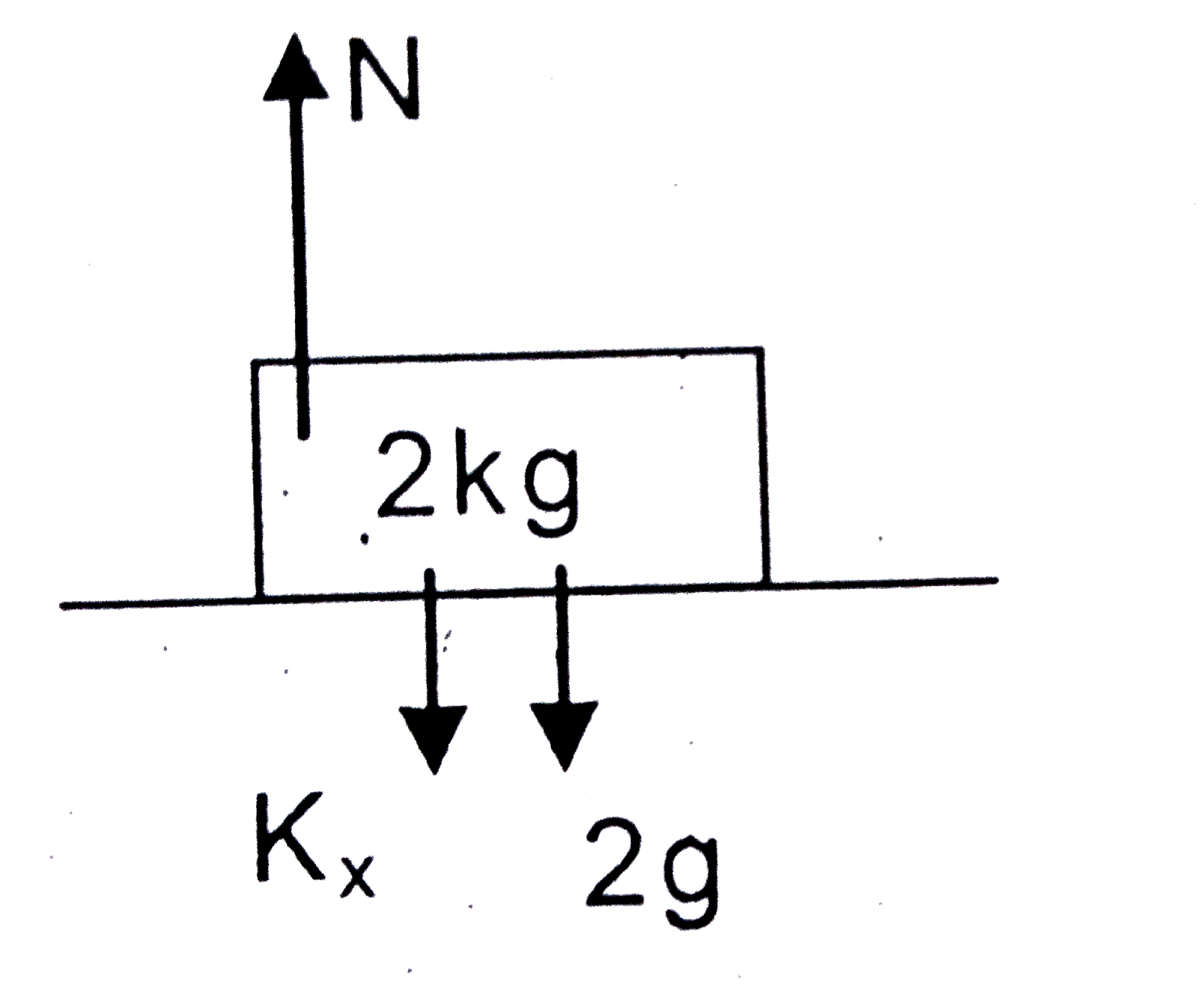
`N=kx+2g`
`=5+20=25N`
Promotional Banner

Topper's Solved these Questions

  • AIIMS 2019 26 MAY EVENING SHIFT

    AIIMS PREVIOUS YEAR PAPERS|Exercise PHYSICS|33 Videos

Similar Questions

Explore conceptually related problems

Initially spring is in natural length and block of mass m is released from rest what should be the minimum value of M (in kg) to just move the 2kg block. If this minimum value is (x)/(8) kg. Find x

Initialy spring is in the natural length and blocks A & B are at rest. Find maximum value of constant force F that can be applied on B such that block A remains at rest. (g = 10 m//s^(2)) (given answer in Newton)

A block of mass m is attached to a spring of force constant k whose other end is fixed to a horizontal surface. Initially the spring is in its natural length and the block is released from rest. The average force acting on the surface by the spring till the instant when the block has zero acceleration for the first time is

Block A of mass m is placed on a plank B . A light support S is fixed on plank B and is attached with the block A with a spring of spring constant K. Consider that initialy spring is in the natural length, and the system is at rest. Find the maximum compression in the spring, if the plank B is moved with a constant acceleration 'a' . (All the surface are smooth) :

Initially spring is in its natural length . The block of mass 3 kg in contact with rigid wall . The block of mass 1 kg is pushed through a distance 4 cm towards the wall and then released. The velocity of the center of mass when the block of mass 3 kg breaks off the wall is (k = 100 N//m)

A block of mass m is connected to a spring (spring constant k ). Initially the block is at rest and the spring is in its natural length. Now the system is released in gravitational field and a variable force F is applied on the upper end of the spring such that the downward acceleration of the block is given as a=g-alphat , where t is time elapses and alpha=1m//s^(2) , the velocity of the point of application of the force is:

A block of mass m attached with a spring and held by a person such that the spring is in natural length l_(0) . Now the man releases the block, the ratio of maximum compression in the spring in the given situation , to that of the compression at equilibrium position.

A block of mass M is kept on a smooth surface and touches the two springs as shown in the figure but not attached to the springs. Initially springs are in their natural length. Now, the block is shifted (l_(0)//2) from the given position in such a way that it compresses a spring and released. The time - period of oscillation of mass will be

Find the maximum tension in the spring if initially spring at its natural length when block is released from rest.

A block of mass m = 2 kg is connected to a a spring of force constant k = 50 N//m . Initially the block is at rest and tlhe spring has natural length. A constant force F = 60 N is applied horizontally towards, the maximum speed of the block (in m//s ) will be (negelect friction).

AIIMS PREVIOUS YEAR PAPERS-AIIMS 2019 26 MAY MORNING SHIFT-PHYSICS
  1. Find magnetic field at centre P if length of side of square loop is 2...

    Text Solution

    |

  2. What is the dimension of Luminous flux :

    Text Solution

    |

  3. Two circular loops having same radius [ R = 10 cm] and same current (7...

    Text Solution

    |

  4. If half life of an element is 69.3 hours then how much of its percent ...

    Text Solution

    |

  5. Initialy spring in its natural length now a block at mass 0.25 kg is r...

    Text Solution

    |

  6. If "7 gm N"(2) is mixed with 20 gm Ar, there C(p)//C(v) of mixture wil...

    Text Solution

    |

  7. If f(0)=5c, lambda 6000Å, a=1cm for a microscope, then wht will be its...

    Text Solution

    |

  8. Distance of 5^("th") dark fringe from centre is 4 mm. If D = 2 m, lamb...

    Text Solution

    |

  9. A conducting and closed container of capacity 100 liter contains an id...

    Text Solution

    |

  10. How can we change a camera from F/4 to F/5.6?

    Text Solution

    |

  11. Force on current carrying loop (Radius = R) in uniform magnetic (B) fi...

    Text Solution

    |

  12. Assertion : Sometimes insects can walk on water. Reason : The gravi...

    Text Solution

    |

  13. Assertion: Incoming light reflected by earth is partially polarized. ...

    Text Solution

    |

  14. Assertion : Photodiode and solar cell work on same mechanism. Reason...

    Text Solution

    |

  15. Assertion : .(1)^(3)H isotope does not undergo fusion of the type.(1)...

    Text Solution

    |

  16. Assertion : Macro properties of gas are affected with increase in heig...

    Text Solution

    |

  17. Assertion : V("rms") and V("mean") of gaseous molecules is nearly of t...

    Text Solution

    |

  18. Assertion : The kinetic energy does not change when a particle moves i...

    Text Solution

    |

  19. Assertion : For revolving electron, direction of angular momentum and ...

    Text Solution

    |

  20. Assertion : A metallic surface is moved in and out in magnetic field t...

    Text Solution

    |

