Home
Class 12
MATHS
Let alpha, beta, gamma be distinct real ...

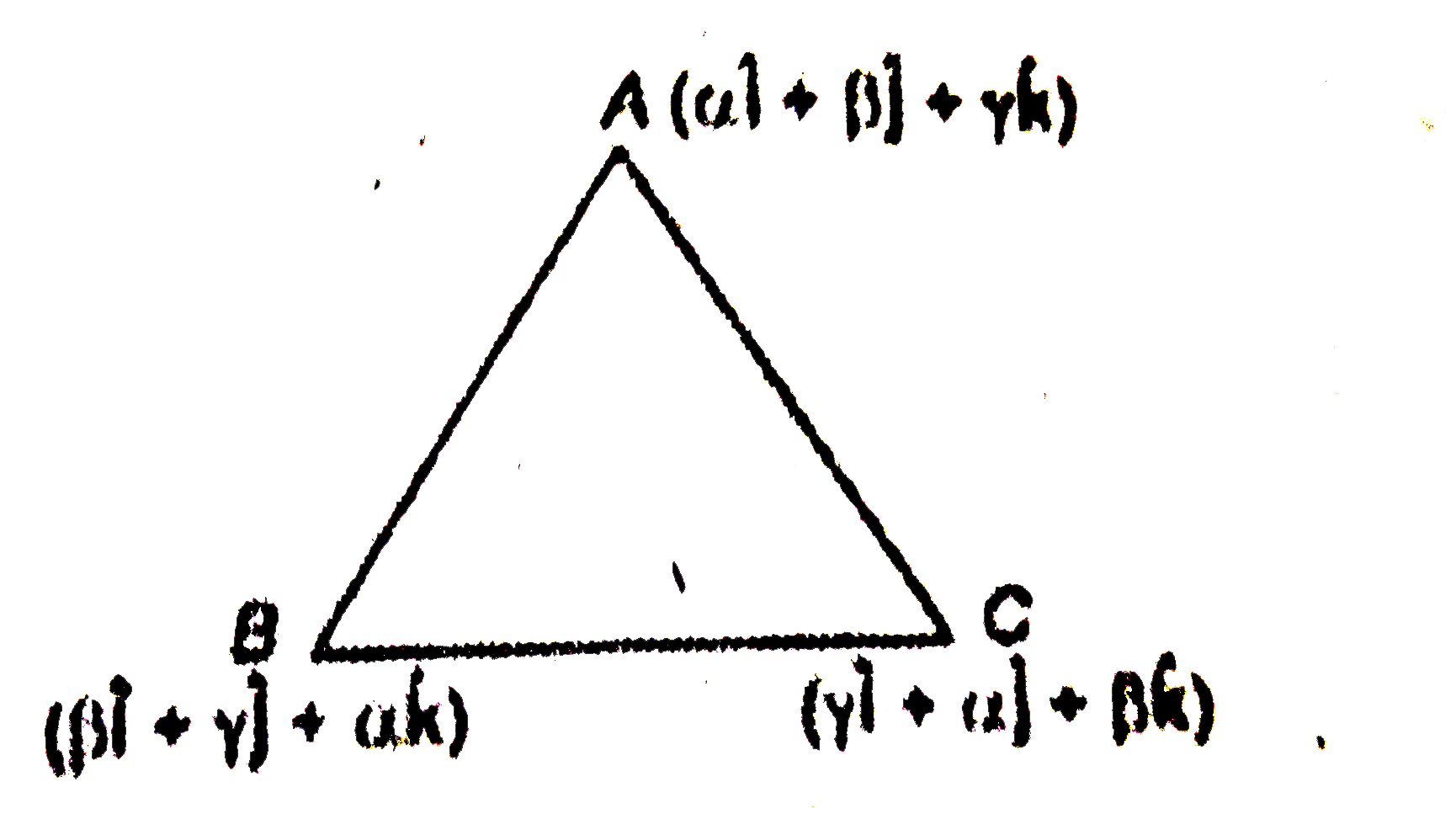
Let `alpha, beta, gamma` be distinct real numbers. The points with position vectors `alpha hati + beta hatj +gamma hat k , beta hati + gamma hatj +alpha hat k , gamma hati +alpha hatj + beta hatk`

A

are collinera

B

form an equilateral triangle

C

form a scalene triangle

D

form a right angled triangle

Text Solution

Verified by Experts

Let given point be A, B and C with positive vectors `alphahati+betahatj+gammahatk,betahati+gammahatj+alphahatk and gamma hati+alphahatj+betahatk`
As `alpha,beta and gamma` are distinct real numbers, therefore ABC form a triangle.
Clearly, `AB=OB-OA=(betahati+gammahatj+alphahatk)-(alphahati+betahatj+gammahatk)`
`=(beta-alpha)hati+(gamma-beta)hatj+(alpha-gamma)hatk`

Now, `|AB|=sqrt((beta-alpha)^(2)+(gamma-beta)^(2)+(alpha-gamma)^(2))`
Similarly, `BC=CA=sqrt((beta-alpha)^(2)+(gamma-beta)^(2)+(alpha-gamma)^(2))`
`thereforeDeltaABC` is an equilateral triangle.
Promotional Banner

Topper's Solved these Questions

  • VECTOR ALGEBRA

    ARIHANT MATHS|Exercise Exercise For Session 1|7 Videos
  • VECTOR ALGEBRA

    ARIHANT MATHS|Exercise Exercise For Session 2|17 Videos
  • TRIGONOMETRIC FUNCTIONS AND IDENTITIES

    ARIHANT MATHS|Exercise Exercise (Questions Asked In Previous 13 Years Exam)|19 Videos

Similar Questions

Explore conceptually related problems

Let alpha, beta and gamma be distinct real numbers. The points with position vectors alpha hat(i) + beta hat(j) + gamma hat(k), beta hat(i) + gamma hat(j) + alpha hat(k) and gamma hat(i) + alpha hat(j) + beta hat(k)

Let alpha, beta , lambda be distinct real numbers. The points with position vectros alpha hat (i) + beta hat(j) + lambda hat(k), beta hat(i) + lambda hat(j) + alpha hat(k) and lambda hat(i) + alpha hat(j) + beta hat (k)

The vector cos alpha cos beta hati + cos alpha sin beta hatj + sin alpha hatk is a

cos alpha sin (beta-gamma) + cos beta sin (gamma-alpha) + cos gamma sin (alpha-beta) =

cos (alpha + beta) cos gamma-cos (beta + gamma) cos alpha = sin beta sin (gamma-alpha)

sin (beta+ gamma- alpha) + sin (gamma+ alpha - beta) + sin (alpha + beta- gamma)- sin (alpha + beta + gamma)=

If alpha,beta,gamma are three distinct real numbers such than 0

If alpha, beta, gamma be the zeros of the polynomial p(x) such that (alpha+beta+gamma) = 3, (alpha beta+beta gamma+gamma alpha) =- 10 and alpha beta gamma =- 24 then p(x) = ?