Home
Class 12
MATHS
If D ,Ea n dF are three points on the si...

If `D ,Ea n dF` are three points on the sides `B C ,C Aa n dA B ,` respectively, of a triangle `A B C` such that the `(B D)/(C D),(C E)/(A E),(A F)/(B F)=-1`

Text Solution

Verified by Experts
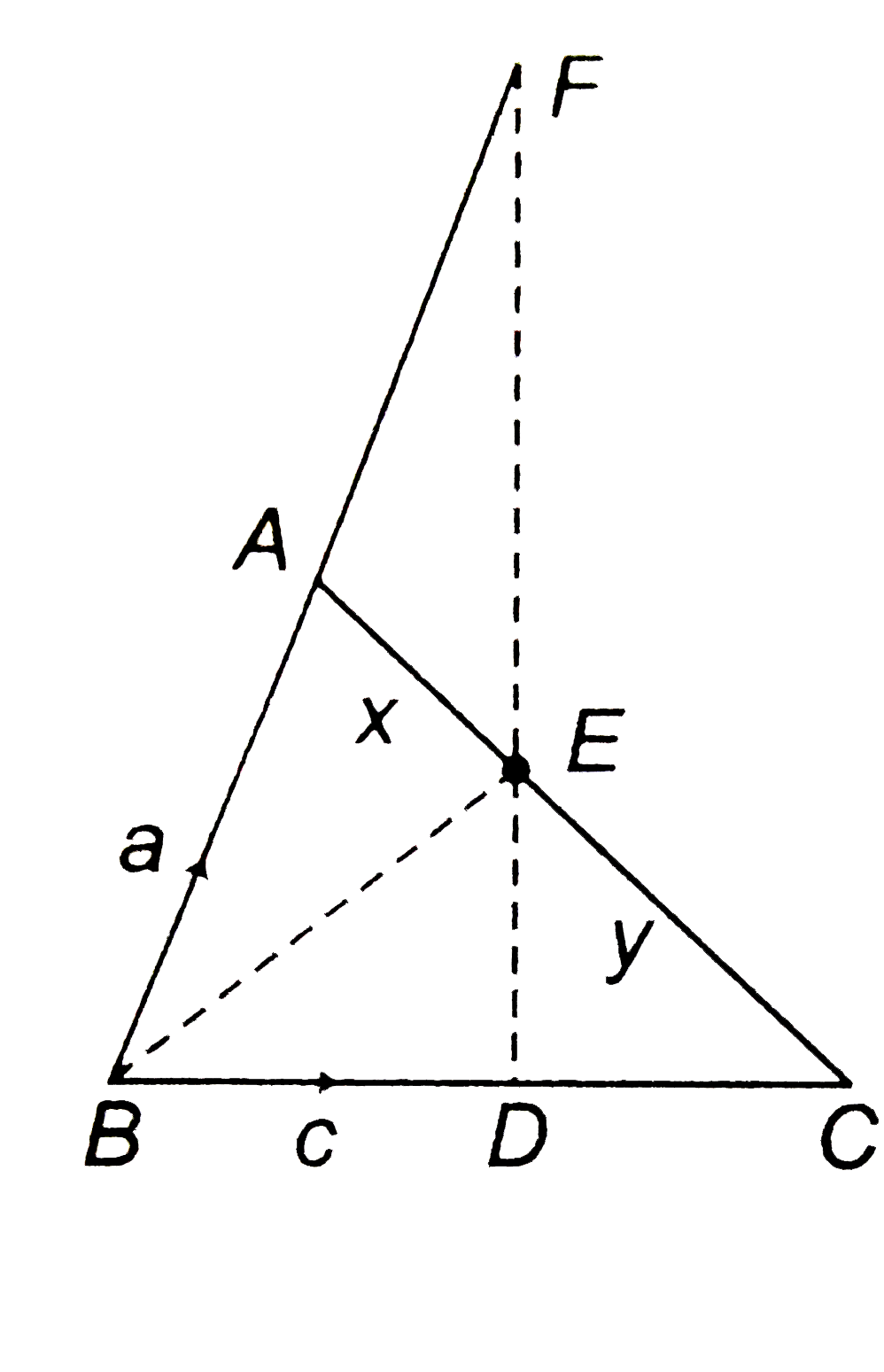
Here, D, E and F be the points on the sides BC,CA and AB respectively of `DeltaABC`. Such that points D,E and F are collinear, be shawn as the adjoining figuece.
Let B as the origin, BA=a and BC=c
The, BF=ka and BD=lc

where, k and l are scalars.
`therefore(BD)/(BC)=l and (BF)/(BA)=k`
`impliesBC:BD=1:l`
`implies(BC)/(BD)-1=(1)/(l)-1implies(DC)/(BD)=(1-l)/(l)`
`implies(BD)/(DC)=(l)/(1-l) and (BA)/(BF)=(1)/(k)`
`implies1-(BA)/(BF)=1-(1)/(k)implies (AF)/(BF)=(k-1)/(k)`
Now, let E divide the line AC in the ratio of x:y
so, that `BE=(xc+ya)/(x+y)=(x*(BD)/(l)+y*(BF)/(k))/(x+y)`
`implies BE-(x)/(l(x+y))BD-(y)/(k(x+y))BF=0`
Since, D,E and F are collinear.
Sum of coefficient must be zero.
hence, `1-(x)/(l(x+y))-(y)/(k(x+y))=0`
`implies(x+y)-(x)/(l)-(y)/(k)=0impliex+y=(x)/(l)+(y)/(k)`
`implies x(1-(1)/(l))=y((1)/(k)-1)impliesx((l-1)/(l))=y((1-k)/(k))`
`implies (l)/(l-1)*(y)/(x)*(k-1)/(k)=1`
`implies(BD)/(DC)*(CE)/(AE)*(AF)/(BF)=1` [using Eqs. (i), (ii) and (iii)].
Promotional Banner

Topper's Solved these Questions

  • VECTOR ALGEBRA

    ARIHANT MATHS|Exercise Exercise For Session 1|7 Videos
  • VECTOR ALGEBRA

    ARIHANT MATHS|Exercise Exercise For Session 2|17 Videos
  • TRIGONOMETRIC FUNCTIONS AND IDENTITIES

    ARIHANT MATHS|Exercise Exercise (Questions Asked In Previous 13 Years Exam)|19 Videos

Similar Questions

Explore conceptually related problems

In triangle A B C ,poin t sD , Ea n dF are taken on the sides B C ,C Aa n dA B , respectigvely, such that (B D)/(D C)=(C E)/(E A)=(A F)/(F B)=ndot Prove that _(D E F)=(n^2-n+1)/((n+1)^2)_(A B C)dot

If D ,E ,F are the mid-points of the sides B C ,C Aa n dA B respectively of a triangle A B C , prove by vector method that A r e aof D E F=1/4(a r e aof A B C)dot

D ,\ E ,\ F are the mid-points of the sides B C ,\ C A and A B respectively of a A B C . Determine the ratio of the areas of D E F and A B C .

If O is a point in space, A B C is a triangle and D , E , F are the mid-points of the sides B C ,C A and A B respectively of the triangle, prove that vec O A + vec O B+ vec O C= vec O D+ vec O E+ vec O Fdot

D ,\ E ,\ F are the mid-point of the sides B C ,\ C A\ a n d\ A B respectively of A B Cdot Then D E F is congruent to triangle. A B C (b) AEF (c) B F D ,\ C D E (d) A F E ,\ B F D ,\ C D E

D ,\ E and F are the points on sides B C ,\ C A and A B respectively of A B C such that A D bisects /_A ,\ \ B E bisects /_B and C F bisects /_C . If A B=5c m ,\ \ B C=8c m and C A=4c m , determine A F ,\ C E and B D .

In a A B C ,\ D ,\ E ,\ F are the mi-points of sides B C ,\ C A\ a n d\ A B respectively. If a r( A B C)=16 c m^2, then a r\ (t r a p e z i u m\ F B C E)= 4\ c m^2 (b) 8\ c m^2 (c) 12 c m^2 (d) 10 c m^2

Let A B C be an isosceles triangle in which A B=A Cdot If D ,\ E ,\ F be the mid-points of the sides B C ,\ C A\ a n d\ A B respectively, show that the segemtn A D\ a n d\ E F bisect each other at right angles.

In a parallelogram A B C D ,E ,F are any two points on the sides A B and B C respectively. Show that a r( A D F)=a r( D C E)dot

In Figure, A B C is a right triangle right angled at A ,\ B C E D ,\ A C F G\ a n d\ A M N are square on the sides B C ,\ C A\ a n d\ A B respectively. Line segment A X\ _|_D E meets B C at Ydot Show that: a r(C Y X E)=a r\ (A C F G)

