Home
Class 11
CHEMISTRY
An electron in the first excited state ...

An electron in the first excited state of if atom obserbed a photon and further excited .The de broglie wavelength of the electron in this state is found to be `13.4Å` Find the wavelength of the photon abserbed by the electron in angstroms Also find the longest and the shorted wavelength emitted when this electron de-excited back to the ground state

Text Solution

Verified by Experts
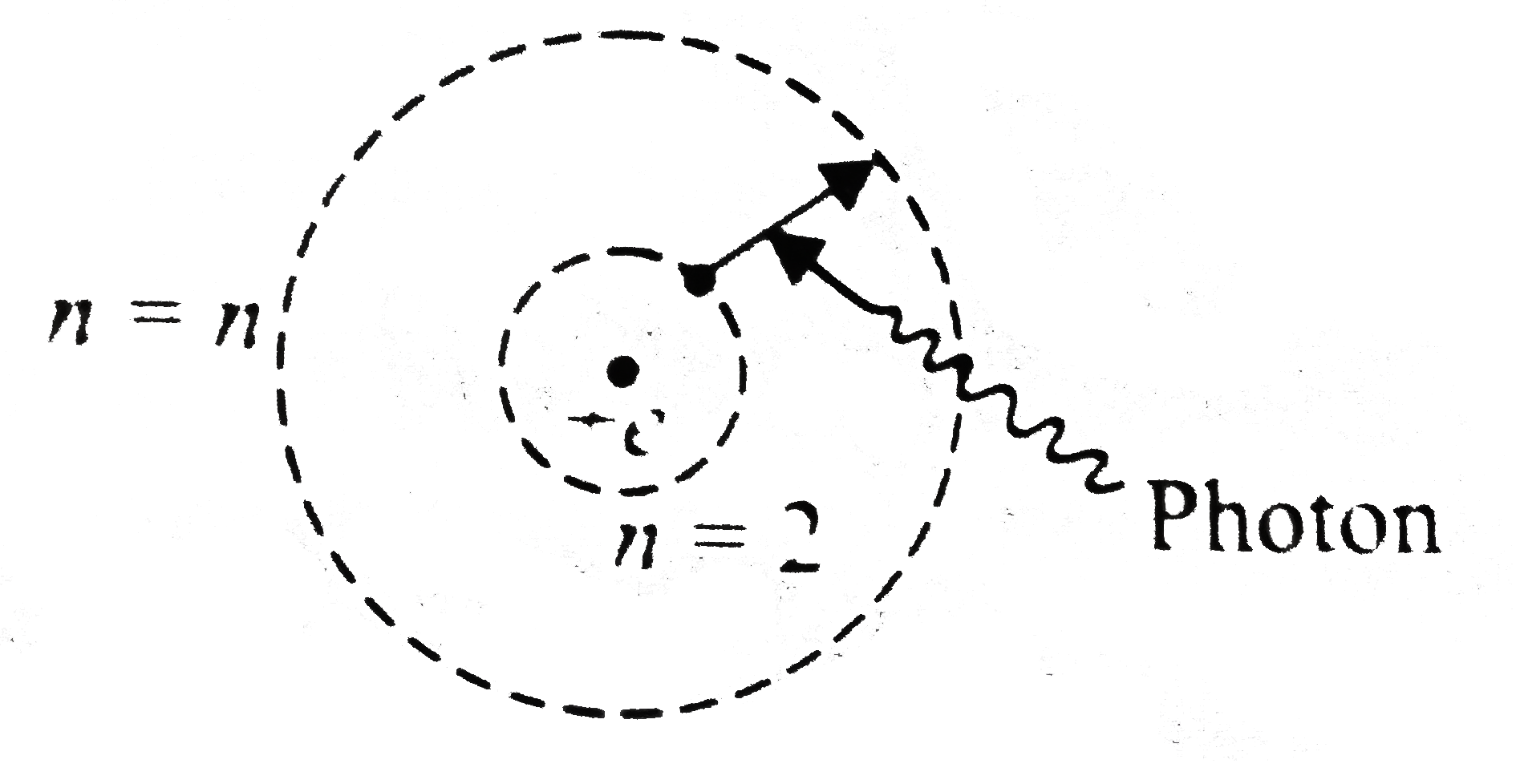
The electron from `n = 2 ` absorted a photon and is further excited to a higher energy lowest (say n)
The electron in this frist level (n) has a de broglie wavelength `(lambda) = 13.4 Å`

`lambda_(e) = (h)/(m_(e)v_(e))`
`and v_(e) = 2.18 xx 10^(6)(Z)/(n) m s^(-1)`
`[v_(A)` "is the velocity of the nth orbit"]
`rArr (6.626 xx 10^(-34))/((13.4 xx 10^(-10)) xx (9.1 xx 10^(-31))) = 2.18 xx 10^(6) xx (1)/(n)`
`rArr n = 4`
Now find the wavelength of the photon respensible for the excitation from `= mn = 2 to n = 4`
Using the relation
` overset(Delta E)underset((2 rarr 4)) = 2.18 xx 10^(-18) Z^(2)((1)/(n_(1)^(2)) - (1)/(n_(2)^(2)))`
`= 4.09 xx 10^(-19)J [n_(1) = 2, n_(2) = 4, Z = 1]`
`rArr = (hc)/(lambda) = 4.09 xx 10^(-19)`
`lambda = 4963.1 Å`
The longest wavelength emitted when this electron (from `n = 4`) falls back to the ground state with correspond to the minimum energy transition
THe transition corresponding to the minimum energy wioll be `4 rarr 3`
The transition corresponding to the maximum energy will be `4 rarr 1`
`Delta E = E_(photon) = (hc)/(lambda) = hv`
`rArr Delta E = (1)/(lambda_("photon")) or Delta E = V_("photon")`
Using the same relation
`Delta E _((4 rarr 3)) = 2.18 xx 10^(-18) Z^(2) ((1)/(n_(1)^(2)) - (1)/(n_(2)^(2))) [ n_(1) = 3, n_(2) = 4, Z = 1]`
`rArr Delta E _((4 rarr 3))= 1.06 xx 10^(-19) J`
`Delta E = E_("photon") = (hc)/(lambda) = 1.06 xx 10^(-19) J`
`rArr = 18752.8 Å`
Shortest wavelength ` 4rarr 1`
`Delta E _((4 rarr 3))= 2.18 xx 10^(-19) xx 1^(2) xx ((1)/(1^(2)) - (1)/(4^(2)))`
`= 2.04 xx 10^(-19) J`
`rArr Delta E _((4 rarr 1))=E_("photon") = (hv)/(lambda)`
`rArr lambda = 973.2 Å`
Promotional Banner

Topper's Solved these Questions

  • ATOMIC STRUCTURE

    CENGAGE CHEMISTRY|Exercise Exercises (Subjective)|52 Videos
  • ATOMIC STRUCTURE

    CENGAGE CHEMISTRY|Exercise Exercises Linked Comprehension|50 Videos
  • APPENDIX - INORGANIC VOLUME 1

    CENGAGE CHEMISTRY|Exercise chapter-7 Single correct answer|1 Videos
  • CHEMICAL BONDING AND MOLECULAR STRUCTURE

    CENGAGE CHEMISTRY|Exercise Archives Subjective|15 Videos

Similar Questions

Explore conceptually related problems

The electron in the first excited state (n_(1)=2) of H - atom absorbs a photon and is further excited to n^(th) shell. The de-Broglie wavelength of the electron in this excited state is 1340 pm. Find the value of n .

The de-Broglie wavelength of electron in gound state of an hydrogen atom is

The de-Broglie wavelength of an electron in the ground state of the hydrogen atom is

An electron, in a hydrogen like atom , is in excited state. It has a total energy of -3.4 eV, find the de-Broglie wavelength of the electron.

If the de broglie wavelength of an electron is 1Å, then the velocity of the electron will be

The de Broglie wavelength of an electron and the wavelength of a photon are same. The ratio between the energy of the photon and the momentum of the electron is

If the radius of the first orbit of the hydrogen atom is 0.53 Å , then the de-Broglie wavelength of the electron in the ground state of hydrogen atom will be

The wavelength of the photon emitted by a hydrogen atom when an electron makes a transition from n = 2 to n = 1 state is :

CENGAGE CHEMISTRY-ATOMIC STRUCTURE-Concept Applicationexercise(4.3)
  1. An electron in the first excited state of if atom obserbed a photon...

    Text Solution

    |

  2. How many quantum number are needed in designate an orbital ? Name the...

    Text Solution

    |

  3. The principal quantum number of n of an atomic orbitals is 5 what are ...

    Text Solution

    |

  4. The azimathal quantum number l of an arbital is 3 what are the possi...

    Text Solution

    |

  5. What is the lowest value of n that allows g orbitals to exist?

    Text Solution

    |

  6. Given the notation for the sub-shell deotected by the following quant...

    Text Solution

    |

  7. How many electron on a fully filled l sub-shell have m(1) = 0 ?

    Text Solution

    |

  8. An electron is in one of this electrons

    Text Solution

    |

  9. If the largest value ofm(1) for an electron is + 3 in what type of su...

    Text Solution

    |

  10. Explain , giving reason , which of the following sets of quantum numbe...

    Text Solution

    |

  11. How many electron in an atom may have the following quantum number ? A...

    Text Solution

    |

  12. How many orbitals are possible in a. 4th energy level b. 5f sub-she...

    Text Solution

    |

  13. What are the possible value of m(1) for the different orbital of a....

    Text Solution

    |

  14. What is the shape 2s orbital .Give two9 point of difference between 1...

    Text Solution

    |

  15. a. How many sub-shell are associated with n = 4? b. How many electr...

    Text Solution

    |

  16. How many spectrical nodal syrface are there in a. a 3s orbital b. a...

    Text Solution

    |

  17. The principal quantum number representwsw

    Text Solution

    |

  18. The energy of an electron of 2p(1) orbital is

    Text Solution

    |

  19. The orbital angular momentum of an electron of an electron in 2s orbit...

    Text Solution

    |

  20. The number of nodals plates of zeroelectron density in the d(xy) orbit...

    Text Solution

    |

