Home
Class 11
CHEMISTRY
One mole of He^(o+) ions is excited .An...

One mole of `He^(o+)` ions is excited .An anaylsis showed that `50%` of ions are in the third energy level `25%` are in the second energy level and the remalining ary in the first energy level .Calculate the energy emitted in kilojoules when all the ions return to the ground state

Text Solution

Verified by Experts
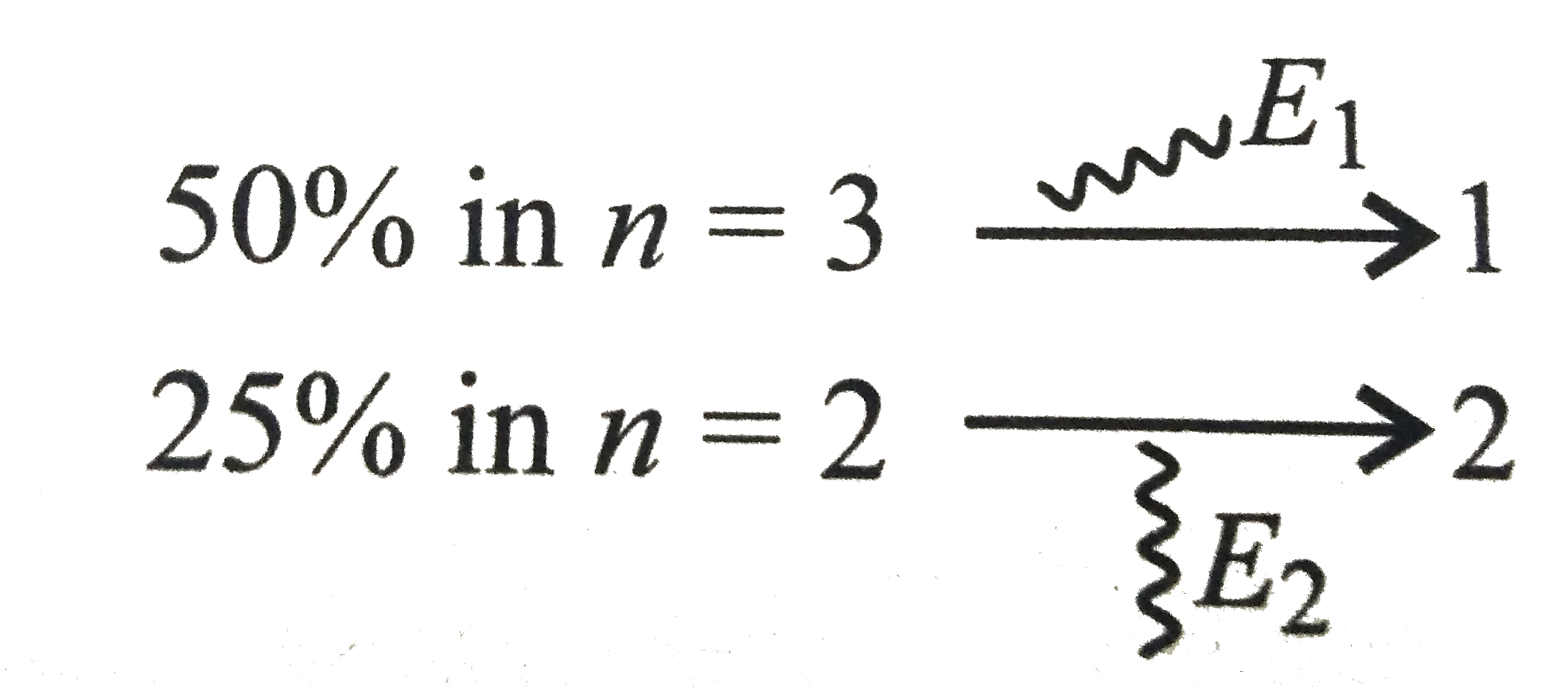

`Delta E = 2.176 xx 10^(-18)Z^(2)[(1)/(1^(2)) - (1)/(n^(2))]1 "per atom" `
Energy released when electron falls to `n = 1 is = {50%[2.176 xx 10^(-18) xx 4(1 - (1)/(9))]`
`+ 25%[2.176 xx 10^(-18) xx 4(1 - (1)/(4))]} xx 6 xx 10^(23) xx 10^(-3)(kJ mol^(-1))`
Promotional Banner

Topper's Solved these Questions

  • ATOMIC STRUCTURE

    CENGAGE CHEMISTRY|Exercise Exercises (Subjective)|52 Videos
  • ATOMIC STRUCTURE

    CENGAGE CHEMISTRY|Exercise Exercises Linked Comprehension|50 Videos
  • APPENDIX - INORGANIC VOLUME 1

    CENGAGE CHEMISTRY|Exercise chapter-7 Single correct answer|1 Videos
  • CHEMICAL BONDING AND MOLECULAR STRUCTURE

    CENGAGE CHEMISTRY|Exercise Archives Subjective|15 Videos

Similar Questions

Explore conceptually related problems

1 mol of He^(+) ion is excited. Spectral analysis showed existence of 50% ions in 3rd level, 25% in 2nd level and remaining 25% in ground state. Ionization energy of He^(+) is 54.4 eV , calculate total energy evolved when all the ions retirn ground state.

1.8 g hydrogen atomic are excited to radiation .The stady of specits indicate that 27% of the atom are is third energy level and 15 % of atom in second energy level and the rest is ground state IP of H is 13.6 eV calculate a. Number of atom present in first and third energy levels b. Total energy envolved when all the atom return to the ground state

1.8 gm of H-atom sample is excited by radiations. The study of spectra indicates that 27% of the atoms are in 3rd energy level, 15% of atoms in 2nd energy level and test in ground state

2g of Hydrogen atoms are excited to radiation. The study of spectra indicated 25% of atoms are in III^(rd) energy level and 20% atoms in II^(nd) energy level and rest in ground state. Calculate the total energy evolved when atoms return to ground state.

The energy level for He^(+) ion atom depends on :

The Bohr of second energy level of He^(o+) ion is ……..nm.

1.8 g hydrogen atoms are excited to raditions . They study of spectra indicates that 27% of the atoms are in 3rd energy level and 15% of atom in 2nd energy level and the rest in ground state .If .I.P.of H is 21.7xx10^(-8) erg . Calcute- (i) No. the atoms present in III & II energy level . (ii) Total energy evolved when all the atoms when all the atoms return to ground state.

Calculate the energy of a He^(+)ion in its first excited state solution

If nuclecus in an excited state fall to a lower energy level, energy is emitted as :

CENGAGE CHEMISTRY-ATOMIC STRUCTURE-Concept Applicationexercise(4.3)
  1. One mole of He^(o+) ions is excited .An anaylsis showed that 50% of...

    Text Solution

    |

  2. How many quantum number are needed in designate an orbital ? Name the...

    Text Solution

    |

  3. The principal quantum number of n of an atomic orbitals is 5 what are ...

    Text Solution

    |

  4. The azimathal quantum number l of an arbital is 3 what are the possi...

    Text Solution

    |

  5. What is the lowest value of n that allows g orbitals to exist?

    Text Solution

    |

  6. Given the notation for the sub-shell deotected by the following quant...

    Text Solution

    |

  7. How many electron on a fully filled l sub-shell have m(1) = 0 ?

    Text Solution

    |

  8. An electron is in one of this electrons

    Text Solution

    |

  9. If the largest value ofm(1) for an electron is + 3 in what type of su...

    Text Solution

    |

  10. Explain , giving reason , which of the following sets of quantum numbe...

    Text Solution

    |

  11. How many electron in an atom may have the following quantum number ? A...

    Text Solution

    |

  12. How many orbitals are possible in a. 4th energy level b. 5f sub-she...

    Text Solution

    |

  13. What are the possible value of m(1) for the different orbital of a....

    Text Solution

    |

  14. What is the shape 2s orbital .Give two9 point of difference between 1...

    Text Solution

    |

  15. a. How many sub-shell are associated with n = 4? b. How many electr...

    Text Solution

    |

  16. How many spectrical nodal syrface are there in a. a 3s orbital b. a...

    Text Solution

    |

  17. The principal quantum number representwsw

    Text Solution

    |

  18. The energy of an electron of 2p(1) orbital is

    Text Solution

    |

  19. The orbital angular momentum of an electron of an electron in 2s orbit...

    Text Solution

    |

  20. The number of nodals plates of zeroelectron density in the d(xy) orbit...

    Text Solution

    |

