Home
Class 11
CHEMISTRY
Write the electronic configuration of th...

Write the electronic configuration of the following species Also and find the number of unpaired electron is each
`Fe,Fe^(2+),Fe^(3+)(Z of Fe = 26)`
b. `Br,Br^(Theta)(Z of Br = 35)`
`V,V^(3+)(Z of V = 23)`

Text Solution

Verified by Experts
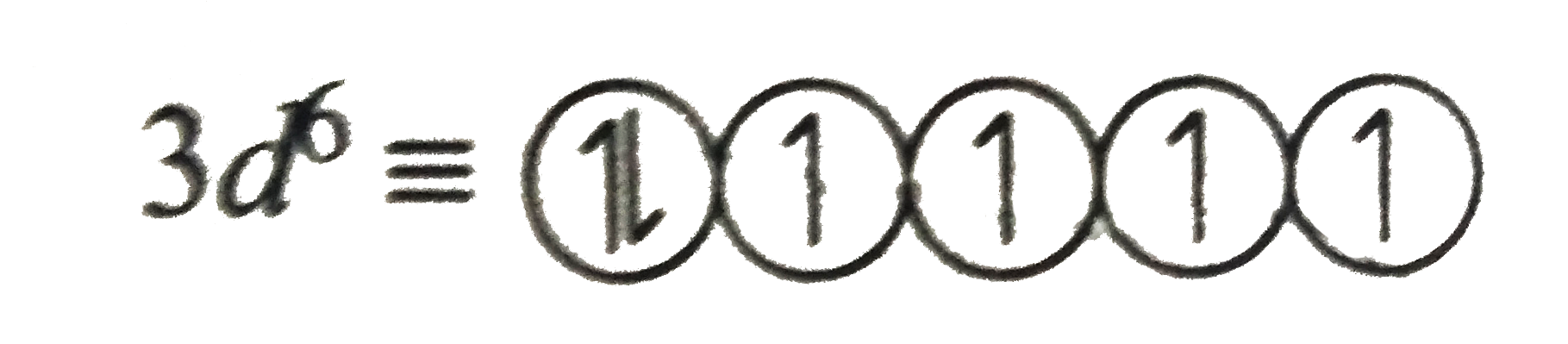
Follow the orde0r of increasing energy (authan rule)
`1s^(2)2s2p3s 4s 3p 4d 5s 4d….`
Note that `3d`1 per hand's rule

Cleraly , the number of unpaired electron is `4`
`Fe^(2+) (Z = 26)` [Number of electrons `= 24]`
White writing the electronic configuration of cation remove the desired number of electrons from the cutermost orbital
In `Fe^(2+)` rem,ove` 2e^(-)` from `4s^(2)` since `4s` orbit (through lower in energy than `3d)` is the outermost .Hence , the configuration of `Fe^(2+)` is ` 1s^(2)2s^(2)2p 2p^(6)3d^(6)4s^(0)`
Note that the number of unpaired electron remains same as that is `Fe i.e. 4`
`Fe^(3+)(Z = 26)` [Number of electron `= 23]`
Note remove `2s` from `4s^(2)` and `3d^(6)` to get the electronic configuration `1s^(2)s^(2)2p 2p^(6)3d^(6)4s^(0)`
Note the now all d orbital have an odd electron (i.e. are half filted)

Hence the number of unpaired electron in `Fe^(2+)` is `5`
b. `Br(Z = 35)`
Following nuthan rule , the unpaired configuration is `1s^(2)s^(2)2p^(6)3p^(6)3d^(10)4s^(2)4p^(5)`Clearly one of `4p^(2)` orbotal contain unpaired electron
`4p^(3)-= (##V_PHY_CHM_P1_C04_S01_328_S03.png" width="80%">
Orbital filled as pe r hund's rule
Hence Br has only one unpaired electron
`Br^(2)(Z = 36)`
Since anion (s) is (are) formedby adding electron (s) so simple write the electron configuration as per the total number of electron is
`1s^(2)2s^(2)2p^(6)3p^(6)3s^(23d^(10)4s^(2)4p^(6)`
Clearly there are no unpaired electron
Following the patterns in (a) we can write the electronic configuration for V as follows :
`V(Z = 23) :1s^(2)2s^(2)2p^(6)3s^(2)3p^(6)4s^(2)3d^(8)`
`3d^(8) = (##V_PHY_CHM_P1_C04_S01_328_S04.png" width="80%">
Orbital filled as per hund's rule
There unpaired electron
`V^(3+)(Z = 20)`
Remve `3e` from the outemost orbital successsivelly i.e. `2e^(-)` from `4s^(2)` and i.e. from `3d^(5)` Hence the electronic configuration of `V^(3+)` is
`1s^(2)2s^(2)2p^(6)3s^(6)3p^(6)4s^(0)3d^(2)`

Orbital filled as per Hend's rule
Two unpaired electron
Promotional Banner

Topper's Solved these Questions

  • ATOMIC STRUCTURE

    CENGAGE CHEMISTRY|Exercise Exercises (Subjective)|52 Videos
  • ATOMIC STRUCTURE

    CENGAGE CHEMISTRY|Exercise Exercises Linked Comprehension|50 Videos
  • APPENDIX - INORGANIC VOLUME 1

    CENGAGE CHEMISTRY|Exercise chapter-7 Single correct answer|1 Videos
  • CHEMICAL BONDING AND MOLECULAR STRUCTURE

    CENGAGE CHEMISTRY|Exercise Archives Subjective|15 Videos

Similar Questions

Explore conceptually related problems

Number of unpaired electrons in Fe^(2+) ion is

What is the number of unpaired electrons in (i) Fe^(3+) (ii) Cu^(+) ?

Number of unpaired electrons in Fe^(3+) (Z = 26) is

Write the electronic configurations and predict the number of unpaired electrons in the following : (i) Cr (Z = 24) (ii) Fe(Z = 26)

Write the electronic configuration and number of unpaired electrons in Fe^(2+) ion.

The number of d-electrons retained in Fe^(2+) (At. no. of Fe = 26) ions is

Find the number of unpaired electrons in e_(g) orbital of Fe in K_(4)[Fe(CN)_(6)]

CENGAGE CHEMISTRY-ATOMIC STRUCTURE-Concept Applicationexercise(4.3)
  1. Write the electronic configuration of the following species Also and f...

    Text Solution

    |

  2. How many quantum number are needed in designate an orbital ? Name the...

    Text Solution

    |

  3. The principal quantum number of n of an atomic orbitals is 5 what are ...

    Text Solution

    |

  4. The azimathal quantum number l of an arbital is 3 what are the possi...

    Text Solution

    |

  5. What is the lowest value of n that allows g orbitals to exist?

    Text Solution

    |

  6. Given the notation for the sub-shell deotected by the following quant...

    Text Solution

    |

  7. How many electron on a fully filled l sub-shell have m(1) = 0 ?

    Text Solution

    |

  8. An electron is in one of this electrons

    Text Solution

    |

  9. If the largest value ofm(1) for an electron is + 3 in what type of su...

    Text Solution

    |

  10. Explain , giving reason , which of the following sets of quantum numbe...

    Text Solution

    |

  11. How many electron in an atom may have the following quantum number ? A...

    Text Solution

    |

  12. How many orbitals are possible in a. 4th energy level b. 5f sub-she...

    Text Solution

    |

  13. What are the possible value of m(1) for the different orbital of a....

    Text Solution

    |

  14. What is the shape 2s orbital .Give two9 point of difference between 1...

    Text Solution

    |

  15. a. How many sub-shell are associated with n = 4? b. How many electr...

    Text Solution

    |

  16. How many spectrical nodal syrface are there in a. a 3s orbital b. a...

    Text Solution

    |

  17. The principal quantum number representwsw

    Text Solution

    |

  18. The energy of an electron of 2p(1) orbital is

    Text Solution

    |

  19. The orbital angular momentum of an electron of an electron in 2s orbit...

    Text Solution

    |

  20. The number of nodals plates of zeroelectron density in the d(xy) orbit...

    Text Solution

    |