Home
Class 11
CHEMISTRY
Two gases in adjoining vessels were brou...

Two gases in adjoining vessels were brought into correct by opening a stopcock between them. The one vessel measured `0.25 L` and contained `NO` gas at `800` torr and `220 K`, the other measured `0.1 L` contained `O_(2)` gas at `600` torr and `220 K`. The reaction to form `N_(2)O_(4)(s)` exhausts the limiting reagent completely,
(`a`) Neglacting the vapour pressure of `N_(2)O`, what is the pressure of the gas remaining at `220 K` after complection of the reaction?
(`b`) What weight of `N_(2)O` is formed?

Text Solution

Verified by Experts
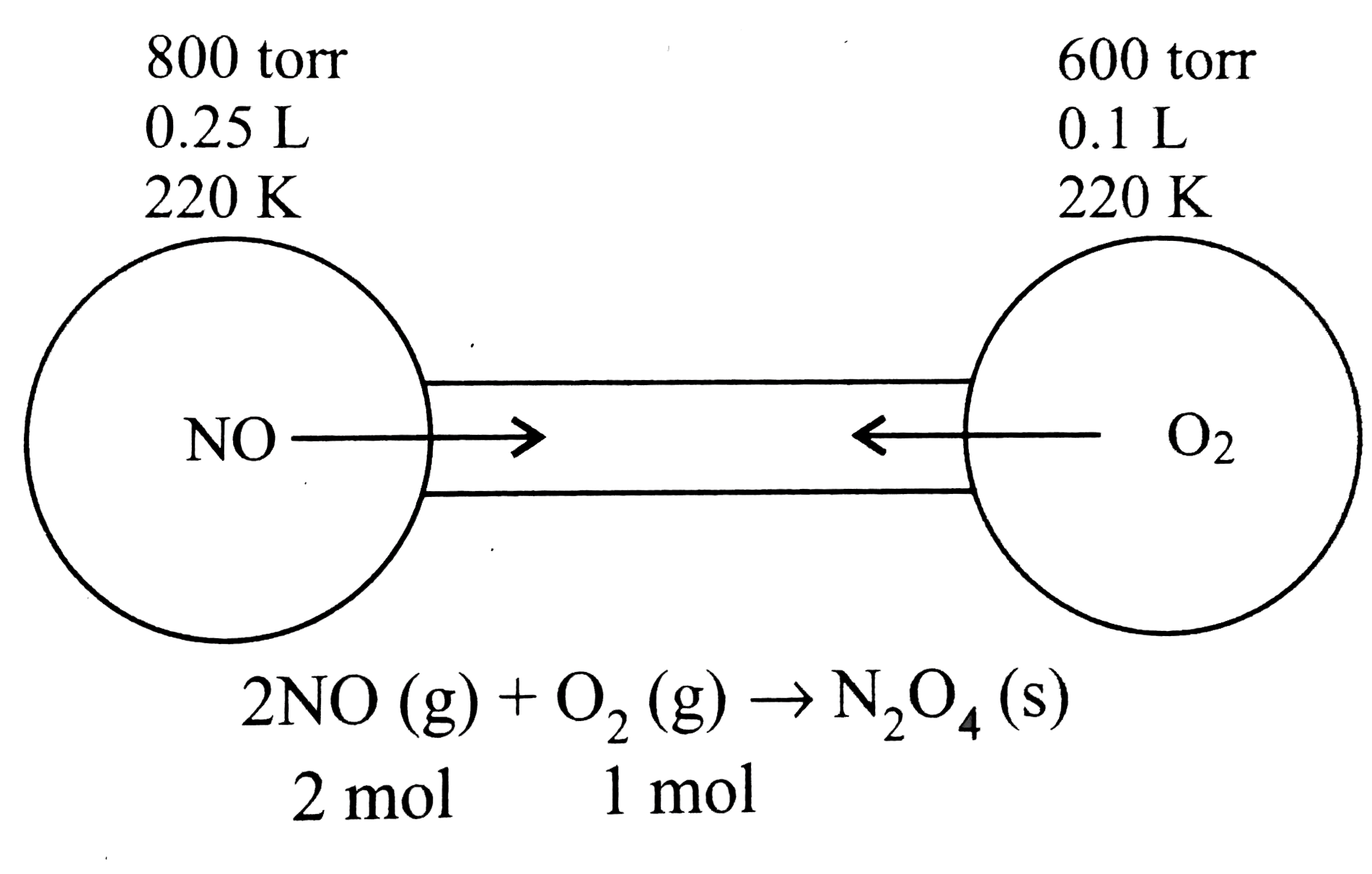

`n_(NO)=(800//760xx0.25)/(0.821xx220)=0.0146`
and
`n_(O_(2))=(600//760xx0.1)/(0.0821xx220)=4.37xx10^(-3)`
moles of `NO` used `=2xx4.37xx10^(-3)`
moles of `NO` left `=0.0146-2xx4.37xx10^(-3)`
`=5.86xx10^(-3)`
Final volume `=0.1+0.25=0.35 L`
`P` due to `NO` left `=(5.86xx10^(-3))/(0.35)xx0.0821xx220=0.3 atm`
Now, find mass of `N_(2)O_(4)`
`1 mol` of `O_(2)=1 mol` of `N_(2)O_(4)=4.37xx10^(-3)`
`=92xx4.37xx10^(-3)=0.402 g`
Promotional Banner

Topper's Solved these Questions

  • STATES OF MATTER

    CENGAGE CHEMISTRY|Exercise Exercises|21 Videos
  • STATES OF MATTER

    CENGAGE CHEMISTRY|Exercise Exercises (Linked Comprehensive)|48 Videos
  • SOME BASIC CONCEPTS AND MOLE CONCEPT

    CENGAGE CHEMISTRY|Exercise Archives Subjective|11 Videos
  • STOICHIOMETRY

    CENGAGE CHEMISTRY|Exercise Archives Subjective|33 Videos

Similar Questions

Explore conceptually related problems

Pressure of a gas in a vessel can be measured by

821mLN_(2) (g) was collected over liquid water at 300 K and 1 atm.If vapour pressure of H_(2)O is 30 torr then moles of N_(2) (g) in moist gas mixture is :

A vessel of 5 litre capacity maintained at 27^(@)C" was filled with 16g of "O_(2)gas. Calculate the pressure of the gas in atmospheres in the container.

A and B are two idential vessels. A contains 15 g ethane at 1 atm and 298 K . The vessel B contains 75 g of a gas X_(2) at same temperature and pressure. The vapour density of X_(2) is :

At room temperature, the following reaction proceeds nearly to completion: 2NO+O_(2)to2NO_(2)toN_(2)O_(4) The dimer, N_(2)O_(4) , solidfies at 262 K . A 250 mL flask and a 100 mL flask are separated by a stopcock. At 300 K , the nitric oxide in the larger flask exerts a pressure of 1.053 atm and the smaller one contains oxygen at 0.789 atm . The gase are mixed by opening the stopcock and after the end of the reaction the flasks are cooled to 220 K . Neglecting the vapour pressure of the dimer, find out the pressure and composition of the gas remaining at 220 K . (Assume the gases to behave ideally)

The pressure of sodium vapour in a 1.0 L container is 10 torr at 1000^(@)C . How many atoms are in the container?

CENGAGE CHEMISTRY-STATES OF MATTER-Exercises (Ture False)
  1. Two gases in adjoining vessels were brought into correct by opening a ...

    Text Solution

    |

  2. In the van der Waals equation (P + (n^(2)a)/(V^(2)))(V - nb) = nRT ...

    Text Solution

    |

  3. Kinetic energy of a molecule is zero at 0^(@)C

    Text Solution

    |

  4. A gas in a closed container will exert much higher pressure due to gra...

    Text Solution

    |

  5. The graph between PV vs P at constant temperature is linear parallel t...

    Text Solution

    |

  6. Real gases show deviation from ideal behaviour at low temperature and ...

    Text Solution

    |

  7. In the microscopic model of the gas, all the moleculer are supposed to...

    Text Solution

    |

  8. For real gases, at high temperature Z = 0 small value of a means gas...

    Text Solution

    |

  9. Small value of a means, gas can be easily liqueifed.

    Text Solution

    |

  10. Rate of diffusion is directly proportional to the square root of molec...

    Text Solution

    |

  11. For ideal gases, Z = 1 at all temperature and pressure.

    Text Solution

    |

  12. According to charles's law,

    Text Solution

    |

  13. The pressure of moist gas is higher than pressure of dry gas.

    Text Solution

    |

  14. Gases do not occupy volume and do not have force of attraction.

    Text Solution

    |

  15. The van der Waal equation of gas is (P + (n^(2)a)/(V^(2))) (V - nb)...

    Text Solution

    |

  16. Surface tension and surface energy have different dimensions.

    Text Solution

    |

  17. The plot of PV vs P at particular temperature is called isovbar.

    Text Solution

    |

  18. Equal volume of all gases always contains equal number of moles.

    Text Solution

    |

  19. A gas with a = 0 cannot be liquified.

    Text Solution

    |

  20. The van der waals constants have same values for all the gases.

    Text Solution

    |

  21. All the molecules in a given sample of gas move with same speed.

    Text Solution

    |

