Home
Class 11
CHEMISTRY
A gas is expanded from volume V(1) to V(...

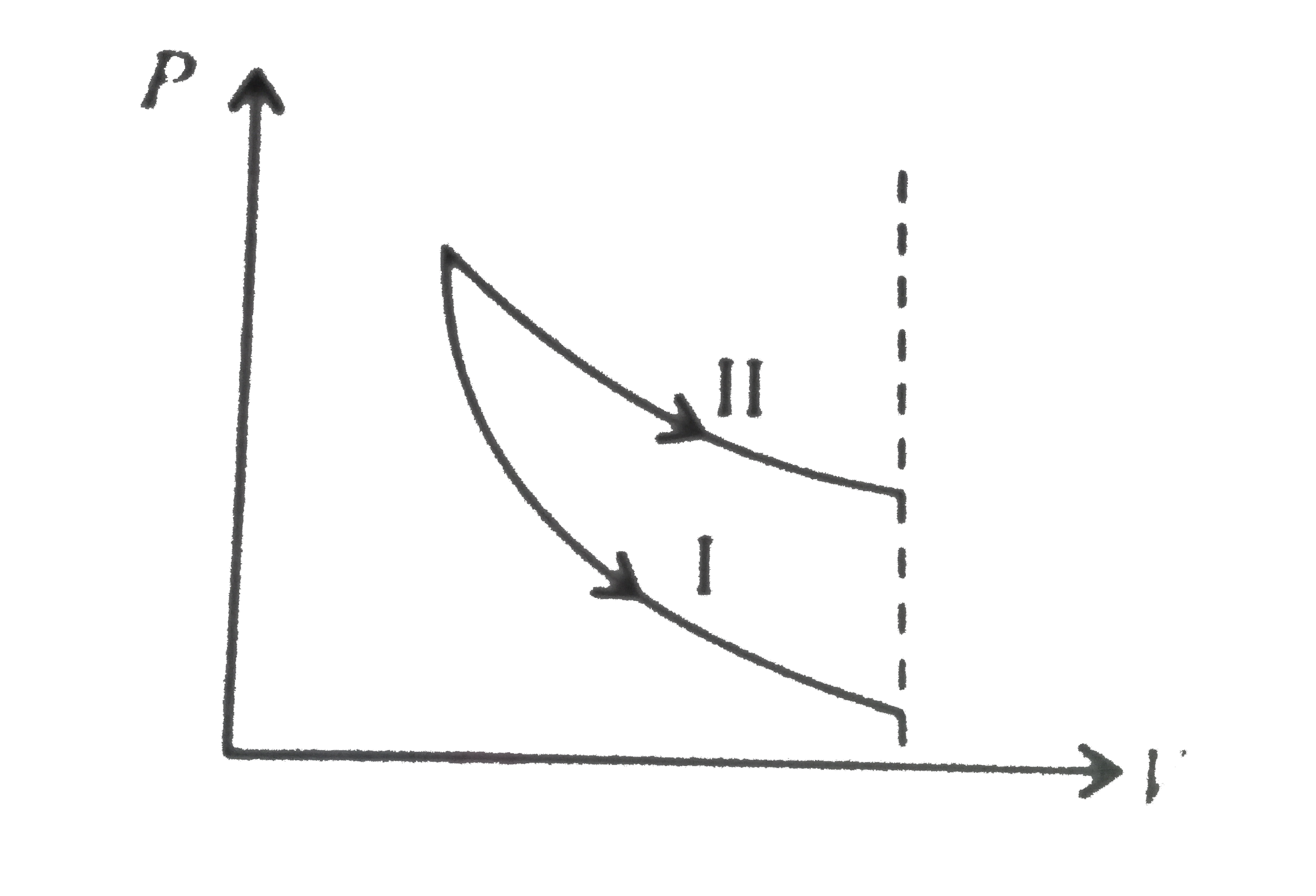
A gas is expanded from volume `V_(1)` to `V_(2` through three different process:
a. Reversible adiabatic
b. Reversible isothermal
c. Irreversible adiabatic (against a constant external pressure `P_(ex))`
The correct option is

A

`[(T_(f))_(Gas)]_("Reversible isothermal") gt [(T_(f))_(GaS)]_("Reversible adiabatic") gt [(T_(f))_(Gas)]_("Irreversible adiabatic")`

B

`[(T_(f))_(Gas)]_("Reversible isothermal") gt [(T_(f))_(GaS)]_("Irreversible adiabatic") gt [(T_(f))_(Gas)]_("Reversible adiabatic")`

C

`w_("Reversible isothermal ")gtw_("Irreversible adiabatic") gt w_("Reversible adiabatic")`

D

`(P_(f))_("Reversible isothermal")gt (P_(f))_("Reversible adiabatic") gt (P_(f))_("Irreversible adiabatic")`

Text Solution

Verified by Experts

`w_("Isothermal") gt w_("Adiabatic")` and `w_(Rev.) gt W_(Irr.) `
`(Rev.)(II) (Rev.)(I)`

`rArr W_("Rev.isothermal") gt W_("Rev.adiabatic") gt W_("irr.adiabatic")`
In adiabatic expansion, `T darr`. More is the work done by the gas, more is the decrease in `T`.
(`:'` Work is being done at the expense of `DeltaU)`
Promotional Banner

Topper's Solved these Questions

  • THERMODYNAMICS

    CENGAGE CHEMISTRY|Exercise Ex 6.1|26 Videos
  • THERMODYNAMICS

    CENGAGE CHEMISTRY|Exercise Ex 6.2|27 Videos
  • STOICHIOMETRY

    CENGAGE CHEMISTRY|Exercise Archives Subjective|33 Videos

Similar Questions

Explore conceptually related problems

The ratio of slopes of P-V plots for reversible adiabatic process and reversible isothermal process of an ideal gas is equal to :

A gaseous sample is generally allowed to do only expansion // compression type work against its surroundings The work done in case of an irreversible expansion ( in the intermediate stages of expansion // compression the states of gases are not defined). The work done can be calculated using dw= -P_(ext)dV while in case of reversible process the work done can be calculated using dw= -PdV where P is pressure of gas at some intermediate stages. Like for an isothermal reversible process. Since P=(nRT)/(V) , so w=intdW= - underset(v_(i))overset(v_(f))int(nRT)/(V).dV= -nRT ln(V_(f)/(V_(i))) Since dw= PdV so magnitude of work done can also be calculated by calculating the area under the PV curve of the reversible process in PV diagram. If four identical samples of an ideal gas initially at similar state (P_(0),V_(0),T_(0)) are allowed to expand to double their volumes by four different process. I: by isothermal irreversible process II: by reversible process having equation P^(2)V= constant III. by reversible adiabatic process IV. by irreversible adiabatic expansion against constant external pressure. Then, in the graph shown in the final state is represented by four different points then, the correct match can be

A gas is expanded form volume V_(0) to 2V_(0) under three different processes as shown in the figure . Process 1 is isobaric process process 2 is isothermal and and process 3 is adiabatic . Let DeltaU_(1),DeltaU_(2) and DeltaU_(3) be the change in internal energy of the gs in these three processes then

A gas expands under constant pressure P from volume V_(1) to V_(2) The work done by the gas is

Select the correct statement for an ideal gas undergoinf reversible or irreversible adiabatic process from same initial process

CENGAGE CHEMISTRY-THERMODYNAMICS-Archives (Subjective)
  1. A gas is expanded from volume V(1) to V(2 through three different proc...

    Text Solution

    |

  2. The enthalpies for the following reactions (DeltaH^(Theta)) at 25^(@)C...

    Text Solution

    |

  3. The standared enthalpies of formation at 298K for C C1(g), H(2)O(g), C...

    Text Solution

    |

  4. Given that: i. C(s) + O(2)(g) rarr CO(2)(g) , DeltaH =- 94.05 kcal ...

    Text Solution

    |

  5. The following statements is true only under some specific conditions. ...

    Text Solution

    |

  6. The bond dissociation energies of gaseous H(2),C1(2), and HC1 are 100,...

    Text Solution

    |

  7. The standard molar heats of formation of ethane, carbon dioxide, and l...

    Text Solution

    |

  8. An intimate mixture of ferric oxide and aluminium is used as solid fue...

    Text Solution

    |

  9. The standard ethelpy of combustion at 25^(@)C of hydrogen, cyclohexene...

    Text Solution

    |

  10. Using the data ( all vaues in kcal mol^(-1) at 25^(@)C) given below, c...

    Text Solution

    |

  11. Determine enthalpy change for, C(3)H(8(g))+H(2(g))rarr C(2)H(6(g))+C...

    Text Solution

    |

  12. Compute the heat of formation of liquie methyl alcohol is kilojoule pe...

    Text Solution

    |

  13. From the following data, calculate the enthalpy change for the combust...

    Text Solution

    |

  14. The standard heat of formation values of SF(6)(g), S(g), and F(g) are ...

    Text Solution

    |

  15. Show that the reaction CO(g) +(1//2)O(2)(g) rarr CO(2)(g) at 300K ...

    Text Solution

    |

  16. A sample of argon gas at 1atm pressure and 27^(@)C expands reversibly ...

    Text Solution

    |

  17. Diborane is a potential rocket fuel that undergoes combustion accordin...

    Text Solution

    |

  18. The standard potential of the following cell is 0.23V at 15^(@)C and 0...

    Text Solution

    |

  19. When 1pentyne (A) is treated with 4N alcoholic KOH at 175^(@)C, it is ...

    Text Solution

    |

  20. Two moles of a perfect gas undergo the following processes: a. A rev...

    Text Solution

    |

  21. C(v) values of He is always (3R)/(2) but C(v) values of H(2) is (3R)/(...

    Text Solution

    |