Home
Class 11
CHEMISTRY
For an ideal gas, an illustratio of thre...

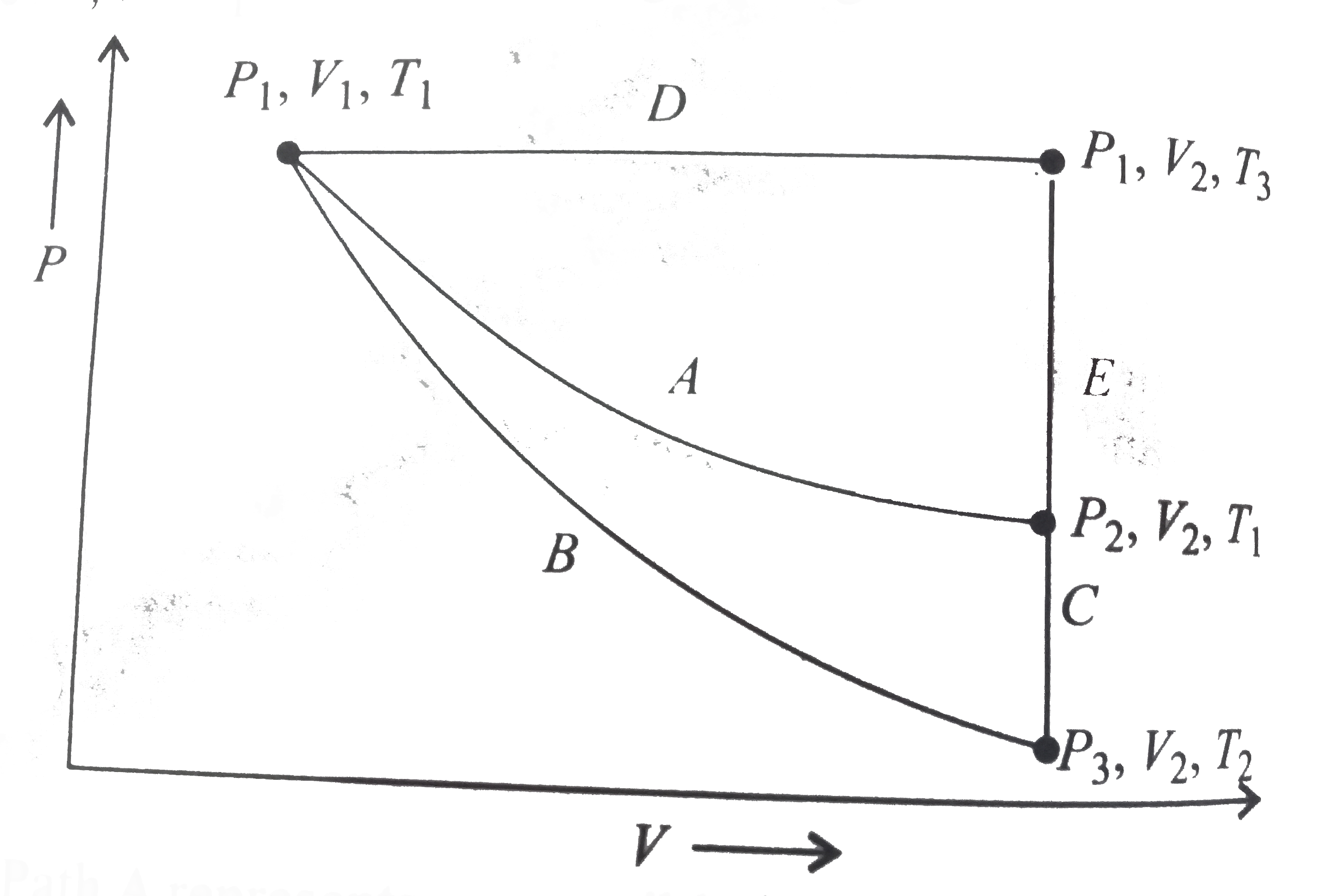
For an ideal gas, an illustratio of three different paths `A(B+C)` and `(D+E)` from an initial state `P_(1), V_(1), T_(1)` to a final state `P_(2), V_(2),T_(1)` is shown in the given figure.

Path `A`represents a reversible isothermal expansion form `P_(1),V_(1)` to `P_(2),V_(2)`, Path `(B+C)` represents a reversible adiabatic expansion `(B)` from `P_(1),V_(1),T_(1)to P_(3),V_(2),T_(2)` followed by reversible heating the gas at constant volume `(C)`from `P_(3),V_(2),T_(2)` to `P_(2),V_(2),T_(1)`. Path `(D+E)` represents a reversible expansion at constant pressure `P_(1)(D)` from `P_(1),V_(1),T_(1)` to `P_(1),V_(2),T_(3)` followed by a reversible cooling at constant volume `V_(2)(E)` from `P_(1),V_(2),T_(3) to P_(2),V_(2),T_(1)`.
What is `q_(rev)`, for path `(D+E)`?

A

`P(V_(2)-V_(1))`

B

`int_(T_(3))^(T_(1)) (C_(V)(T))/(T)dT`

C

`nRIn(V_(2))/(V_(1))`

D

`int_(T_(1))^(T_(3)) C_(V)(T)dT`

Text Solution

Verified by Experts

`w =q = P_(1) (V_(2) -V_(1))`
Promotional Banner

Topper's Solved these Questions

  • THERMODYNAMICS

    CENGAGE CHEMISTRY|Exercise Exercises (Multiple Correct)|50 Videos
  • THERMODYNAMICS

    CENGAGE CHEMISTRY|Exercise Exercises (Single Correct)|62 Videos
  • THERMODYNAMICS

    CENGAGE CHEMISTRY|Exercise Exercises (Subjective)|70 Videos
  • STOICHIOMETRY

    CENGAGE CHEMISTRY|Exercise Archives Subjective|33 Videos

Similar Questions

Explore conceptually related problems

For an ideal gas, an illustratio of three different paths A(B+C) and (D+E) from an initial state P_(1), V_(1), T_(1) to a final state P_(2), V_(2),T_(1) is shown in the given figure. Path A represents a reversible isothermal expansion form P_(1),V_(1) to P_(2),V_(2) , Path (B+C) represents a reversible adiabatic expansion (B) from P_(1),V_(1),T_(1)to P_(3),V_(2),T_(2) followed by reversible heating the gas at constant volume (C) from P_(3),V_(2),T_(2) to P_(2),V_(2),T_(1) . Path (D+E) represents a reversible expansion at constant pressure P_(1)(D) from P_(1),V_(1),T_(1) to P_(1),V_(2),T_(3) followed by a reversible cooling at constant volume V_(2)(E) from P_(1),V_(2),T_(3) to P_(2),V_(2),T_(1) . What is DeltaS for path (D +E) ?

For an ideal gas, an illustratio of three different paths A(B+C) and (D+E) from an initial state P_(1), V_(1), T_(1) to a final state P_(2), V_(2),T_(1) is shown in the given figure. Path A represents a reversible isothermal expansion form P_(1),V_(1) to P_(2),V_(2) , Path (B+C) represents a reversible adiabatic expansion (B) from P_(1),V_(1),T_(1)to P_(3),V_(2),T_(2) followed by reversible heating the gas at constant volume (C) from P_(3),V_(2),T_(2) to P_(2),V_(2),T_(1) . Path (D+E) represents a reversible expansion at constant pressure P_(1)(D) from P_(1),V_(1),T_(1) to P_(1),V_(2),T_(3) followed by a reversible cooling at constant volume V_(2)(E) from P_(1),V_(2),T_(3) to P_(2),V_(2),T_(1) . What is DeltaS for path A ?

For an ideal gas, an illustration of the different paths, A (B + C) and (D + E) from an intial state P_(1), V_(1), T_(1) to a final state P_(2), V_(2), T_(1) as shown in the given figure. Path (A) represents a reversible isothernal expanison from P_(1)V_(1) to P_(2)V_(2) . Path (B + C) represents a reversible adiabatic expansion (B) from P_(1), V_(1), T_(1) to P_(3), V_(2), T_(2) followed by reversible heating the gas at constant volume (C) from P_(3), V_(2), T_(2) to P_(2), V_(2) T_(1) to P_(1) , V_(2), T_(3) followed by reversible cooling at a constant volume V_(2) (E) from P_(1), V_(2), T_(3) to P_(2), V_(2), T_(1) What is Delta S for path (D + E) ?

A gas with (c_(p))/(c_(V))=gamma goes from an intial state (p_(1), V_(1), T_(1)) to a final state (p_(2), V_(2), T_(2)) through an adiabatic process. The work done by the gas is

A system changes from the state (P_(1), V_(1)) to (P_(2) , V_(2)) as shown in the figure below. What is the work done by the system –

In an adiabatic process, the state of a gas is changed from P_(1),V_(1),T_(1), "to" P_(2),V_(2),T_(2). Which of the following relation is correct

CENGAGE CHEMISTRY-THERMODYNAMICS-Exercises (Linked Comprehension)
  1. For an ideal gas, an illustratio of three different paths A(B+C) and (...

    Text Solution

    |

  2. For an ideal gas, an illustratio of three different paths A(B+C) and (...

    Text Solution

    |

  3. For an ideal gas, an illustratio of three different paths A(B+C) and (...

    Text Solution

    |

  4. For an ideal gas, an illustratio of three different paths A(B+C) and (...

    Text Solution

    |

  5. Concrete is produced form a mixture of cement, water and small stones....

    Text Solution

    |

  6. Concrete is produced form a mixture of cement, water and small stones....

    Text Solution

    |

  7. Concrete is produced form a mixture of cement, water and small stones....

    Text Solution

    |

  8. Concrete is produced form a mixture of cement, water and small stones....

    Text Solution

    |

  9. Concrete is produced form a mixture of cement, water and small stones....

    Text Solution

    |

  10. A sample of ideal gas undergoes isothermal expansion in a reversible m...

    Text Solution

    |

  11. A sample of ideal gas undergoes isothermal expansion in a reversible m...

    Text Solution

    |

  12. A sample of ideal gas undergoes isothermal expansion in a reversible m...

    Text Solution

    |

  13. A sample of ideal gas undergoes isothermal expansion in a reversible m...

    Text Solution

    |

  14. A sample of ideal gas undergoes isothermal expansion in a reversible m...

    Text Solution

    |

  15. Free enegry , G = H - TS, is state function that indicates whther a re...

    Text Solution

    |

  16. Free enegry , G = H - TS, is state function that indicates whther a re...

    Text Solution

    |

  17. Free enegry , G = H - TS, is state function that indicates whther a re...

    Text Solution

    |

  18. Free enegry , G = H - TS, is state function that indicates whther a re...

    Text Solution

    |

  19. Free enegry , G = H - TS, is state function that indicates whther a re...

    Text Solution

    |

  20. The state of a mole of an ideal gas changed from state A at pressure 2...

    Text Solution

    |

