Home
Class 11
CHEMISTRY
The state of a mole of an ideal gas chan...

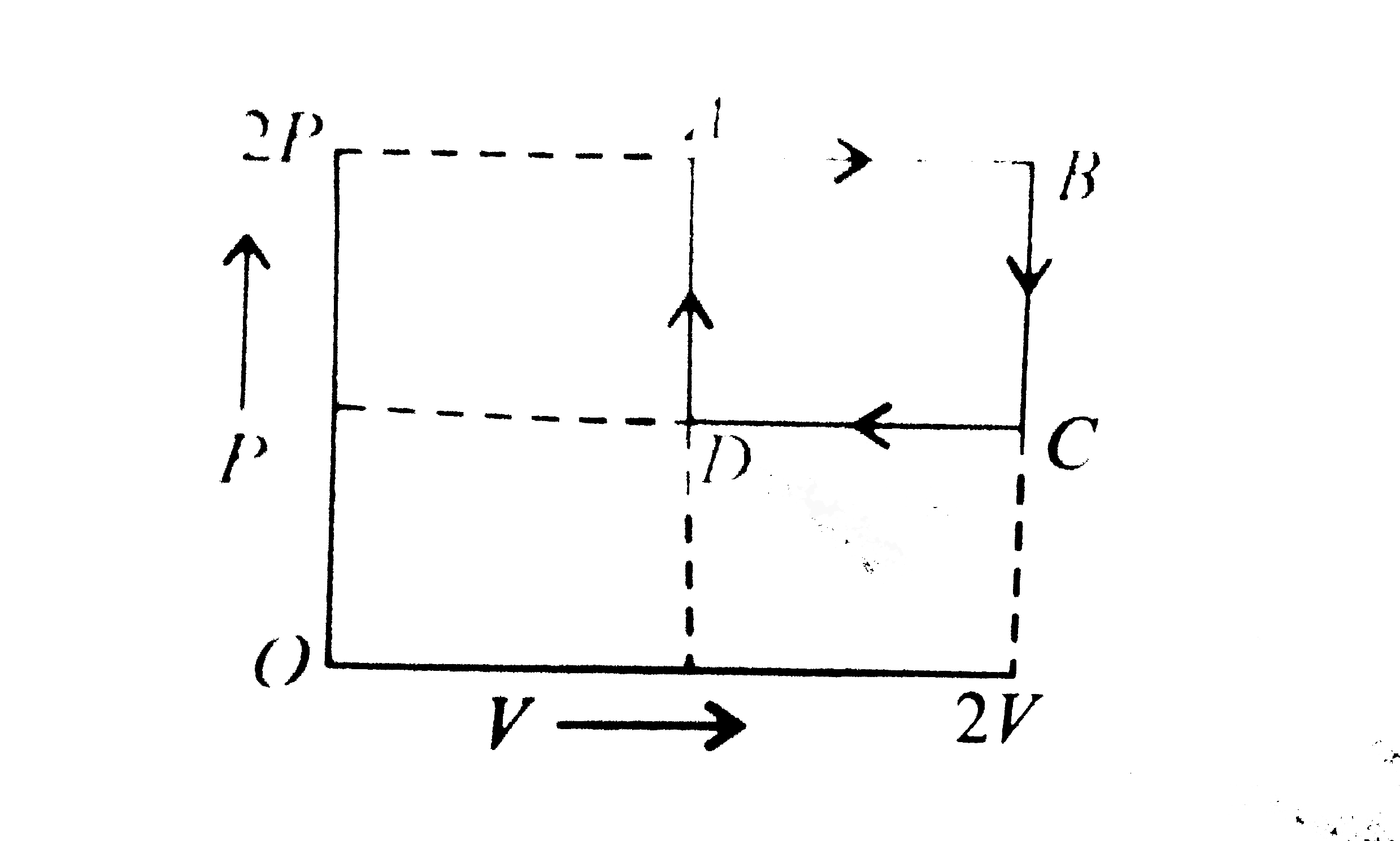
The state of a mole of an ideal gas changed from state `A` at pressure `2P` and volume `V` follows four different processes and finally returns to initial state `A` reversibly as shown below in the graph. By interpreting the graph, answer the following questions.

What would be the work done in state `B to C`?

A

`-PV`

B

`PV`

C

`2PV`

D

Zero

Text Solution

Verified by Experts

In conversion from `B` to `C`, volume does not change or `DeltaV = 0`, therefore `w = 0`
Promotional Banner

Topper's Solved these Questions

  • THERMODYNAMICS

    CENGAGE CHEMISTRY|Exercise Exercises (Multiple Correct)|50 Videos
  • THERMODYNAMICS

    CENGAGE CHEMISTRY|Exercise Exercises (Single Correct)|62 Videos
  • THERMODYNAMICS

    CENGAGE CHEMISTRY|Exercise Exercises (Subjective)|70 Videos
  • STOICHIOMETRY

    CENGAGE CHEMISTRY|Exercise Archives Subjective|33 Videos

Similar Questions

Explore conceptually related problems

The state of a mole of an ideal gas changed from state A at pressure 2P and volume V follows four different processes and finally returns to initial state A reversibly as shown below in the graph. By interpreting the graph, answer the following questions. what would the be total done by the gas?

The state of a mole of an ideal gas changed from state A at pressure 2P and volume V follows four different processes and finally returns to initial state A reversibly as shown below in the graph. By interpreting the graph, answer the following questions. What would be the heat obsorbed by the system in this cyclic process?

The state of a mole of an ideal gas changed from state A at pressure 2P and volume V follows four different processes and finally returns to initial state A reversibly as shown below in the graph. By interpreting the graph, answer the following questions. Which is the kind of process followed from state A to state, B ?

The state of a mole of an ideal gas changed from state A at pressure 2P and volume V follows four different processes and finally returns to initial state A reversibly as shown below in the graph. By interpreting the graph, answer the following questions. In state D to state A , what kind of process is followed?

An ideal gas change from state a to state b as shown in Fig. what is the work done by the gas in the process?

CENGAGE CHEMISTRY-THERMODYNAMICS-Exercises (Linked Comprehension)
  1. The state of a mole of an ideal gas changed from state A at pressure 2...

    Text Solution

    |

  2. The state of a mole of an ideal gas changed from state A at pressure 2...

    Text Solution

    |

  3. The state of a mole of an ideal gas changed from state A at pressure 2...

    Text Solution

    |

  4. The state of a mole of an ideal gas changed from state A at pressure 2...

    Text Solution

    |

  5. The second law of thermodynamics is a fundamental law of science. In t...

    Text Solution

    |

  6. The second law of thermodynamics is a fundamental law of science. In t...

    Text Solution

    |

  7. The second law of thermodynamics is a fundamental law of science. In t...

    Text Solution

    |

  8. A sample consisting of 1mol of a mono-atomic perfect gas (C(V) = (3)/(...

    Text Solution

    |

  9. A sample consisting of 1mol of a mono-atomic perfect gas (C(V) = (3)/(...

    Text Solution

    |

  10. A sample consisting of 1mol of a mono-atomic perfect gas (C(V) = (3)/(...

    Text Solution

    |

  11. A sample consisting of 1mol of a mono-atomic perfect gas (C(V) = (3)/(...

    Text Solution

    |

  12. Chemical reactions are invariably associated with the transfter of ene...

    Text Solution

    |

  13. Chemical reactions are invariably associated with the transfter of ene...

    Text Solution

    |

  14. Chemical reactions are invariably associated with the transfter of ene...

    Text Solution

    |

  15. Chemical reactions are invariably associated with the transfter of ene...

    Text Solution

    |

  16. Bond energies can be obtained by using the following relation: DeltaH ...

    Text Solution

    |

  17. Bond energies can be obtained by using the following relation: DeltaH ...

    Text Solution

    |

  18. Bond energies can be obtained by using the following relation: DeltaH ...

    Text Solution

    |

  19. Bond energies can be obtained by using the following relation: DeltaH ...

    Text Solution

    |

  20. Bond energies can be obtained by using the following relation: DeltaH ...

    Text Solution

    |

