Home
Class 11
CHEMISTRY
For a homogenous gaseous reaction X(g)...

For a homogenous gaseous reaction
`X(g)+2Y)g)hArrZ(g)` ,
at `473 K`, the value of `K_(c )=0.35` concentration units. When `2` moles of `Y` are mixed with `1` mole of `X`, at what pressure `60%` of `X` is converted to `Z`?

Text Solution

Verified by Experts
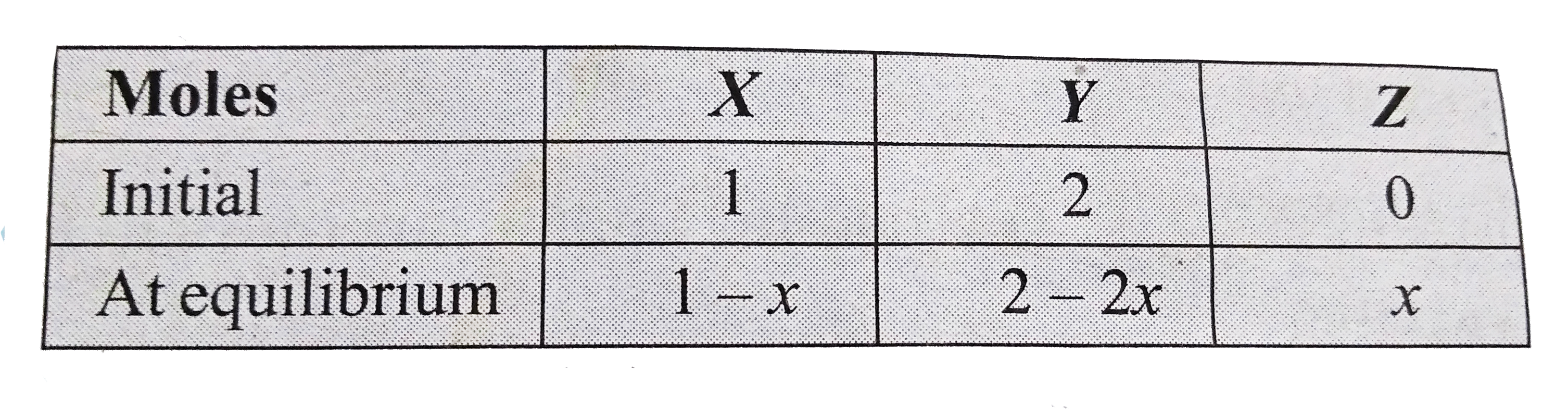
Since the pressure is to be calculate, so first find `K_(p)` using the relation between `K_(c )` and `K_(p)`.
`K_(c )=0.35, R=0.0821, T=473`,
For reaction `X(g)+2Y(g)hArrZ(g)`
`Deltan_(g)=n_(P)-n_(R)=1-(2+1)=-2`
`K_(p)=K_(c )(RT)^(Deltan)=0.35xx(0.0821xx473)^(-2)=2.32xx10^(-4)`
[Note: Volume of flask is also not fiven. So, convert `K_(c )` to `K_(p)`]
The expression for `K_(p)` is: `K_(p)=p_(Z)/(p_(X)(p_(Y))^(2))`

rArr Total moles `(n_(T))=3-2x`
Let P= equilibrium pressure, then particle pressure of `X, Y` and `Z` are:
`rArr p_(X)=(1-x)/(3-2x)P, p_(Y)=(2-2x)/(3-2x)P, p_(Z)=x/(3-2x)P`
`K_(p)=(x/(3-2x)P)/(((1-x)/(3-2x)P)((2-2x)/(3-2x)P)^(2))=(x(3-2x)^(2))/(P^(2)(1-x)(2-2x)^(2))`
`rArr x=0.6` (given)
:. `K_(p)=(0.6(3-1.2)^(2))/(p^(2)(1-0.6)(2-1.2)^(2))=2.32xx10^(-4)`
`rArr P^(2)=(1,8xx10^(2))^(2) rArr P=180 "atm"`
Promotional Banner

Topper's Solved these Questions

  • CHEMICAL EQUILIBRIUM

    CENGAGE CHEMISTRY|Exercise Concept Applicationexercise 7.1|53 Videos
  • CHEMICAL EQUILIBRIUM

    CENGAGE CHEMISTRY|Exercise Ex 7.2|40 Videos
  • CHEMICAL BONDING AND MOLECULAR STRUCTURE

    CENGAGE CHEMISTRY|Exercise Archives Subjective|15 Videos
  • CLASSIFICATION AND NOMENCLATURE OF ORGANIC COMPOUNDS

    CENGAGE CHEMISTRY|Exercise Analytical and Descriptive Type|3 Videos

Similar Questions

Explore conceptually related problems

For a gaseous phase reaction A+2B hArr AB_(2), K_(c)=0.3475 L^(2) "mole"^(-2) at 200^(@)C . When 2 moles of B are mixed with one "mole" of A, what total pressure is required to convert 60% of A in AB_(2) ?

For a reaction : A(g)+2B(g)hArrC(g)+D(g)+E(g), K_(eq)=2 Calculate equilibrium concentration of B if initially 10 moles of A are mixed with 20 moles of b in a 2 litre rigid container.

For the reaction SO_(2(g))+(1)/(2)O_(2(g))hArrSO_(3(g)) , if K_(c)=K_(p)(RT)^(X) then the value of X is

The value of K_(c) for the reaction : H_(2)(g)+I_(2)(g)hArr 2HI(g) is 45.9 at 773 K. If one mole of H_(2) , two mole of I_(2) and three moles of HI are taken in a 1.0 L flask, the concentrations of HI at equilibrium at 773 K.

Two solid X and Y dissociate into gaseous products at a certain temperature as followas: X(s)hArrA(g)+C(g) , and Y(s)hArrB(g)+C(g) At a given temperature, the pressure over excess solid X is 40 mm and total pressure over solid Y is 80 mm . Calculate a. The value of K_(p) for two reactions. b. The ratio of moles of A and B in the vapour state over a mixture of X and Y . c. The total pressure of gases over a mixture of X and Y .

One mole of nitrogen is mixed with three moles of hydrogen in a four litre container. If 0.25 per cent of nitrogen is converted to ammonia by the following reaction N_(2)(g)+3H_(2)(g)hArr2NH_(3)(g) , then calculate the equilibrium constant, K_(c) in concentration, units. What will be the value of K_(c) for the following equilibrium? 1/2 N_(2)(g)+3/2H_(2)(g)hArrNH_(3)(g)

Delta H^(@) for the reaction X_((g))+Y_((g))hArrZ_((g)) is -4.6 kcal , the valueof DeltaU^(@) of th e reaction at 227^(@)C is (R=2 cal.mol^(-1)K^(-1)) :

