Home
Class 11
CHEMISTRY
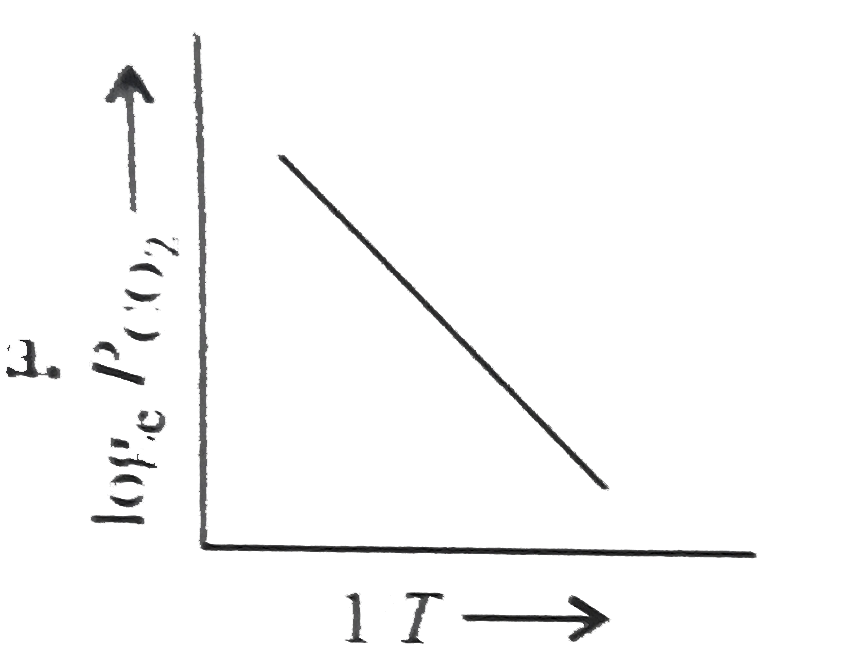
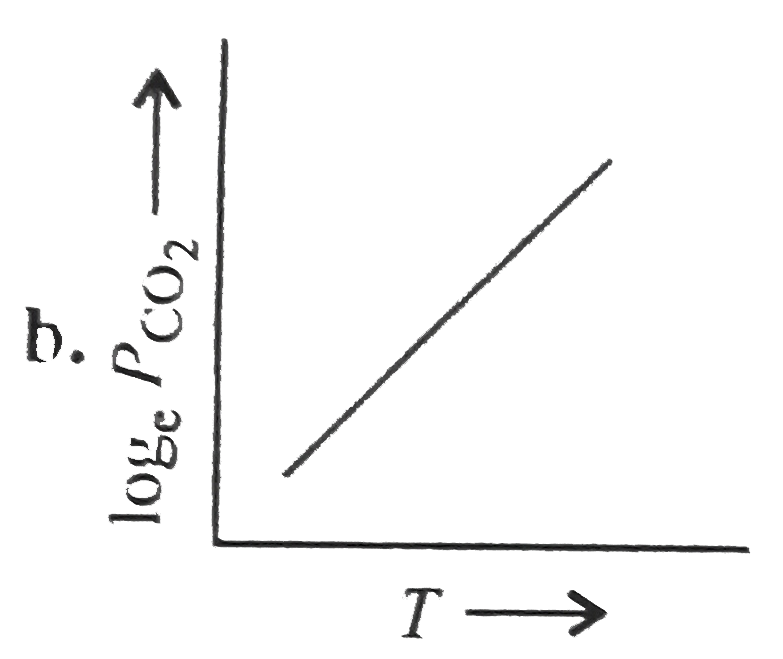
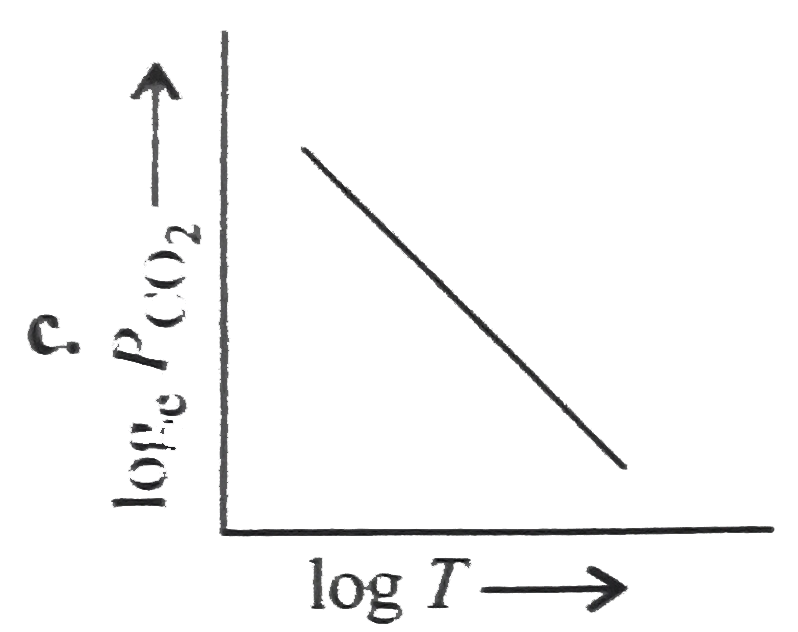
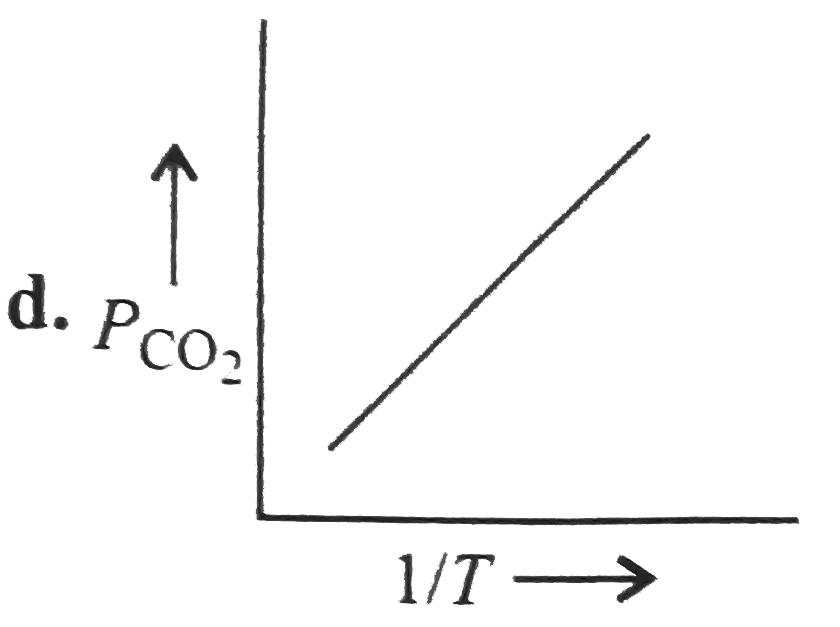
For the chemical equilibrium, CaCO(3)(...

For the chemical equilibrium,
`CaCO_(3)(s) hArr CaO(s)+CO_(2)(g)`
`Delta_(r)H^(ɵ)` can be determined from which one of the following plots?

A

B

C

D

Text Solution

AI Generated Solution

The correct Answer is:

To determine the standard enthalpy change (ΔrH°) for the reaction \[ \text{CaCO}_3(s) \rightleftharpoons \text{CaO}(s) + \text{CO}_2(g) \] we can use the relationship between the equilibrium constant (Kp) and temperature. The appropriate plot for this determination involves the logarithm of the equilibrium constant (log Kp) versus the inverse of the temperature (1/T). ### Step-by-Step Solution: 1. **Understanding the Reaction**: The reaction involves the decomposition of solid calcium carbonate (CaCO3) into solid calcium oxide (CaO) and gaseous carbon dioxide (CO2). The solid states do not contribute to the equilibrium constant (Kp), so we only consider the gaseous component. 2. **Using the Van 't Hoff Equation**: The Van 't Hoff equation relates the change in the equilibrium constant (Kp) with temperature and is given by: \[ \frac{d(\ln K_p)}{dT} = \frac{\Delta_rH^\circ}{RT^2} \] This can be rearranged to show that: \[ \ln K_p = -\frac{\Delta_rH^\circ}{R} \cdot \frac{1}{T} + C \] where C is a constant. 3. **Transforming to Logarithmic Form**: We can convert the natural logarithm (ln) to base 10 logarithm (log) using the relationship: \[ \ln K_p = 2.303 \cdot \log K_p \] Thus, we can express it as: \[ \log K_p = -\frac{\Delta_rH^\circ}{2.303R} \cdot \frac{1}{T} + \text{constant} \] 4. **Identifying the Plot**: From the equation derived, we see that if we plot log Kp (y-axis) against 1/T (x-axis), we will obtain a straight line. The slope of this line will be: \[ \text{slope} = -\frac{\Delta_rH^\circ}{2.303R} \] This indicates that the slope is negative, which is crucial for determining ΔrH°. 5. **Conclusion**: Therefore, the standard enthalpy change (ΔrH°) can be determined from a plot of log Kp versus 1/T. ### Final Answer: The standard enthalpy change (ΔrH°) can be determined from a plot of **log Kp vs. 1/T**.

To determine the standard enthalpy change (ΔrH°) for the reaction \[ \text{CaCO}_3(s) \rightleftharpoons \text{CaO}(s) + \text{CO}_2(g) \] we can use the relationship between the equilibrium constant (Kp) and temperature. The appropriate plot for this determination involves the logarithm of the equilibrium constant (log Kp) versus the inverse of the temperature (1/T). ### Step-by-Step Solution: ...
Promotional Banner

Topper's Solved these Questions

  • CHEMICAL EQUILIBRIUM

    CENGAGE CHEMISTRY|Exercise Concept Applicationexercise 7.1|53 Videos
  • CHEMICAL EQUILIBRIUM

    CENGAGE CHEMISTRY|Exercise Ex 7.2|40 Videos
  • CHEMICAL BONDING AND MOLECULAR STRUCTURE

    CENGAGE CHEMISTRY|Exercise Archives Subjective|15 Videos
  • CLASSIFICATION AND NOMENCLATURE OF ORGANIC COMPOUNDS

    CENGAGE CHEMISTRY|Exercise Analytical and Descriptive Type|3 Videos

Similar Questions

Explore conceptually related problems

For the reaction : CaCO_(3) (s) hArr CaO (s) + CO_(2) (g)

For the reaction CaCO_(3(s)) hArr CaO_((s))+CO_(2(g))k_p is equal to

For CaCO_(3)(s) hArr CaO(s)+CO_(2)(g), K_(c) is equal to …………..

For the reaction at equilibrium CaCO_(3) hArr CaO(s) + CO_(2)(g) What CaO(s) is removed reaction moves in forward direction.

CaCO_3(s) hArr CaO(s) + CO_2(g), DeltaH =110 kJ The pressure of CO_2 :

For the reaction CaCO_(3)(s)hArrCaO(s)+CO_(2)(g) the equilibrium amount of CO_(2) can be increased by :
