Home
Class 11
CHEMISTRY
Malonic acid is an organic dibasic acid ...

Malonic acid is an organic dibasic acid such as `H_(2)S` having first ionistion constant, `K_(1) = 1.42 xx 10^(-3)` and second ionisation constant, `K_(2) = 2.0 xx 10^(-6)`. Compute the divalent molanate ion concentration in:
a. `0.001M` malonic acid.
b. a solution that is `0.0001M` in malonc acid and `0.0004M HC1`.
c. a solution that is `0.0001 M` in malonic acid and `0.1 M HC1`.

Text Solution

Verified by Experts
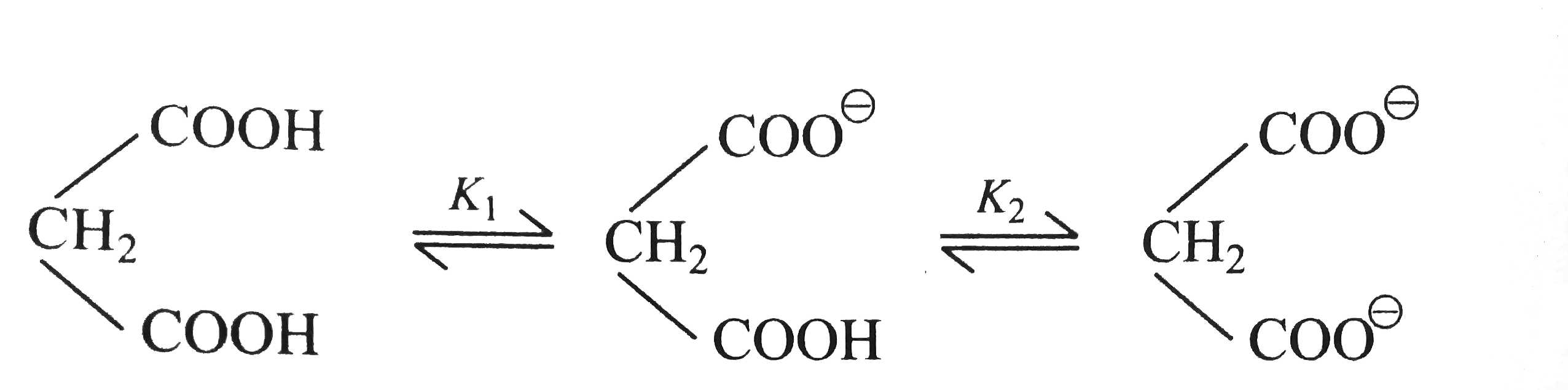

a. Consider malonic acid to be `H_(2)A`, where malonate ions is `A^(2-)`. For dibasic acid, we consider ionisation in two stages as follows:
`{:(H_(2)A hArr,H^(o+)+,HA^(Θ),,"first ionisation constant",),(C-x,x,x,=K_(1)=1.42xx10^(-3),),(,,,C= "initial concentration",),(,,,=0.001M,):}`
`rArr K_(1) = ([H^(o+)][HA^( Θ)])/([H_(2)A]) =(x^(2))/(C-x) = 1.42 xx 10^(-3)`
Solving the quadratic,
`x^(2) +1.42 xx 10^(-3) x - 1.42 xx 10^(-6) = 0`
`rArr x = 6.75 xx 10^(-4)M`
Note that `K_(1) gt gt K_(2)` so concentration of `H^(o+)` in solution is considered only from first dissociation, i.e., `[H^(o+)] = xM` neglect `[H^(o+)]` concentration from second ionsiation.
Consider second ionisation:
`{:(HA^(Θ)rarr,H^(o+)+,A^(2-),,"Second ionisation" =K_(2),),(x,x,-,=2.0 xx 10^(-6),),(x-y,x+y,y,,):}`
`rArr K_(2) = ([H^(o+)][A^(2-)])/([HA^(Θ)]) = ((x+y)y)/(x-y)`
Note: `[H^(o+)] = x + y~~x [HA^(o+) = x - y = x (y lt lt x)`
`rArr K_(2) = y [A^(2-)] = 2.0 xx 10^(-6)M`
Note: Ustually, `[A^(2-)]` for `H_(2)A` (dibasic acid) can be aproximately taken to be `K_(2)`.
b. Hence `C = 10^(-4)M`,
`[H^(o+)] = 4 xx 10^(-4)M` (from `HC1)`
`rArr K_(1) = ([H^(o+)][HA^(Θ)])/([H_(2)A]) = ((4 xx10^(-4) +x)(x))/(10^(-4)-x)`
`= 1.42 xx 10^(-3)`
Importane: Note that, we can not go for approximation in this case, since the concentration of `HC1` is so low that `H^(o+)` is considered both from `HC1` and malonic acid. Solving the quadratic.
`x^(2) + 1.82 xx 10^(-3) x- 1.42 x 10^(-7) = 0`
`rArr x = 7.5 xx 10^(-5)M`
Now consider, second ionisation and substitute for value of `x`.
`K_(2) = ([H^(o+)][A^(2-)])/([HA^(Θ)]) = ((4 xx 10^(-4) +x)(y))/(x) = 2.0 xx 10^(-6)`
`rArr ((4 xx10^(-4)+7.5xx10^(-5))y)/(7.5xx10^(-5))=2.0xx10^(-6)`
`rArr y = [A^(2-)] = 3.2 xx 10^(-7)M`
c. Here `C = 10^(-4)M, [H^(o+)] = 0.1M`
`rArr K_(a) = K_(1)K_(2) = ([H^(o+)]^(2)[A^(2-)])/([H_(2)A]) = ((0.1)^(2)[A^(2-)])/(10^(-4))`
`= 2.84 xx 10^(-9)`
Important: Note thate, we will do the approximation in this case, since the concentration of `HC1` is so high that `H^(o+)` considered from malonic acid is negligible. Recall the ionisation of `H_(2)S(g)` in an acidic solution. Solving the equation, we get: `[A^(2-)] = 2.84 xx 10^(-11)M`
Promotional Banner

Topper's Solved these Questions

  • IONIC EQUILIBRIUM

    CENGAGE CHEMISTRY|Exercise Ex 8.1|18 Videos
  • IONIC EQUILIBRIUM

    CENGAGE CHEMISTRY|Exercise Ex 8.2|27 Videos
  • HYDROGEN, WATER AND HYDROGEN PEROXIDE

    CENGAGE CHEMISTRY|Exercise Subjective Archive (Subjective)|3 Videos
  • ISOMERISM

    CENGAGE CHEMISTRY|Exercise Assertion-Reasoning Type|1 Videos

Similar Questions

Explore conceptually related problems

The dissociation constant for an acid HA is 1.6 xx 10^(-5) . Calculate its H_(3)O^(+) in concentration in 0.01 M solution .

The hydrogen ion concentration of a 0.006 M benzoic acid solution is (K_(a) = 6 xx 10^(-5))

K_(a) for an acid HA is 4.9 xx 10^(-8) . Calculate percentage dissocitation H^(+) ion concentration for its 0.1 M aqueous solution.

The acid dissociation constant K_(a) of acetic acid is 1.74 xx 10^(-5) at 298 K. The pH of a solution of 0.1 M acetic acid is

Calculate the H^+ ion concentration in 0.10 M acetic acid solution- Given that the dissociation constant of acetic acid in water is 1.8 xx 10^(-6) .

CENGAGE CHEMISTRY-IONIC EQUILIBRIUM-Archives Subjective
  1. Malonic acid is an organic dibasic acid such as H(2)S having first ion...

    Text Solution

    |

  2. How much moles of sodium propionate should be added to 1L of an aqueou...

    Text Solution

    |

  3. Given reason for the statement that the pH of an aqueous solution of s...

    Text Solution

    |

  4. 20 mL of 0.2M sodium hydroxide is added to 50 mL of 0.2 M acetic acid ...

    Text Solution

    |

  5. The dissociation constant of a weak acid HA si 4.9 xx 10^(-8). After m...

    Text Solution

    |

  6. A solution contains a mixture of Ag^(+)(0.10M) and Hg(2)^(2+)(0.10M) w...

    Text Solution

    |

  7. The concentration of hydrogen ions in a 0.2M solution of formic acid i...

    Text Solution

    |

  8. The solubility of Mg (OH)(2) in pure water is 9.57 xx 10^(-3) gL^(-1)....

    Text Solution

    |

  9. What is the pH of the solution when 0.20 mol of HCI is added to 1L of ...

    Text Solution

    |

  10. How many gram moles of HCI will be required to prepare 1L of buffer so...

    Text Solution

    |

  11. Freshly precipiteated Al and Mg hydroxides are stirred vigorously in a...

    Text Solution

    |

  12. What is the pH of 1 M solution of acetic acid ? To what volume one lit...

    Text Solution

    |

  13. A 50 mL solution of weak base BOH is titrated with 0.1N HCI solution. ...

    Text Solution

    |

  14. The K(SP) of Ag(2)C(2)O(4) at 25^(@)C is 1.29xx10^(-11)mol^(3)L^(-3). ...

    Text Solution

    |

  15. The K(SP)of Ca(OH)(2)is 4.42xx10^(-5)at 25^(@)C. A 500 mL of saturated...

    Text Solution

    |

  16. The pH of blood stream is maintained by a proper balance of H(2)CO(3) ...

    Text Solution

    |

  17. An aqueous solution of a metal bromide MBr(2)(0.05M) is saturated with...

    Text Solution

    |

  18. For the reaction Ag(CN)(2)^(ɵ)hArr Ag^(o+)+2CN^(ɵ), the K(c ) at 25^...

    Text Solution

    |

  19. Calculate the pH of an aqueous solution of 1.0M ammonium formate assum...

    Text Solution

    |

  20. What is the pH of a 0.50M aqueous NaCN solution ? (pK(b)of CN^(-)=4.70...

    Text Solution

    |

  21. The ionization constant of overset(o+)(NH(4)) ion in water is 5.6 xx 1...

    Text Solution

    |

