Home
Class 12
CHEMISTRY
A cell, as shown below, consists of ther...

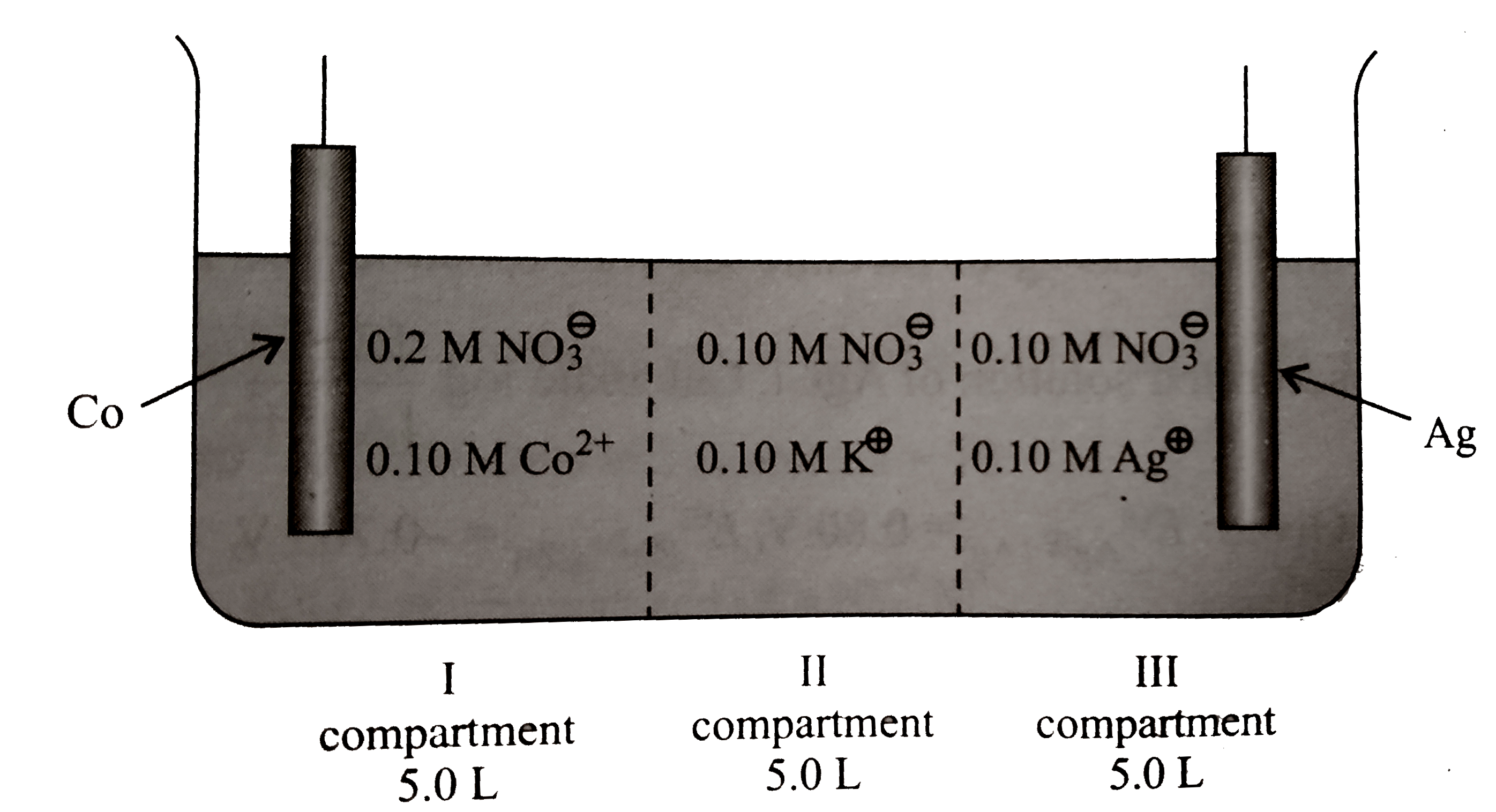
A cell, as shown below, consists of there compartments separated by porous pots. The first contains a cobalt eletrode in `5.0L` of `0.10M Co(NO_(3)),` the second contains `5.0L` of `0.10M KNO_(3),` the third contains an `Ag` electrode in `5.0L` of `0.10M AgNO_(3)`. Assuming that current with in the cell iis carried equally by the negative and positive ions by passign `0.1F` of electricity.

Given `: Co^(2+)+2e^(-) rarr Co" "E^(c-)=-0.28V`
Ag^(o+)+e^(-) rarr Ag" "E^(c-)=0.80V`
`2Ag^(o+)+Corarr Co^(2+)+2Ag" "E^(c-)._(cell)=1.08V`
Finally the `II` compartment contains

A

`I`

B

`I,II,`

C

`I,II,III`

D

`II,III,IV`

Text Solution

Verified by Experts

The correct Answer is:
d

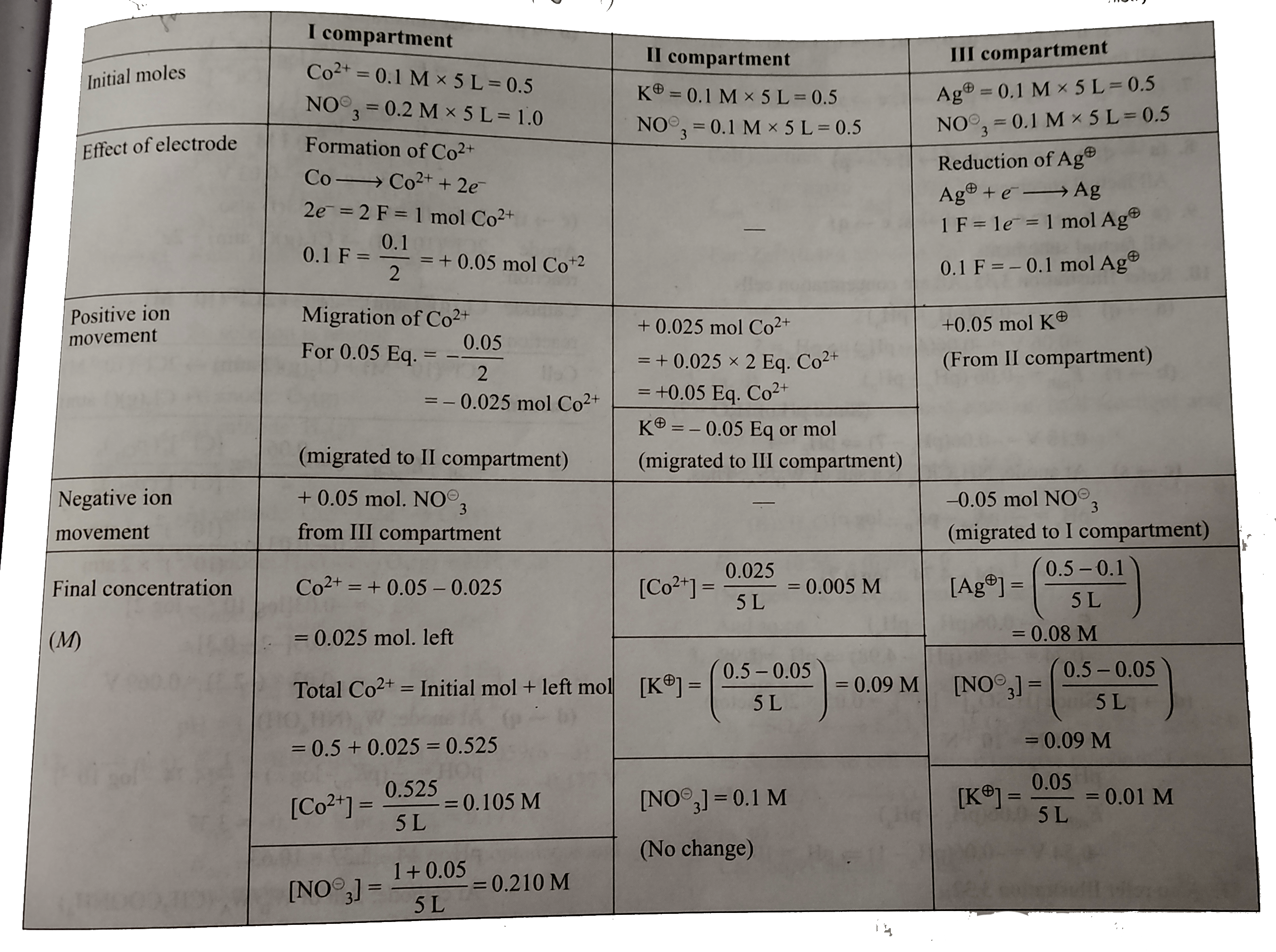
Since `Co^(2+)` ions from `I` compartment do not move to `III` compartment, so `Co^(2+)` ions are not present there.
As explained in Question, there is a movement of `NO_(3)^(c-)` ions, some concentration of `NO^(c-)._(3)` ions is left in `III` compartment. There is also a movement of `K^(o+)` ions from `II` compartment to both `I` and `III` compartments.
There is decrease in positive charge due to reduction of `Ag(o+)` to `Ag` in `III` compartment.
Hence, ions present in `III` compartment are`: Ag^(o+), NO_(3)^(c-),` and `K^(O+)`.
Effect of electrode`:` Oxidation of `Co` to `Co^(2+)` at anode and reduction of `Ag^(o+)` to `Ag` at cathode occurs by the passage of `0.1 F` of electricity.
Effect by the migration of ions through porous barries `:`
Since charge carried by positive or negative ions is equal therefore transport number of each ion is equal, `i.e.,t_(c)o+=t_(a)c- =(1)/(1+1)=0.5` . Hence, number of ions transported from one compartment to another`-0.5xx0.1F=0.05Eq.`
Promotional Banner

Topper's Solved these Questions

  • ELECTROCHEMISTRY

    CENGAGE CHEMISTRY|Exercise Exercisemultiple Correct Ansers|53 Videos
  • ELECTROCHEMISTRY

    CENGAGE CHEMISTRY|Exercise Exercises Ingle Correct|178 Videos
  • ELECTROCHEMISTRY

    CENGAGE CHEMISTRY|Exercise Ex 3.3 (Objective)|10 Videos
  • D AND F BLOCK ELEMENTS

    CENGAGE CHEMISTRY|Exercise Archives Subjective|29 Videos
  • GENERAL PRINCIPLES AND PROCESS OF ISOLATION OF ELEMENTS

    CENGAGE CHEMISTRY|Exercise Archives (Subjective)|14 Videos

Similar Questions

Explore conceptually related problems

A cell, as shown below, consists of there compartments separated by porous pots. The first contains a cobalt eletrode in 5.0L of 0.10M Co(NO_(3)), the second contains 5.0L of 0.10M KNO_(3), the third contains an Ag electrode in 5.0L of 0.10M AgNO_(3) . Assuming that current with in the cell iis carried equally by the negative and positive ions by passign 0.1F of electricity. Given : Co^(2+)+2e^(-) rarr Co" "E^(c-)=-0.28V Ag^(o+)+e^(-) rarr Ag" "E^(c-)=0.80V 2Ag^(o+)+Corarr Co^(2+)+2Ag" "E^(c-)._(cell)=1.08V The final concentration of NO_(3)^(c-) in I,II, and III compartment is

A cell, as shown below, consists of there compartments separated by porous pots. The first contains a cobalt eletrode in 5.0L of 0.10M Co(NO_(3)), the second contains 5.0L of 0.10M KNO_(3), the third contains an Ag electrode in 5.0L of 0.10M AgNO_(3) . Assuming that current with in the cell iis carried equally by the negative and positive ions by passign 0.1F of electricity. Given : Co^(2+)+2e^(-) rarr Co" "E^(c-)=-0.28V Ag^(o+)+e^(-) rarr Ag" "E^(c-)=0.80V 2Ag^(o+)+Corarr Co^(2+)+2Ag" "E^(c-)._(cell)=1.08V The final concentration of Co^(2+) in I, II, and III compartment is

A cell, as shown below, consists of there compartments separated by porous pots. The first contains a cobalt eletrode in 5.0L of 0.10M Co(NO_(3)), the second contains 5.0L of 0.10M KNO_(3), the third contains an Ag electrode in 5.0L of 0.10M AgNO_(3) . Assuming that current with in the cell iis carried equally by the negative and positive ions by passign 0.1F of electricity. Given : Co^(2+)+2e^(-) rarr Co" "E^(c-)=-0.28V Ag^(o+)+e^(-) rarr Ag" "E^(c-)=0.80V 2Ag^(o+)+Corarr Co^(2+)+2Ag" "E^(c-)._(cell)=1.08V The final concentration of Ag^(o+) in I,II, and III compartment is

A cell, as shown below, consists of there compartments separated by porous pots. The first contains a cobalt eletrode in 5.0L of 0.10M Co(NO_(3)), the second contains 5.0L of 0.10M KNO_(3), the third contains an Ag electrode in 5.0L of 0.10M AgNO_(3) . Assuming that current with in the cell iis carried equally by the negative and positive ions by passign 0.1F of electricity. Given : Co^(2+)+2e^(-) rarr Co" "E^(c-)=-0.28V Ag^(o+)+e^(-) rarr Ag" "E^(c-)=0.80V 2Ag^(o+)+Corarr Co^(2+)+2Ag" "E^(c-)._(cell)=1.08V The final concentration of K^(o+) in I,II, and III compartment is

The cell consists of three compartments separated by porous barriers. The first contains a cobalt electrode in 5.00 L of 0.100 M cobalt (II) nitrate, the second contains 5.00 L of 0.100M AgNO_(3) . Assuming that the current within the cell is carried equally by the positive and negative ions, tabulate the concentrations of ions of each type in each compartment of the cell after the passage of 0.100 mole electrons. given Co^(2+)+2e^(-)toCo" "E^(0)=-0.28V Ag^(+)+e^(-)toAg" "E^(0)=0.80V Spontaneous reaction is: 2Ag^(+)+CotoCo^(2+)+2Ag" "1.08V

Calculate the molarity of each ion in solution after 2.0 litre of 3.0 M AgNO_(3) is mixed with 3.0 litre of 1.0 M BaCl_(2) .

A jheterogeneous system is produced when 0.040 moles of solid NaCl is added to 0.10 L of 0.10 M Pb(NO_(3))_(2) . Which ion is present in the aqueous phase at the highest concentration?

CENGAGE CHEMISTRY-ELECTROCHEMISTRY-Exercise(Linked Comprehension )
  1. The magnitude ( but not the sign ) of the standard reduction potential...

    Text Solution

    |

  2. A volataic cell consists of an electode of solide silver immerse in a ...

    Text Solution

    |

  3. A volataic cell consists of an electode of solide silver immerse in a ...

    Text Solution

    |

  4. Fuel cells : Fuel cells are galvanic cells in which the chemical energ...

    Text Solution

    |

  5. Fuel cells : Fuel cells are galvanic cells in which the chemical energ...

    Text Solution

    |

  6. Fuel cells : Fuel cells are galvanic cells in which the chemical energ...

    Text Solution

    |

  7. Fuel cells : Fuel cells are galvanic cells in which the chemical energ...

    Text Solution

    |

  8. A conductivity cell is used to measure the conductance of electrolyte ...

    Text Solution

    |

  9. A conductivity cell is used to measure the conductance of electrolyte ...

    Text Solution

    |

  10. Breathalyzer is used to detect the alcohol content in the suspected dr...

    Text Solution

    |

  11. Breathalyzer is used to detect the alcohol content in the suspected dr...

    Text Solution

    |

  12. Breathalyzer is used to detect the alcohol content in the suspected dr...

    Text Solution

    |

  13. Breathalyzer is used to detect the alcohol content in the suspected dr...

    Text Solution

    |

  14. A cell, as shown below, consists of there compartments separated by po...

    Text Solution

    |

  15. A cell, as shown below, consists of there compartments separated by po...

    Text Solution

    |

  16. A cell, as shown below, consists of there compartments separated by po...

    Text Solution

    |

  17. A cell, as shown below, consists of there compartments separated by po...

    Text Solution

    |

  18. A cell, as shown below, consists of there compartments separated by po...

    Text Solution

    |

  19. A cell, as shown below, consists of there compartments separated by po...

    Text Solution

    |

  20. A cell, as shown below, consists of there compartments separated by po...

    Text Solution

    |

