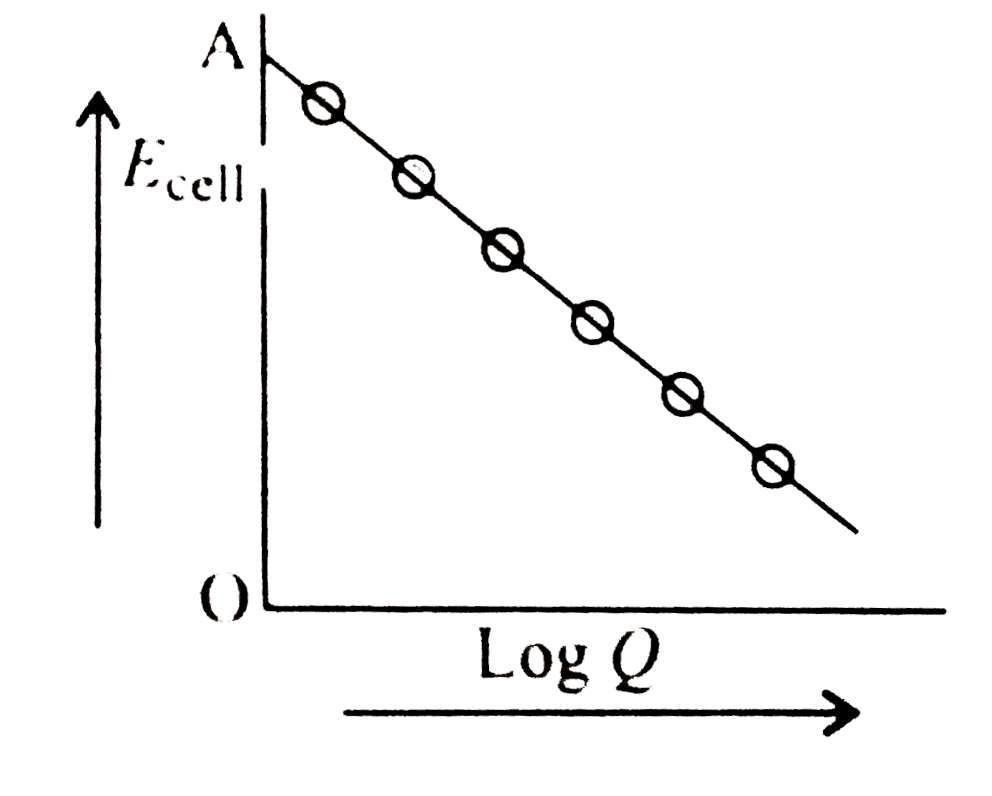
A
B
C
D
Text Solution
Verified by Experts
The correct Answer is:



Topper's Solved these Questions
ELECTROCHEMISTRY
CENGAGE CHEMISTRY|Exercise Exerciseassertion -Reasoning|25 VideosELECTROCHEMISTRY
CENGAGE CHEMISTRY|Exercise Exerciseinterger|8 VideosELECTROCHEMISTRY
CENGAGE CHEMISTRY|Exercise Exercisemultiple Correct Ansers|53 VideosD AND F BLOCK ELEMENTS
CENGAGE CHEMISTRY|Exercise Archives Subjective|29 VideosGENERAL PRINCIPLES AND PROCESS OF ISOLATION OF ELEMENTS
CENGAGE CHEMISTRY|Exercise Archives (Subjective)|14 Videos
Similar Questions
Explore conceptually related problems
CENGAGE CHEMISTRY-ELECTROCHEMISTRY-Exercises Ingle Correct
- For the cell Zn(s)|Zn^(2+)||Cu^(2+)|Cu(s), the standard cell voltage,...
Text Solution
|
- DeltaG=DeltaH-TDeltaS and ltBRgt DeltaG=DeltaH+T[(d(DeltaG))/(dT)](p)...
Text Solution
|
- Zn+Cu^(2+)(aq)hArrCu+Zn^(2+)(aq). Reaction quotient is Q=([Zn^(2+)])...
Text Solution
|
- The standard reduction potentials of Cu^(2+)|Cu and Cu^(2+)|Cu^(o+) ar...
Text Solution
|
- Zn | Zn^(2+)(C(1) || Zn^(2+)(C(2)| Zn. For this cell DeltaG is negativ...
Text Solution
|
- Pt(H(2))(p(1))|H^(o+)(1M)|(H(2))(p(2)),Pt cell reaction will be exergo...
Text Solution
|
- Pt(Cl(2))(p(1))|HCl(0.1M)|(Cl(2))(p(2)),Pt cell reaction will be ender...
Text Solution
|
- Pt(H(2))(1atm)|H(2)O, electrode potential at 298K is
Text Solution
|
- For the half cell At pH=2, the electrode potential is
Text Solution
|
- Which of the following changes will increase the EMF of the cell : C...
Text Solution
|
- underset(1 L solution)(Ag|Ag^(o+)(1M))||underset(1 L solution)(Ag^(o+)...
Text Solution
|
- The cell EMF is independent of the concentration of the species of the...
Text Solution
|
- Assume that during the electrolysis of AgNO+(3), only H(2)O is electro...
Text Solution
|
- During electrolysis of acidified water, O(2) gas is formed at the anod...
Text Solution
|
- The gas evolved at the anode when K(2)SO(4)(aq) is electrolyzed betwee...
Text Solution
|
- A quantity of electrical charge that brigns about the depositiion of 4...
Text Solution
|
- 100mL of buffer of 1 M NH(3)(aq) and 1 M NH(4)^(o+)(aq) are placed i...
Text Solution
|
- Given the ionic conductance of underset(underset(COO^(c-))(|))(COO^(c-...
Text Solution
|
- The variation equivalent conductance of stronge electrolyte with sqrt(...
Text Solution
|
- Given the standard potential of the following at 25^(@)C. MnO(2) ra...
Text Solution
|