Home
Class 12
CHEMISTRY
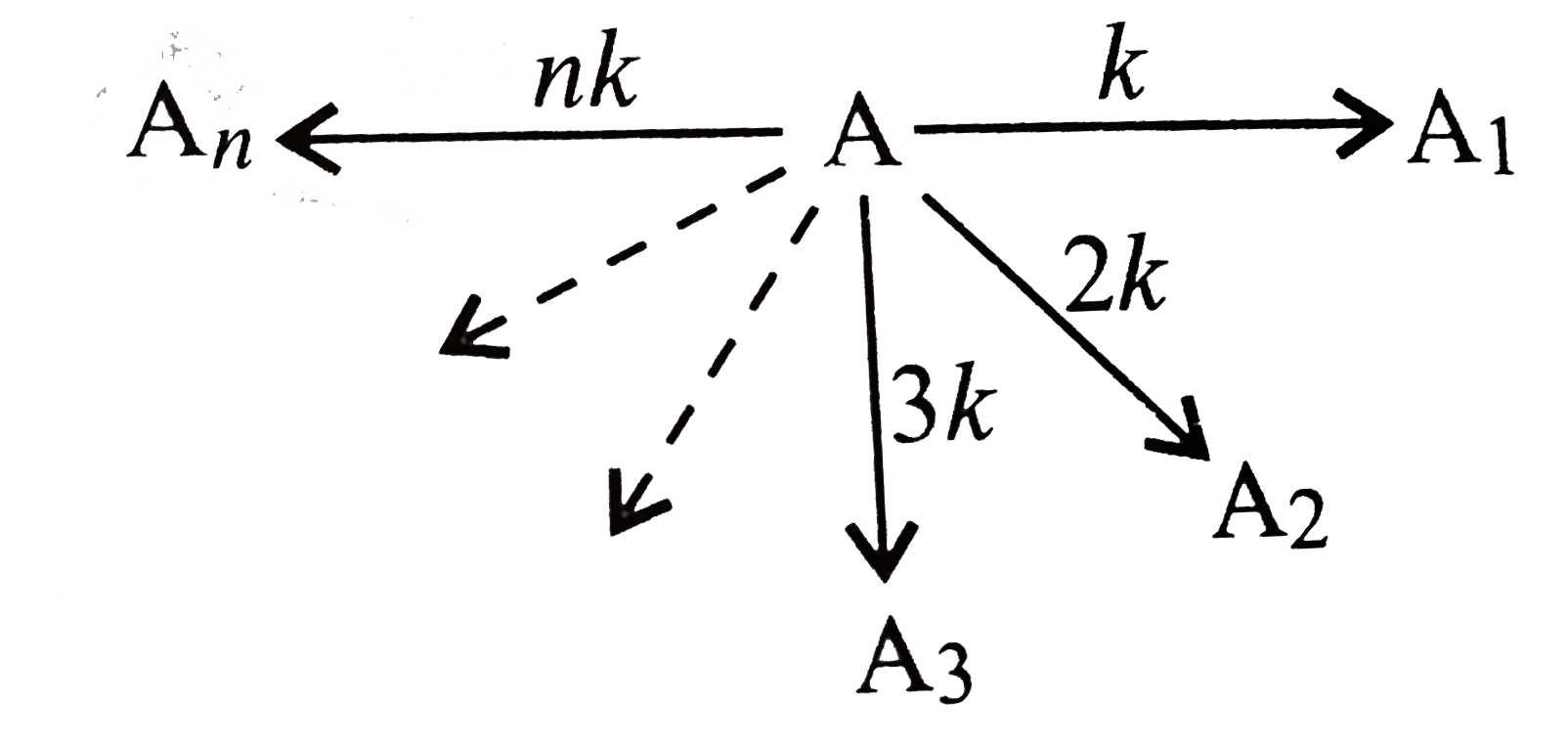
Mechanism of the reaction is: What ...

Mechanism of the reaction is:

What is (a) `(-d[A])/(dt)`, (b) `(d[A_(1)])/(dt)` , (c ) `(d[A_(n)])/(dt)`, (d) `(d[A_(1)])/(-d[A])` for same time?

Text Solution

Verified by Experts

(a) `(-d[A])/(dt) = [k + 2k+3k+….nk] [A]`
`= [1+2+3+…..+n][k][A]`
`= (n(n+1))/(2)k[A]`
(b) `(d[A_(1)])/(dt) = k[A]`
( c) `(d[A_(n)])/(dt) = nk[A]`
(d) `(d[A])/(-d[A]) = (k[A])/((n(n+1))/(2)k[A]) = (2)/(n(n+1))`
Promotional Banner

Topper's Solved these Questions

  • CHEMICAL KINETICS

    CENGAGE CHEMISTRY|Exercise Solved Example|52 Videos
  • CHEMICAL KINETICS

    CENGAGE CHEMISTRY|Exercise Ex 4.1 (Objective)|9 Videos
  • CARBOXYLIC ACIDS AND THEIR DERIVATIVES

    CENGAGE CHEMISTRY|Exercise Exercises Archives (Analytical And Descriptive)|34 Videos
  • COORDINATION COMPOUNDS

    CENGAGE CHEMISTRY|Exercise Archives Subjective|18 Videos

Similar Questions

Explore conceptually related problems

Mechanism of the reaction is: What is (-d[A])/(dt) ?

d/(dt) (1/t)=

Mechanism of the reaction is: A_(2) overset(k_(2))hArr 2A A + B overset(k_(2))rarr C A_(2) + C overset(k)rarr D + A What is (a) (-d[A_(2)])/(dt) , (b) (-d[A])/(dt) , (c ) (d[C])/(d t) , (d) (d[D])/(dt) ?

If for the reaction A to B" rate" =-(d[A])/(dt)=2(d[B])/(dt) then, rate law is

For the reaction: aA + bB rarr cC+dD Rate = (dx)/(dt) = (-1)/(a)(d[A])/(dt) = (-1)/(b)(d[B])/(dt) = (1)/( c)(d[C])/(dt) = (1)/(d)(d[D])/(dt) For reaction 3BrO^(ɵ) rarr BrO_(3)^(ɵ) + 2Br^(ɵ) , the value of rate constant at 80^(@)C in the rate law for -(d[BrO^(ɵ)])/(dt) was found to be 0.054 L mol^(-1)s^(-1) . The rate constant (k) for the reaction in terms of (d[BrO_(3)^(ɵ)])/(dt) is

For the reaction: aA + bB rarr cC+dD Rate = (dx)/(dt) = (-1)/(a)(d[A])/(dt) = (-1)/(b)(d[B])/(dt) = (1)/( c)(d[C])/(dt) = (1)/(d)(d[D])/(dt) A reaction follows the given concentration-time graph. The rate for this reaction at 20 s will be

For the reaction: aA + bB rarr cC+dD Rate = (dx)/(dt) = (-1)/(a)(d[A])/(dt) = (-1)/(b)(d[B])/(dt) = (1)/( c)(d[C])/(dt) = (1)/(d)(d[D])/(dt) In the following reaction, xA rarr yB log.[-(d[A])/(dt)] = log.[(d[B])/(dt)] + 0.3 where negative isgn indicates rate of disappearance of the reactant. Thus, x:y is:

For the reaction: aA + bB rarr cC+dD Rate = (dx)/(dt) = (-1)/(a)(d[A])/(dt) = (-1)/(b)(d[B])/(dt) = (1)/( c)(d[C])/(dt) = (1)/(d)(d[D])/(dt) The rate of formation of SO_(3) in the following reaction 2SO_(2) + O_(2) rarr 2SO_(3) is 100 g min^(-1) . Hence the rate of disappearance of O_(2) is

Mechanism of the reaction is: A_(2) underset(k')overset(k)hArr 2A A + B_(2) overset(k_(2))rarr C + B B + A_(2) overset(k_(2))rarr C + A What is (a) (-d[A_(2)])/(dt) ,(b) (-d[A])/(dt) , ( c) (d[B])/(dt) ,(d) (d[C])/(dt)

CENGAGE CHEMISTRY-CHEMICAL KINETICS-Archives Subjective
  1. Mechanism of the reaction is: What is (a) (-d[A])/(dt), (b) (d[A(...

    Text Solution

    |

  2. Rate of a reaction A + B rarr Product, is given as a function of diffe...

    Text Solution

    |

  3. A first order reaction is 20% complete in 10 min. Calculate (a) the sp...

    Text Solution

    |

  4. While studying the decompoistion of gaseous N(2)O(5), it is observed t...

    Text Solution

    |

  5. A first order gas reaction has k = 1.5 xx 10^(-6) s^(-1) at 200^(@)C. ...

    Text Solution

    |

  6. A first order reaction is 50% completed in 30 min at 27^(@)C and in 10...

    Text Solution

    |

  7. In a Arrhenius equation for a certain reaction, the values of A and E(...

    Text Solution

    |

  8. The decomposition of N(2)O(5) according to the equation: 2N(2)O(5)(g) ...

    Text Solution

    |

  9. Two reaction, (I)A rarr Products and (II) B rarr Products, follow firs...

    Text Solution

    |

  10. The gas phase decomposition of dimethyl ether follows first order kine...

    Text Solution

    |

  11. A first order reaction A rarr B requires activation energy of 70 kJ mo...

    Text Solution

    |

  12. form the following data for the reaction between A and B, (a) Cal...

    Text Solution

    |

  13. At 380^(@)C , the half-life periof for the first order decompoistion o...

    Text Solution

    |

  14. The ionization constant of overset(o+)(NH(4)) ion in water is 5.6 xx 1...

    Text Solution

    |

  15. The time required for 10% completion of a first order reaction at 298 ...

    Text Solution

    |

  16. The rate constant for the first order decompoistion of a certain react...

    Text Solution

    |

  17. For the equation N(2)O(5)(g)=2NO(2)(g)+(1//2)O(2)(g), calculate the ...

    Text Solution

    |

  18. The rate constant of a reaction is 1.5 xx 10^(7)s^(-1) at 50^(@)C and ...

    Text Solution

    |

  19. The rate constant for an isomerization reaction, A rarr B is 4.5 xx 10...

    Text Solution

    |

  20. A hydrogenation reaction is carried out at 500 K. If the same reaction...

    Text Solution

    |

  21. The vapour pressure of two miscible liquids (A) and (B) are 300 and 50...

    Text Solution

    |
