Home
Class 12
CHEMISTRY
The inverison of cane sugar was studied ...

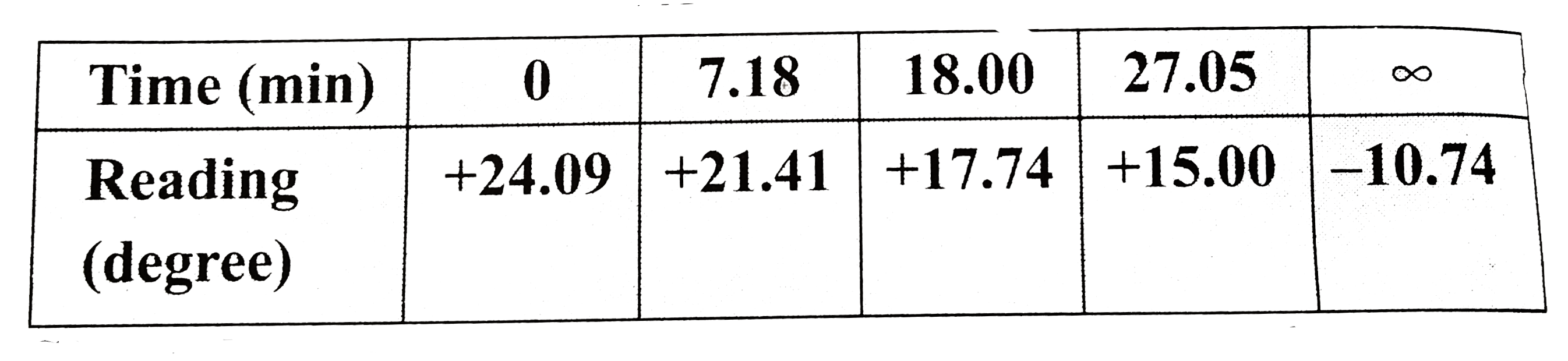
The inverison of cane sugar was studied is `HCl` at `298 K`. The following polarimetric readings were obtained at different intervals of time:

Show that the inverison of cane sugar is a unimolecular reaction.

Text Solution

Verified by Experts
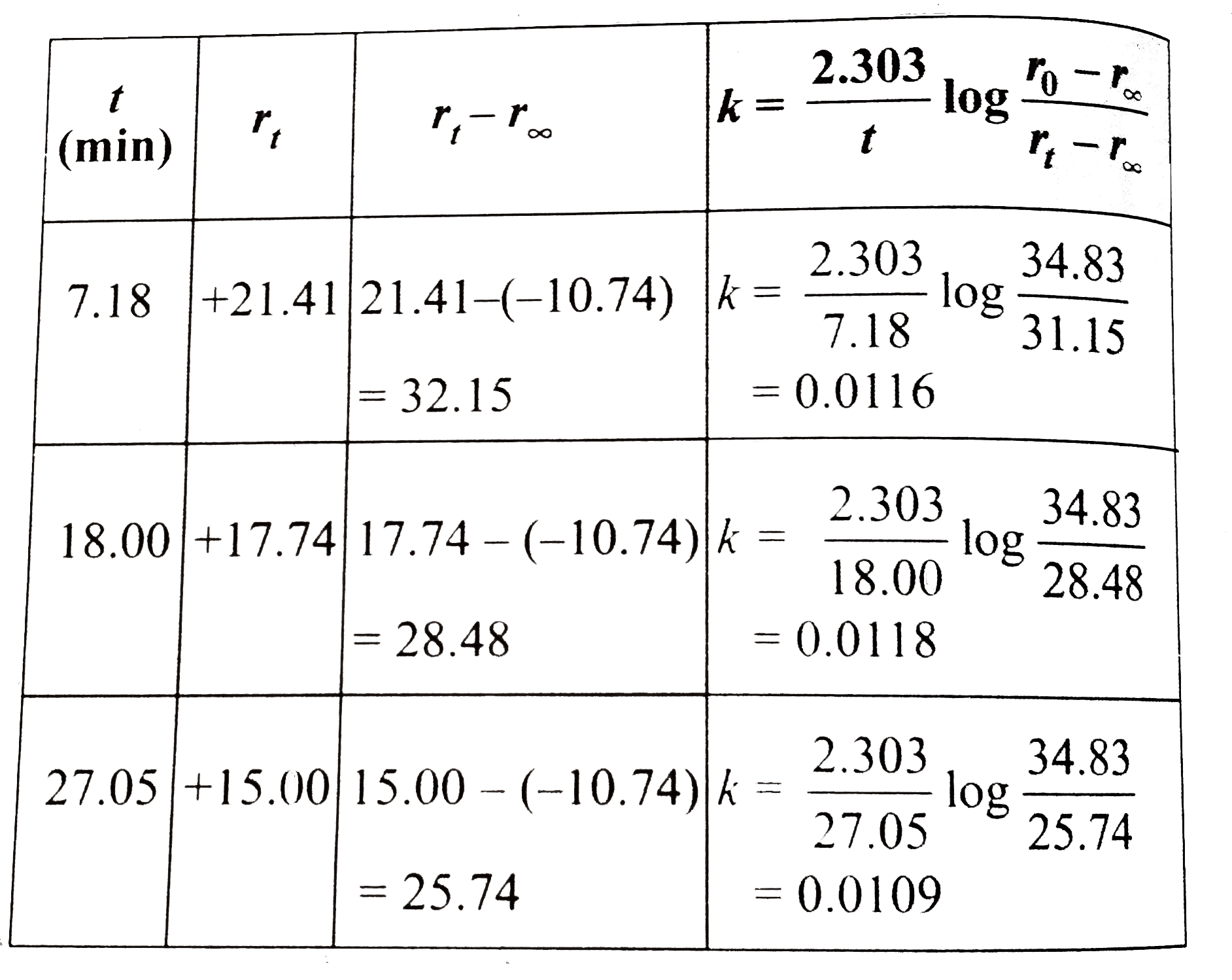
In the present case, `r_(0) = +24.09, r_(oo) = -10.74`
`:. r_(0) - r_(oo) = +24.09 - (-10.74) = 34.83`
The value of `k` at different instants may be calculated as under:

The constancy in the value of `k` proves that the reaction is of the first order.
Temperature Dependence of a Reaction, Energy of Activation, and Arrhenius Equation
Promotional Banner

Topper's Solved these Questions

  • CHEMICAL KINETICS

    CENGAGE CHEMISTRY|Exercise Ex 4.1 (Objective)|9 Videos
  • CHEMICAL KINETICS

    CENGAGE CHEMISTRY|Exercise Ex 4.2 (Objective)|10 Videos
  • CHEMICAL KINETICS

    CENGAGE CHEMISTRY|Exercise Archives Subjective|23 Videos
  • CARBOXYLIC ACIDS AND THEIR DERIVATIVES

    CENGAGE CHEMISTRY|Exercise Exercises Archives (Analytical And Descriptive)|34 Videos
  • COORDINATION COMPOUNDS

    CENGAGE CHEMISTRY|Exercise Archives Subjective|18 Videos

Similar Questions

Explore conceptually related problems

The inverison of cane sugar is a……………reaction though its molecularity is………………. .

A 20% solution of cane sugar having dextrorotation of 34.50 inverted by 0.5 N lactic acid to at 298 K . The rotations determined are as follows: |{:("Time (min)",0,14.55,111.36,oo),("Rotation",34.50,31.10,13.98,-10.77):}| Show that the inverison of sugar is a unimolecular reaction.

In the following which is 550 time sweetner than cane sugar

The following results were obtained during kinetic studies of the reaction, 2A +Brarr Products The time (in minutes) required to consume half of A is:

For the non-stoichiometre reaction 2 A + B to C + D , the following kinetic data were obtained in three separate experiments , all at 298 K The rate law for the formation of C is

For the non – stoichiometre reaction 2A + B rarr C + D , the following kinetic data were obtained in three separate experiments, all at 298 K The rate law for the formation of C is:

Benene diaxonium chloride in aqeous solution decomposes as : C_6H_5-N=N^(+)Cl_(aq)^(-) +H_2O_(aq)rarrC_6H_5OH_(aq)+N_2(g)+HCl_(aq) The reaction follows first order kinetics. If P_t is the pressure of N_2 at constant volume and temperature corresponding to different intervals of time t and p_f that after completion of the reaction, then which of the following graphs conforms to the kinetics of the reaction ?

The inverison of cane sugar proceeds with half life of 500 min at pH 5 for any concentration of sugar. However, if pH = 6 , if the half life changes to 50 min . The rate law expresison for the sugar inverison can be written as

CENGAGE CHEMISTRY-CHEMICAL KINETICS-Solved Example
  1. A proposed mechanism for a reaction ArarrB is A underset(k(2))overse...

    Text Solution

    |

  2. Bicyclohexane was found to undergo two parallel first order rearrangem...

    Text Solution

    |

  3. Trans 1,2-dideuterocyclopropane (A) undergoes a first order decompoist...

    Text Solution

    |

  4. The decompoistion of Cl(2)O(7) at 400 K in gas phase to Cl(2) and O(2)...

    Text Solution

    |

  5. Ethylene is profuced by C(4)H(8)("cyclobutane")overset(Delta)rarr2C(...

    Text Solution

    |

  6. form the following data for the decompoistion of N(2)O(5) in carbon te...

    Text Solution

    |

  7. 1.0 mL of ethyl acetate was added to 25 mL of N//2 HCl, 2 mL of the mi...

    Text Solution

    |

  8. The inverison of cane sugar was studied is HCl at 298 K. The following...

    Text Solution

    |

  9. An exothermic reaction XrarrY has an activation energy of 90kJ mol^(-1...

    Text Solution

    |

  10. Refer picture given below. (a) Calculate DeltaH for the reaction and...

    Text Solution

    |

  11. Calculate the activation energy of a reaction whose reaction rate at 3...

    Text Solution

    |

  12. The activation energy of a reaction is 94.14 kJ mol^(-1) and the value...

    Text Solution

    |

  13. The rate constant of a reaction is 1.5 xx 10^(7)s^(-1) at 50^(@)C and ...

    Text Solution

    |

  14. For two reactions (i) P rarr Product and (ii) Q rarr Product, the orde...

    Text Solution

    |

  15. For two firstorder reactions having same concentration of A and B at t...

    Text Solution

    |

  16. The Arrehenius equation for the rate constant of decompoistion of meth...

    Text Solution

    |

  17. The activation energy of the reaction: A + B rarr Products is 105.73 k...

    Text Solution

    |

  18. For a reverisble reaction A hArr B, if pre-exponential factor is same...

    Text Solution

    |

  19. Two reaction : X rarr Products and Y rarr Products have rate constants...

    Text Solution

    |

  20. The decompoistion of compound A in solution is a first order process w...

    Text Solution

    |

