Home
Class 11
CHEMISTRY
Write the structure of cety ethy1 dimeth...

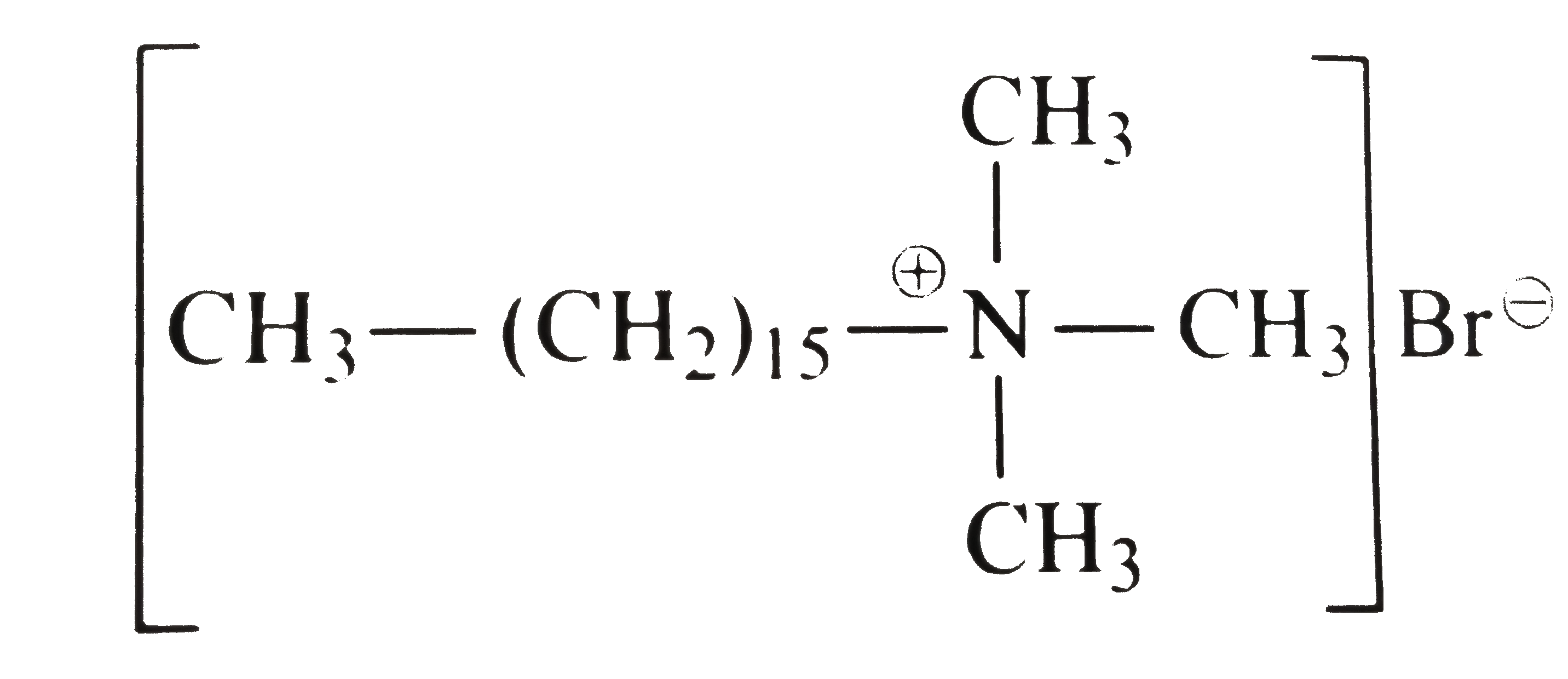
Write the structure of cety` ethy1` dimethy1 ammonium bromide, a compound with anitseptic property and also used as a cationic detergent.
Predict its solubity behaviour in water and diethy ether.
b. Write structure of cety` trimethy` ammonium bromide, a popular cationic dtergent used in hair condittiners.

Text Solution

Verified by Experts
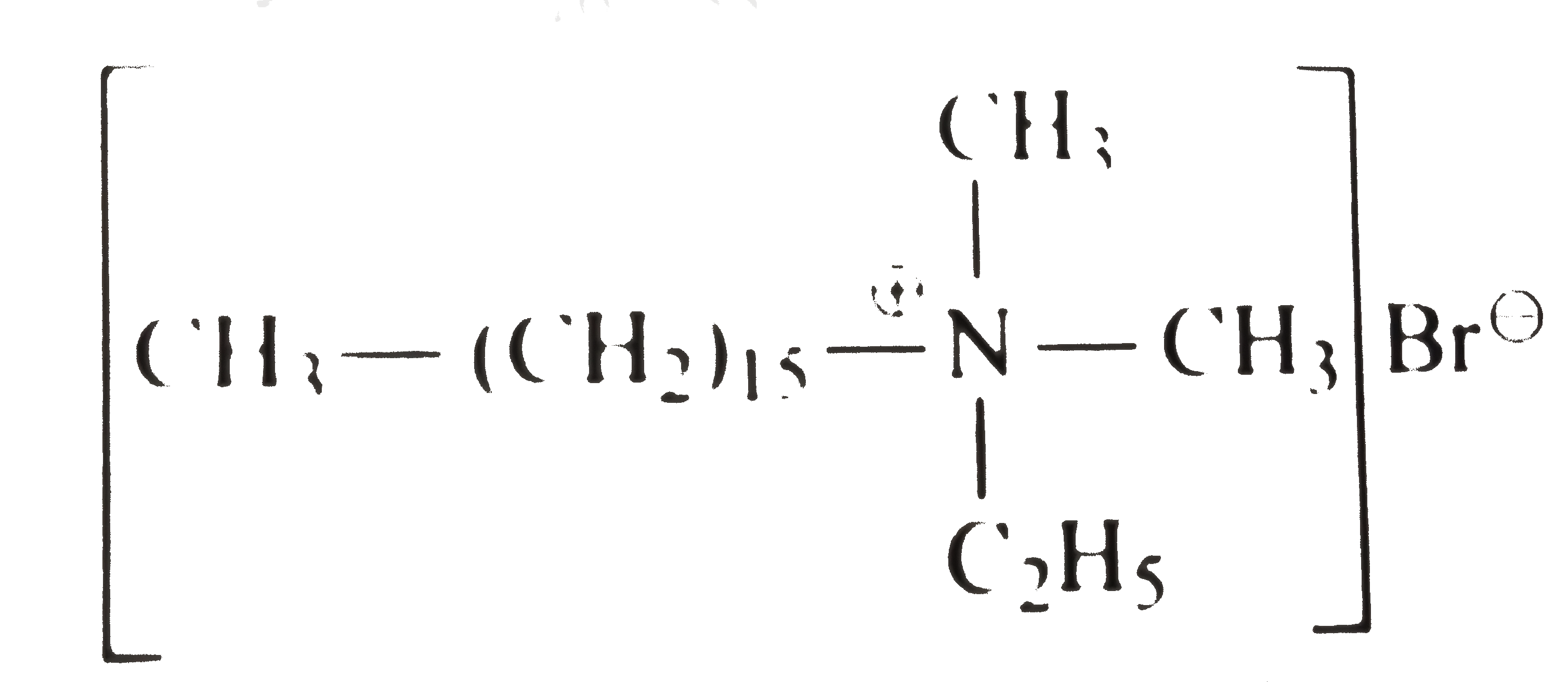
Cety1 = `C_(16) H_(33) --`
Due to the ionic character (a ture salt). It is soluble in `H_(2)O`. The organic cation and `Br^((-))` ion are well solvated by water molecule. It is also soluble in the solvent of low polartiy (diethy1 ether) due to the long chain, hydrophobic alky1 groups are held by van der waals forces between these alky groups and ether molecules.

Promotional Banner

Topper's Solved these Questions

  • CLASSIFICATION AND NOMENCLATURE OF ORGANIC COMPOUNDS

    CENGAGE CHEMISTRY|Exercise Exercises|10 Videos
  • CLASSIFICATION AND NOMENCLATURE OF ORGANIC COMPOUNDS

    CENGAGE CHEMISTRY|Exercise Concept Application Type|7 Videos
  • CLASSIFICATION AND NOMENCLATURE OF ORGANIC COMPOUNDS

    CENGAGE CHEMISTRY|Exercise Analytical and Descriptive Type|3 Videos
  • CHEMICAL EQUILIBRIUM

    CENGAGE CHEMISTRY|Exercise Archives (Subjective)|11 Videos
  • GENERAL ORGANIC CHEMISTRY

    CENGAGE CHEMISTRY|Exercise Analytical and Descriptive|1 Videos

Similar Questions

Explore conceptually related problems

Early crystallographers had trouble solving the structures of inorganic solids using X-ray diffraction because some of the mathematical tools for analyzing the data had not yet been developed. Once a trial structure was proposed, it was relatively easy to calculate the diffraction pattern, but it was difficult to go the other way (from the diffraction pattern to the structure) if nothing was known a priori about the arrangement of atoms in the unit cell. It was important to develop some guidelines for guessing the coordination numbers and bonding geometries of atoms in crystals. The first such rules were proposed by Linus Pauling, who considered how one might pack together oppositely charged spheres of different radii. Pauling proposed from geometric considerations that the quality of the "fit" depended on the radius ratio of the anion and the cation. If the anion is considered as the packing atom in the crystal, then the smaller catin fills interstitial sites ("holes"). Cations will find arrangements in which they can contact the largest number of anions. If the cation can touch all of its nearest neighbour anions then the fit is good. If the cation is too small for a given site, that coordination number will be unstable and it will prefer a lower coordination structure. The table below gives the ranges of cation/anion radius ratios that give the best fit for a given coordination geometry. {:("Coordiantion number","Geometry",rho =(r_("cation"))/(r_("amion"))),(2,"linear",0-0.155),(3,"triangular",0.155 - 0.225),(4,"tetrahedral",0.225 - 0.414),(4,"square planar",0.414 - 0.732),(6,"octahedral",0.414 - 0.732),(8,"cubic",0.732 - 1.0),(12,"cuboctahedral",1.0):} (Source : Ionic Radii and Radius Ratios. (2021, June 8). Retrieved June 29, 2021, from https://chem.ibretexts.org/@go/page/183346) A solid AB has square planar structure. If the radius of cation A^(+) is 120 pm, calculate the maximum possible value of anion B^(-) .

Cyclopentyl bromide on treatment with magnesium in dry ether forms an. organometallic compound (A), The organometallic compound reacts with ethanal to give an alcohol (B) after mild hydrolysis. Prolonged treatment of alcohol (B) with an equivalent amount of HBr givos 1-bromo 1- methylcyclohexane (C). Write the structure of (A), (B) and explain how (C) is obtained from (B)?

Cyclobutyl bromide on treatment with magnesium in dry ether forms an organometallic compound (A) . The organometallic compound (A) reacts with ethanol to give an alcohol (B) after mild acidification. Prolonged treatment of alcohol (B) with an equivalent amount of HBr gives 1-bromo-1-methylcyclopentane ( C) Write the structures of (A) and (B) , and explain how (C) is obtained from (B) .

Read the given passage and answer the questions number 1 to 5 that follow: The substitution reaction of alkyl halide mainly occurs by S_N 1 and S_N 2 mechanism. Whatever mechanism alkyl halides follow for the substitution reaction to occur, the polarity of the carbon halogen bond is responsible for these substitution reactions. The rate of S_N 1 reactions are governed by the stability of carbocation whereas for S_N 2 reactions steric factor is the deciding factor. If the starting material is a chiral compound, we may end up with an inverted product or racemic mixture depending upon the type of mechanism followed by alkyl halide. Cleavage of ethers with HI also governed by steric factor and stability of carbocation, which indicates that in organic chemistry, these two major factors help us in deciding the kind of product formed 1. Predict the stereochemistry of the product formed if an optically active alkyl halide undergoes substitution reaction by S_N 1 mechanism. 2. Name the instrument used for measuring the angle by which the plane polarised light is rotated. 3. Predict the major product formed when 2-Bromopentane reacts with alcoholic KOH. 4. Give one use of CHI_3 5. Write the structures of the products formed when anisole is treated with HI.