A
B
C
D
Text Solution
Verified by Experts
The correct Answer is:
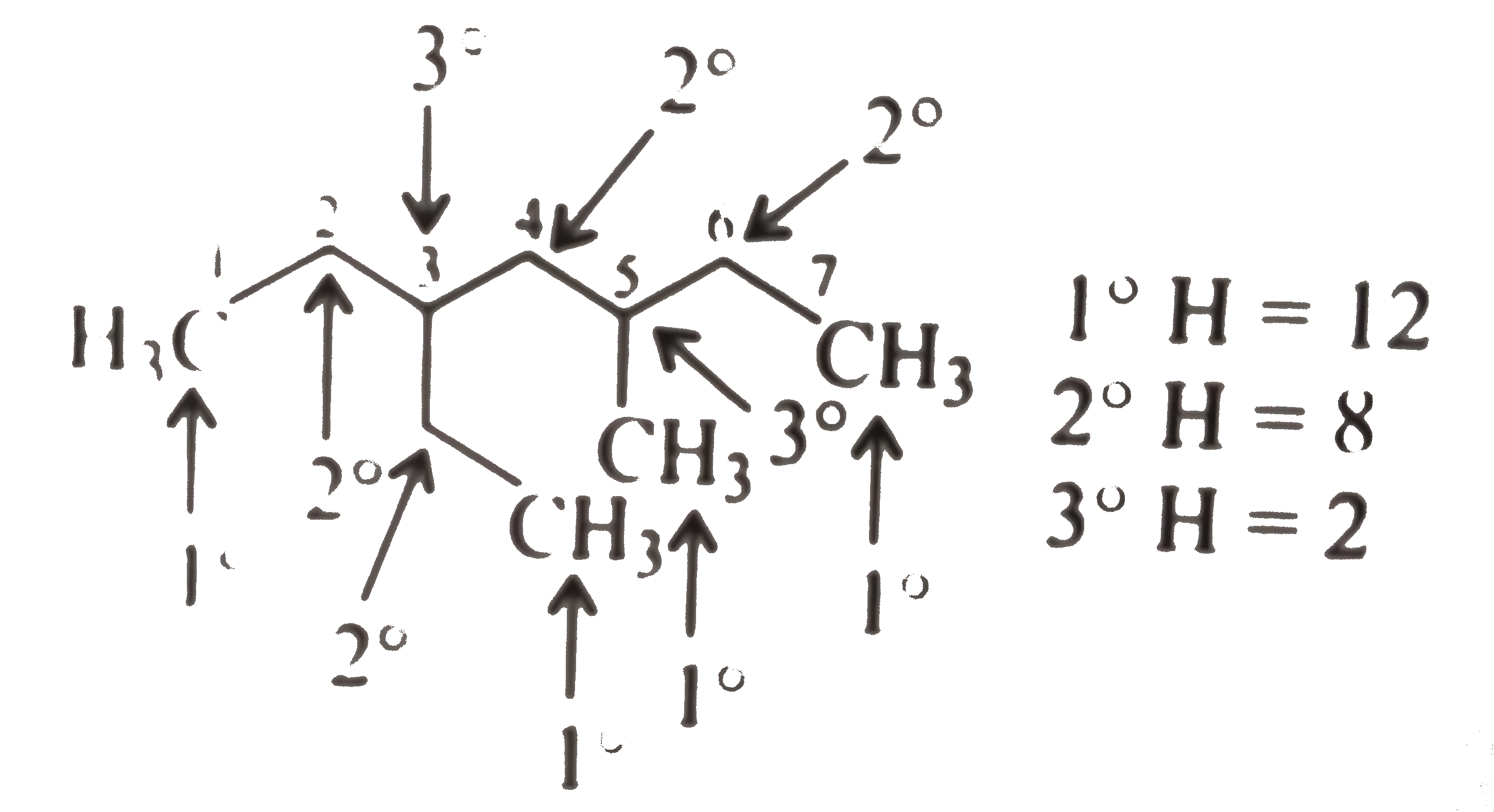



Topper's Solved these Questions
CLASSIFICATION AND NOMENCLATURE OF ORGANIC COMPOUNDS
CENGAGE CHEMISTRY|Exercise Assertion-Reasoning Type|5 VideosCLASSIFICATION AND NOMENCLATURE OF ORGANIC COMPOUNDS
CENGAGE CHEMISTRY|Exercise Fill in the Blanks Type|5 VideosCLASSIFICATION AND NOMENCLATURE OF ORGANIC COMPOUNDS
CENGAGE CHEMISTRY|Exercise Multiple corrcct Answers Types|11 VideosCHEMICAL EQUILIBRIUM
CENGAGE CHEMISTRY|Exercise Archives (Subjective)|11 VideosGENERAL ORGANIC CHEMISTRY
CENGAGE CHEMISTRY|Exercise Analytical and Descriptive|1 Videos
Similar Questions
Explore conceptually related problems
CENGAGE CHEMISTRY-CLASSIFICATION AND NOMENCLATURE OF ORGANIC COMPOUNDS-Single correct Answer Type
- The decreasig order of priority for the following functional groups is...
Text Solution
|
- The number of 1^(@), 2^(@), and 3^(@) H atoms in 2,5,6-trimethy1 octan...
Text Solution
|
- The number of 1^(@), 2^(@), and 3^(@) H atoms in 3-ethy1-5-methy1 hept...
Text Solution
|
- The number of sigma- and pi-bond in hexan-2,4-diol, respectively,is:
Text Solution
|
- The number of sigma- and pi-bond in 5-oxohexanoic acid, respectively, ...
Text Solution
|
- Which of the following is correctly named?
Text Solution
|
- The systematic naming of the following cycloalkane is
Text Solution
|
- In which of the following reactions, the principal group loses its pre...
Text Solution
|
- Which of the following is oxetane?
Text Solution
|
- The systematic nomencalutre of the following spiro-compound is:
Text Solution
|
- An alkane (A) having a molecular mass of 72 produces one monochlorinat...
Text Solution
|
- A compound (A) with molecular formula C(5) H(10) gives one monochlorin...
Text Solution
|
- Which of the following the following in a 3^(@) amine?
Text Solution
|
- Which of the following as a 3^(@) alcohol?
Text Solution
|
- Which of the following is zerone?
Text Solution
|
- Which of the following is pyrogallol?
Text Solution
|
- In 3-chloro cyclohexanol, the primary prefix is:
Text Solution
|
- In 2-Chloro-3-methyl hexanoic acid, the primary suffix is:
Text Solution
|
- The correct name of the compound (I) is:
Text Solution
|
- Which of the following is not a cumulated diene?
Text Solution
|