Home
Class 12
MATHS
Find the area of the greatest rectang...

Find the area of the greatest rectangle that can be inscribed in an ellipse `(x^2)/(a^2)+(y^2)/(b^2)=1`

Text Solution

Verified by Experts
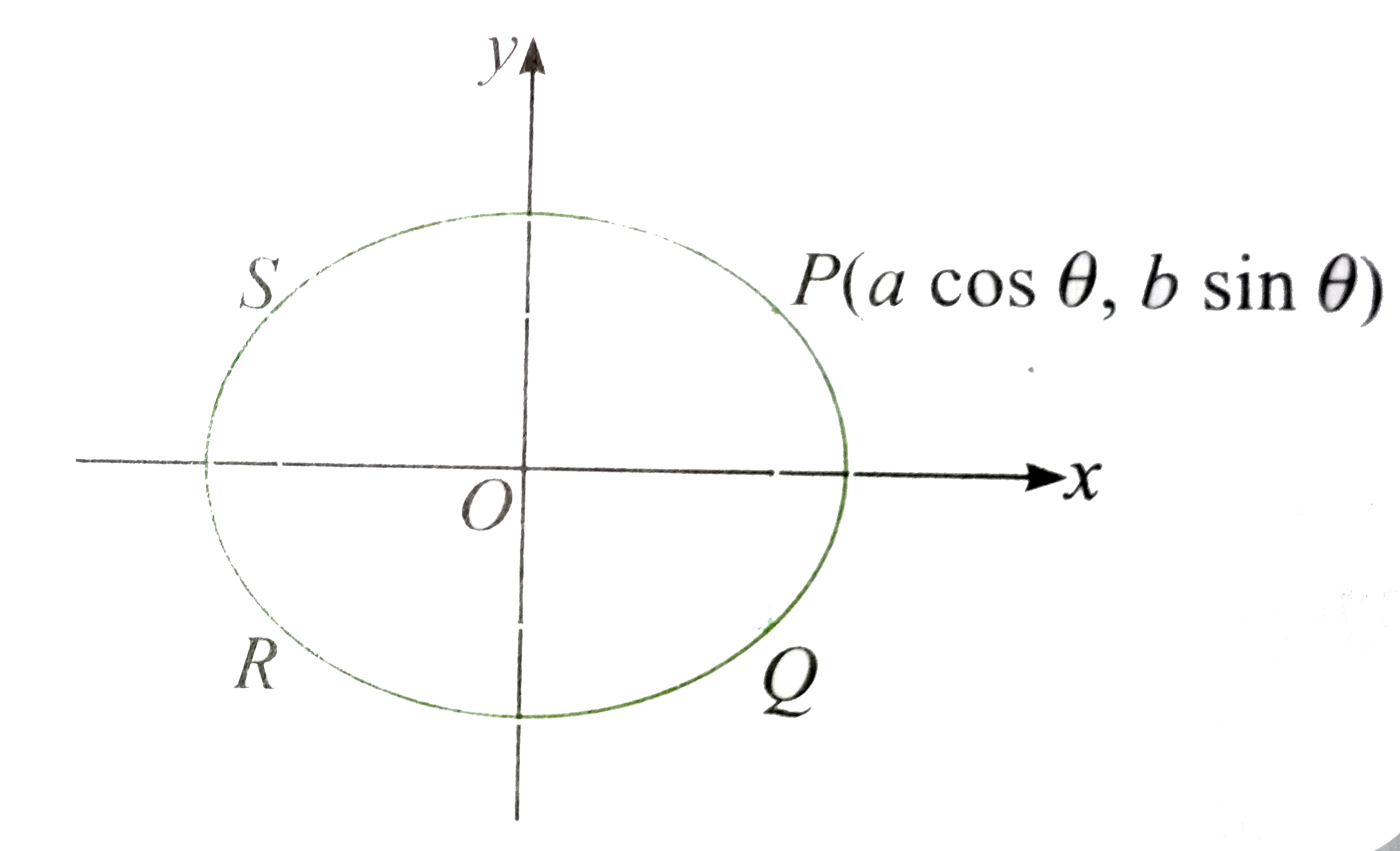
Reactangle can be inscribed in the ellipse with its sides parallel ot axes of theellipse as shown in the following figure.

Let `P-=(a cos theta, b sin theta)`
`:.` Area o reactangle PQRS
`=(2 a cos theta) (2b sin theta)`
`= 2ab sin 2 theta`
This is maximum when `sin 2 theta=1`
Henece, maximum area `=2ab(1)=2ab`
Promotional Banner

Topper's Solved these Questions

  • CUET MOCK TEST 2022

    XII BOARDS PREVIOUS YEAR|Exercise Question|49 Videos

Similar Questions

Explore conceptually related problems

Area of the greatest rectangle that can be inscribed in the ellipse (x^(2))/(a^(2))+(y^(2))/(b^(2))=1 is

The sides of the greatest rectangle that can be inscribed in the ellipse (x^(2))/(a^(2))+(y^(2))/(b^(2))=1 are

2.The area of the greatest rectangle that can be inscribed in the ellipse (x^(2))/(9)+y^(2)=1 is

Find the area of the greatest isosceles triangle that can be inscribed in the ellipse ((x^(2))/(a^(2)))+((y^(2))/(b^(2)))=1 having its vertex coincident with one extremity of the major axis.

The greatest side of the rectangle of the greatest area that can be inscribed in the ellipse x^(2)+2y^(2)=8 ,is

Find the maximum are of the isosceles triangle inscribed in the ellipse (x^(2))/(a^(2))+(y^(2))/(b^(2))=1, with its vertex at one end of major axis.

Find the maximum area of an isosceles triangle inscribed in the ellipse (x^(2))/(a^(2))+(y^(2))/(b^(2))=1 with its vertex at one end of the major axis.

The area of the rectangle of maximum area inscribed in the ellipse (x^(2))/(25)+(y^(2))/(16)=1 is

XII BOARDS PREVIOUS YEAR-BOARD PAPER SOLUTIONS-All Questions
  1. Evaluate: intx^2\ dotcos^(-1)\ x\ dx

    Text Solution

    |

  2. Evaluate : int1/(x+xlogx)\ dx

    Text Solution

    |

  3. Find the area of the greatest rectangle that can be inscribed in an...

    Text Solution

    |

  4. If the binary operation **, defined on Q, is defined as a**b=2a+b-a ...

    Text Solution

    |

  5. Find the value of the following: tan (1/2)[sin^(-1) ((2x)/(1+x^2))+c...

    Text Solution

    |

  6. Evaluate : int0^1 1/(sqrt(2x+3))\ dx

    Text Solution

    |

  7. Find a unit vector in the direction of vec a=2 hat i-\ 3 hat j+6 hat ...

    Text Solution

    |

  8. If [[y+2x,5],[-x,3]]=[[7, 5],[-2 ,3]], find the value of y

    Text Solution

    |

  9. Find the position vector of a point R which divides the line joinin...

    Text Solution

    |

  10. Find the Cartesian equation of the plane passing through the points...

    Text Solution

    |

  11. What is the cosine of the angle which the vector sqrt(2) hat i+ hat j+...

    Text Solution

    |

  12. On a multiple choice examination with three possible answers (out o...

    Text Solution

    |

  13. If A=(a(i j))= [[2, 3,-5],[1, 4, 9],[ 0, 7,-2]] and B=(b(i j))=[[2, 1,...

    Text Solution

    |

  14. Using elementary row operations, find the inverse of the following ...

    Text Solution

    |

  15. Let Z be the set of all integers and R be the relation on Z defined as...

    Text Solution

    |

  16. Evaluate : int(pi//6)^(pi//3)(sinx+cosx)/(sqrt(sin2x))\ dxdot

    Text Solution

    |

  17. If siny=xsin(a+y), prove that (dy)/(dx)=(sin^2(a+y))/(sina)

    Text Solution

    |

  18. If (cosx)^y=(cosy)^x , find (dy)/(dx)

    Text Solution

    |

  19. Evaluate: intx^2log(1+x)dx\

    Text Solution

    |

  20. Differentiate tan^(-1)[(sqrt(1+x^2)-1)/x] with respect to x

    Text Solution

    |

