

Home
Class 11
PHYSICS
A particle is projected in air at some ...

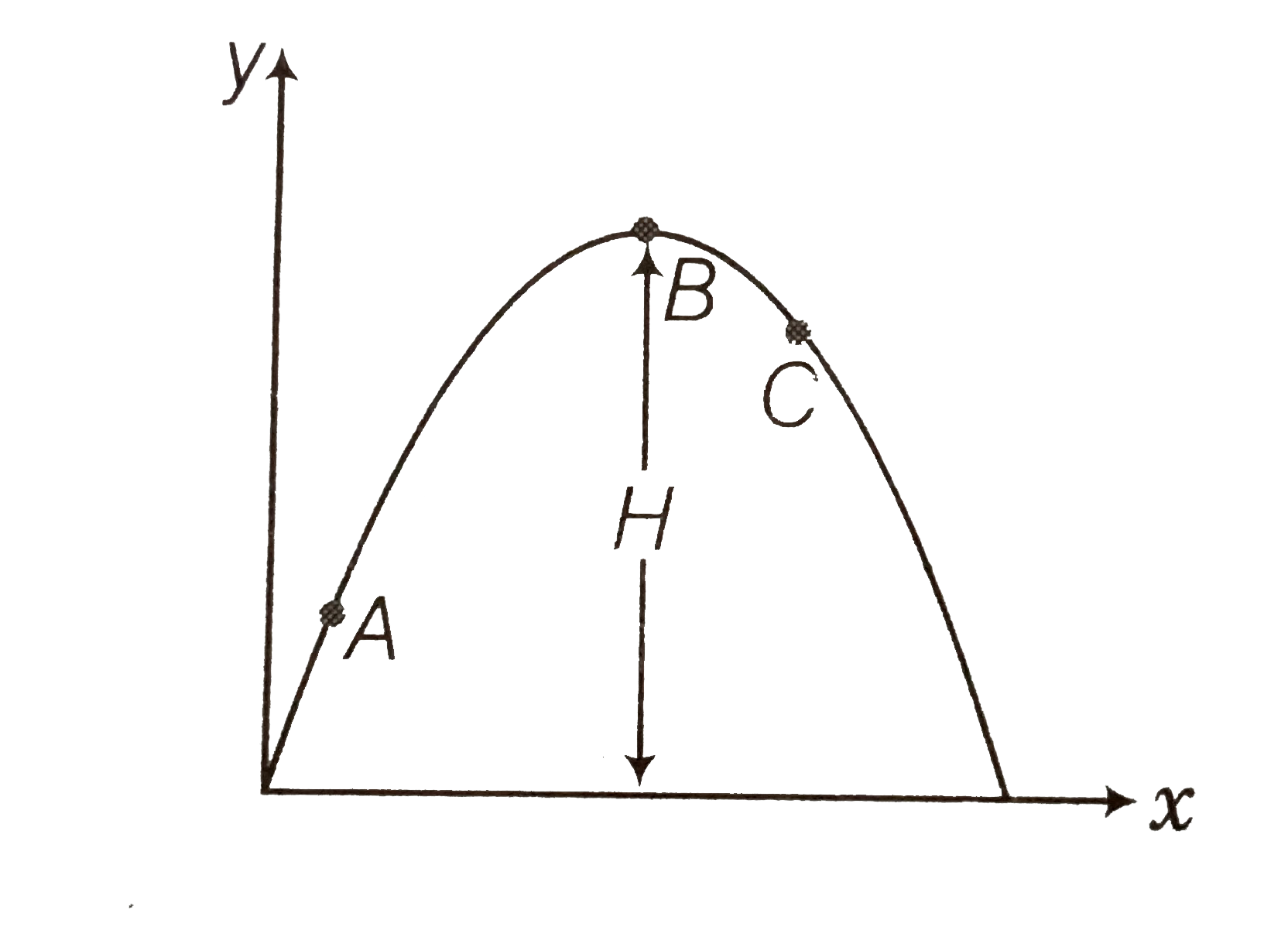
A particle is projected in air at some angle to the horizontal, moves along parabola as shown in figure where x and y indicate horizontal and vertical directions, respectively . Shown in the diagram, direction of velocity and acceleration at points A, B and C.

Promotional Banner

Similar Questions

Explore conceptually related problems

A particle is projected in air at some angle to the horizontal , moves along parabola shown in the figure where x and y indicate horizontal and verticle diections, respectively. Shown in the diagram, direction of velocity and acceleration at point A,B and C.

Path of a projectile is shown in figure then the direction of acceleration at point A, B and C are respectively :-

Find the velocity of the image of a moving object in situation shown in figure in which object and mirror velocities in horizontal and vertical directions are shown.

A particle is projected from ground at some angle with horizontal (Assuming point of projection to the origin and the horizontal and vertical directions to be the x and y axis) the particle passes through the points (3, 4) m and (4, 3) m during its motion then the range of the particle would be : (g=10 m//s^(2))

A particle is projected from ground at some angle with horizontal (Assuming point of projection to the origin and the horizontal and vertical directions to be the x and y axis) the particle passes through the points (3, 4) m and (4, 3) m during its motion then the range of the particle would be : (g=10 m//s^(2))

A particle is projected from a point P with a velocity v at an angle theta with horizontal. At a certain point Q it moves at right angles to its initial direction. Then

A particle is projected from a point P with a velocity v at an angle theta with horizontal. At a certain point Q it moves at right angles to its initial direction. Then

A particle is projected from a point P with a velocity v at an angle theta with horizontal. At a certain point Q it moves at right angles to its initial direction. Then