Home
Class 12
CHEMISTRY
How does a transition metal ion acquire ...

How does a transition metal ion acquire a colour?

Text Solution

Verified by Experts
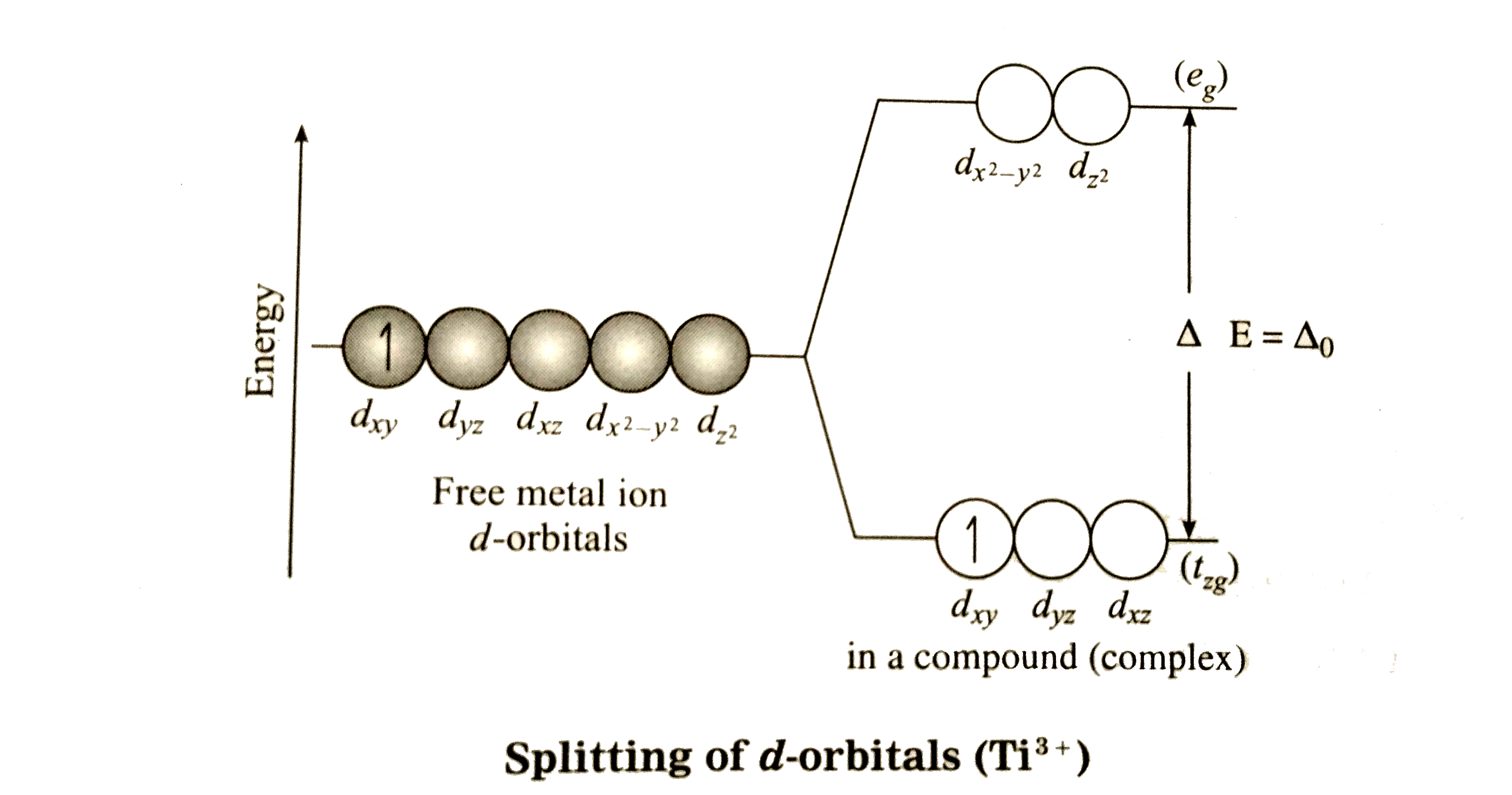
(1) The transition metal ions has have incompelety filled (n-1) d-orbitlas.
(2) d-orbitals are degenerte orbitals, i.e., all five suborbitals of d-orbitals namely `d_(xy) , d_(yz), d_(x^(2) - y^(2)), d_(z^(2))` have nearly equal energy in a free metal ions.
(3) In compounds , in the pressnce of anions or complexing ligands, degenergy is lost and these five degenerate d-orbitals splits into two groups as follows.
(i) One group of d-orbitals have lower energy and consists of three orbitals namely `d_(xy)d_(xy)` and `d_(xy)` .They are called `t_(2g)` orbitals .
(ii) The second group of d-orbitals have higher energy and consist two orbitals `d_(x^(2) - y^(2))` and `d_(z^(2))` and they are called `e_(g)` orbitals.

(4) They energy differenec `DeltaE` between these two sets of d-orbitals is called crystal be field splitting energy (CFSE).
(5) `DeltaE` has very small value equal to the energy of electromagnetic radiation in the visible region `(DeltaE hu = (hc)/(lambda))`
(6) There ariese a transition of one or more unpaired electrons form `t_(2g)` orbitals to `e_(g)` orbitals due to the absorption of radiation in the visible region.
(7) When the electron d-orbitals `(t_(2g))` it transmits the light that is complementary in colour to colour of radiation absorbed. This imparts a characteristic colour to the compound or a metal ion.
For example in the figure the transition of one elecrons `(3d^(1))` in the complex `[Ti(H_(2)O)_(6)]^(3+)` is shown.
Promotional Banner

Similar Questions

Explore conceptually related problems

Which of the following transition metal ion is not coloured?

In which of the following transition metal ion complexes, the colour in not due to d-d transition?

Which of the following transition metal ions is colourless ?

Give reason in one or two sentences ''Most transition metal compound are coloured''.

