Home
Class 12
CHEMISTRY
Explain the octablral geometry of co...

Explain the octablral geometry of complexes using crystal field theory.

Text Solution

Verified by Experts
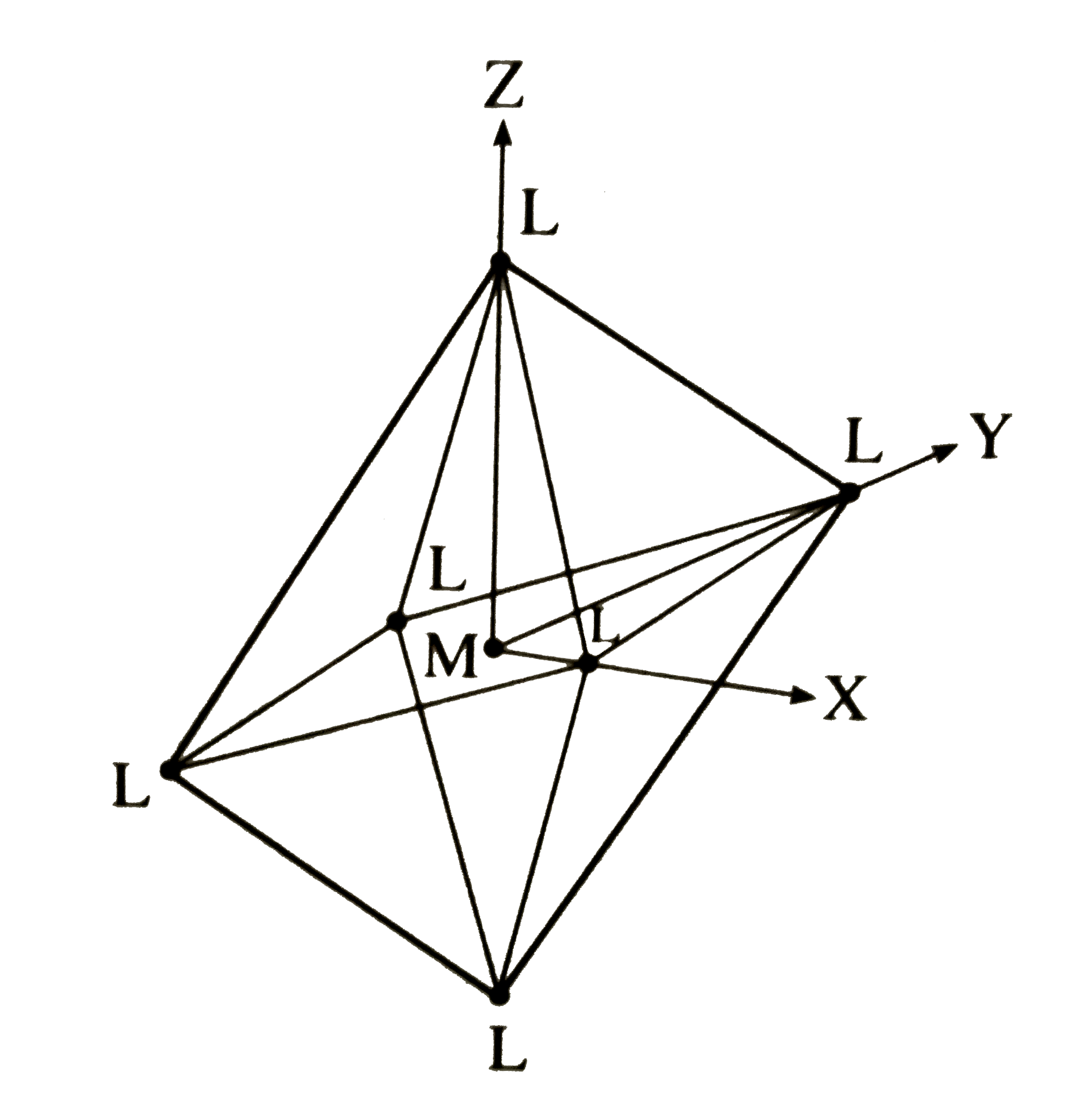
(1) In an octahedral complex `[MX_(6)]^(n pm)`+, the metal atom or ion is placed at the centre of regular octaherdron at six vertices of the octahedron.

(2) Among five degenerate d-orbitals, two orbitals namely `d_(x^(2) - y^(2))` and `d_(z^(2))` are axial and have maximum electron density along the axes, while remaing three d-oritals namely `d_(xy) ,d_(yz) ` and `d_(zx)` are planar and have maximum electron density in the planes and in- bewteen the axes.
(3) Hence, when the ligands approach a metal ion, the orbitals `d_(x^(2)-y^(2))` and `d_(z^(2))` experience greater repulsion and the orbitals `d_(xy) ,d_(yz) and d_(zx)` experience less repulsion.
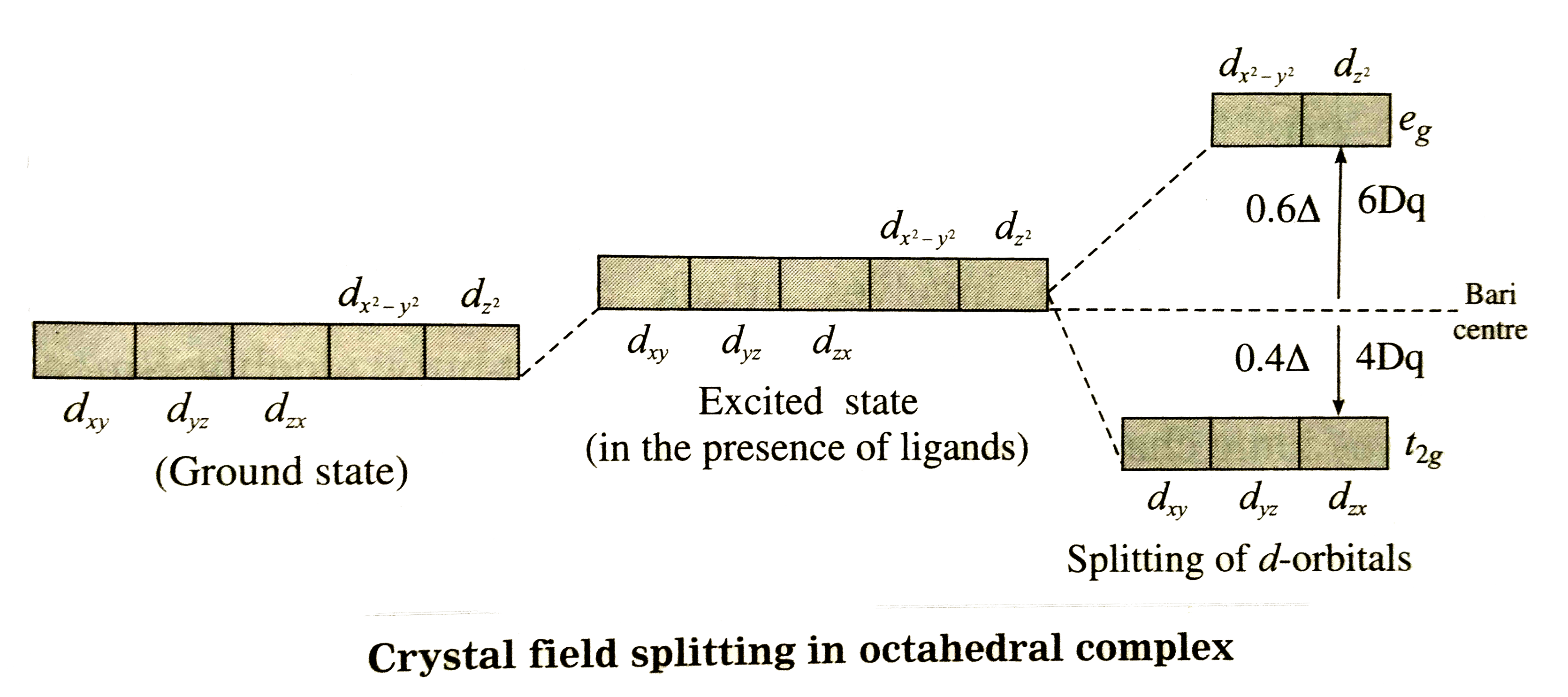
(4) Therefore the energy of `d_(x^(2) - y^(2))` and `d_(z^(3))` increase while the energy of `d_(xy), d_(yz) and d_(zx)` decrease and five d - orbital lose degeneracy and split into two point group . The orbitals `d_(xy), d_(xy) and d_(zx)` form `t_(2g)` group of lower energy while `d_(x^(2) - y^(2))` and `d_(z^(2))` form `e_(g)` group of higher energy .
Thus `t_(2g)` has three degenerate orbitals while `e_(g)` has two degenerate orbitals.

(5) Experimental calculations show that the energy of `t_(2g)` orbitals is lowered by `0.4Delta_(0)` or `4D_(q)` and energy of `e_(g)` orbital is increased by `0.6Delta` or `6D_(q)`. Thus energy difference between ty and eg orbitals is `Delta_(0)` or `10D_(q)` which is crystal field splitting energy.
(6) CFSE increases with the increasing strength of ligands and oxidation state of central metal ion.
Promotional Banner

Similar Questions

Explore conceptually related problems

According to crystal field theory (CFT) :

The hexaquo manganese(II) ion contains five unpaired electrons, while the hexacyanoion contains only one unpaired electron. Explain using the crystal field theory.

Crystal field theory was proposed by H.beths (1929) and Van Vleck (1932) and as originally applied to ionic crystals to explain their optical properties and is, therefore, called crystal field theory, however, this theory was applied to the study of coordination compounds in 1950 and this theory accounts for more satisfactory expalnation for the properties of complexes especially colour and magnetism. What is the geometry of [Co(NH_(3))_(6)]^(2+) ?

Crystal field theory was proposed by H.beths (1929) and Van Vleck (1932) and as originally applied to ionic crystals to explain their optical properties and is, therefore, called crystal field theory, however, this theory was applied to the study of coordination compounds in 1950 and this theory accounts for more satisfactory expalnation for the properties of complexes especially colour and magnetism. Which of the following complex is paramagnetic in nature ?

Crystal field theory was proposed by H.beths (1929) and Van Vleck (1932) and as originally applied to ionic crystals to explain their optical properties and is, therefore, called crystal field theory, however, this theory was applied to the study of coordination compounds in 1950 and this theory accounts for more satisfactory expalnation for the properties of complexes especially colour and magnetism. What is the hybridisation of [Ni(H_(2)O)_(6)]^(2+) ?