Home
Class 12
PHYSICS
The acceleration of a particle performin...

The acceleration of a particle performing S.H.M. at mean position is

Text Solution

Verified by Experts
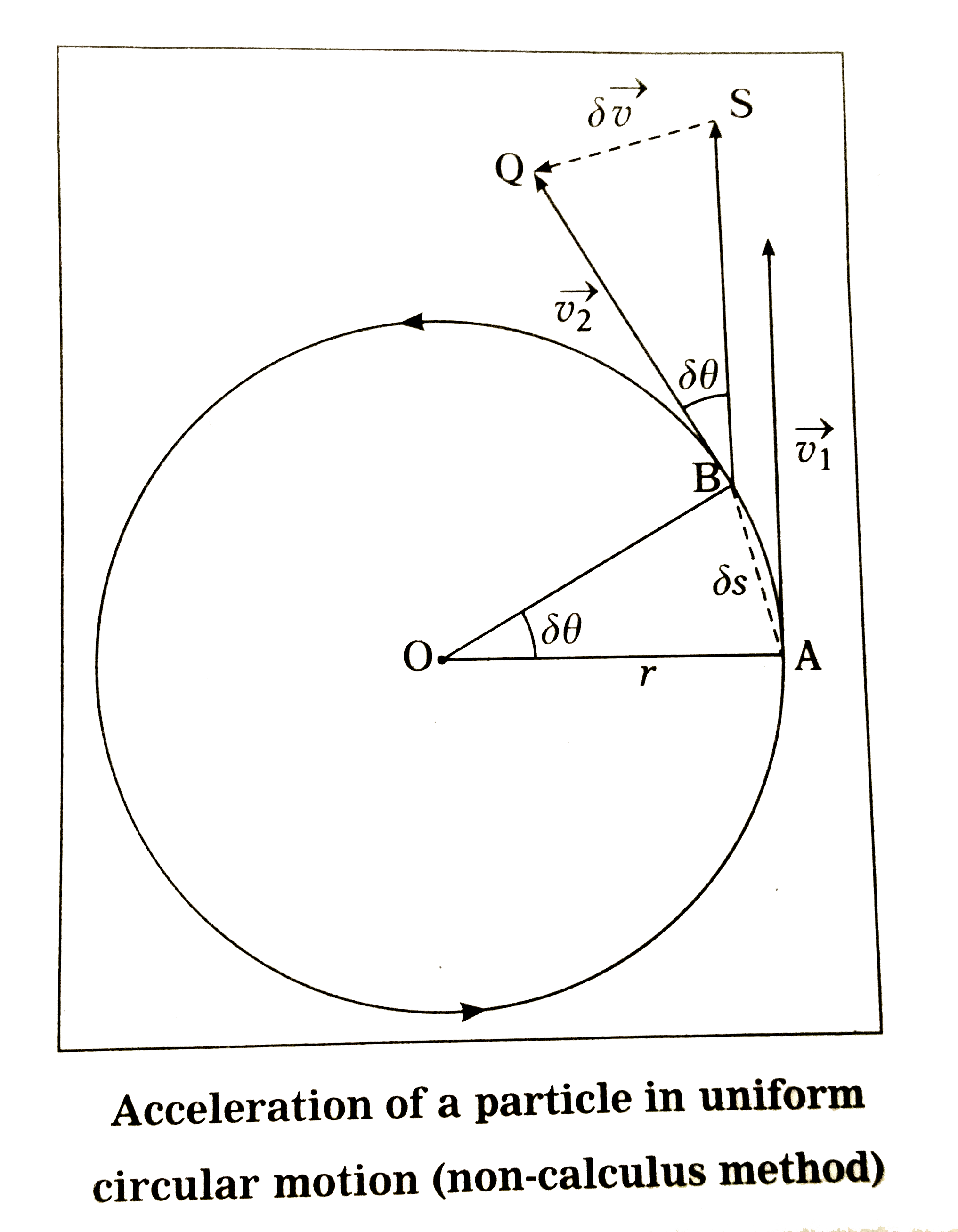
Consider a particle performing uniform circular motion along a circular path of radius r in the anticlockwise sense as shown in the figure. Let v and `omega` denote respectively the linear and the angular speed of the particle. In a very small time inerval `deltat`, the particle moves along the circumference from point A to point B through a distance `deltas` and readius vector `vecr` rotates through an angle `deltatheta`.
The linear velocity `vecv` of the particle at any instant is tangential, in the direction of motion. THe direction of `vecv` changes constantly, though its magnitude v remains constant in UCM `vecv_(1)` and `vecv_(2)` are the velocities of the particle at A and B, respectively.
To find the change in velocity `deltavecv` of the particle in time `deltat`, we redraw the vector `vecv_(1)` at B so that `vec(BS) = vec(v_(1))`
`vec(BS)+vec(SQ)=vec(BQ)`
`therefore vec(SQ)=vec(BQ)-vec(BS)=vec(v_(2))-vec(v_(1))=deltavecv`
When the radius vector rotates through an angle `deltatheta`, the tangent to the radius vector also rotates through the angle `deltatheta` Hence, triangle OAB and BSQ are similar.
`therefore(SQ)/(AB)=(BS)/(OA)`
Now, `SQ = |deltavecv|,AB =deltas,BS = v and OA = r`
`therefore (|deltavecv)/(deltas)=(v)/(r)" "therefore(|deltavecv|)/(deltat)=(v)/(r)*(deltas)/(deltat)`
The acceleration of the particle is the time rate of change of its velocity.
`thereforea = (|dvecv|)/(dt)=lim_(deltat to0)(|deltavecv|)/(deltat)`
`=(u)/(v)=lim_(deltat to 0)(deltaS)/(deltat)=(u)/(v)*(ds)/(dt)=(u)/(v)*v" "(therefore(ds)/(dt)=v)`
`therefore a = (v_(2))/(r )`
Thus give the magnitude of the accerleration `veca` of the particle. THe direction of `veca` is the smae as that of `deltavecv` in the limit `deltat to 0`, As `deltat to 0`, point B is very close to A and `deltatheta to 0` . Then `deltavecv` becomes perpendicular to `vecv` itself-radially inward. Hence, the accerleration of a particle performing UCM is directed towards the centre O of the circle, and it is called the radial or centripetal acceleration, `a_(c )`.
Using the relation `v = omegar`
`a_(c)=(v_(2))/(r)=omega^(2)r=vomega`
If `hatr` is a unit vector along `vecr(vecr = rhatr)`, we can write
`veca_(c)=-(v^(2))/(r)hatr=-(omega^(2)r)hatr-omega^(2)vecr`
Where minus sign shows that the direction of `veca_(c )` is opposite to that of `vecr`.
Promotional Banner

Topper's Solved these Questions

  • DERIVATIONS-I

    NAVNEET PUBLICATION - MAHARASHTRA BOARD|Exercise Gravitation|7 Videos
  • DERIVATIONS-I

    NAVNEET PUBLICATION - MAHARASHTRA BOARD|Exercise Rotational Motion|13 Videos
  • DEFINITIONS

    NAVNEET PUBLICATION - MAHARASHTRA BOARD|Exercise COMMUNICATION SYSTEMS|3 Videos
  • DERIVATIONS-II

    NAVNEET PUBLICATION - MAHARASHTRA BOARD|Exercise Assignments|9 Videos

Similar Questions

Explore conceptually related problems

The acceleration of a particle performing S.H.M. at extreme position is

The particle performing S.H.M., about mean position it has

The velocity of a particle performing S.H.M. at mean position is

The acceleration of a particle executing S.H.M. is

The kinetic energy of a particle performing S.H.M. at mean position is

What is the acceleration of a particle executing S.H.M. at its mean position.?

The potential energy of a particle performing S.H.M. at mean position is

The potential energy of a particle performing S.H.M. at mean position is

The velocity of a particle performing S.H.M. at extreme position is

The velocity of a particle performing S.H.M. at any position

