Home
Class 12
PHYSICS
The maximum speed with which a vehicle c...

The maximum speed with which a vehicle can be safely driven along curved road of radius r, banked at angle `theta ` is

Text Solution

Verified by Experts
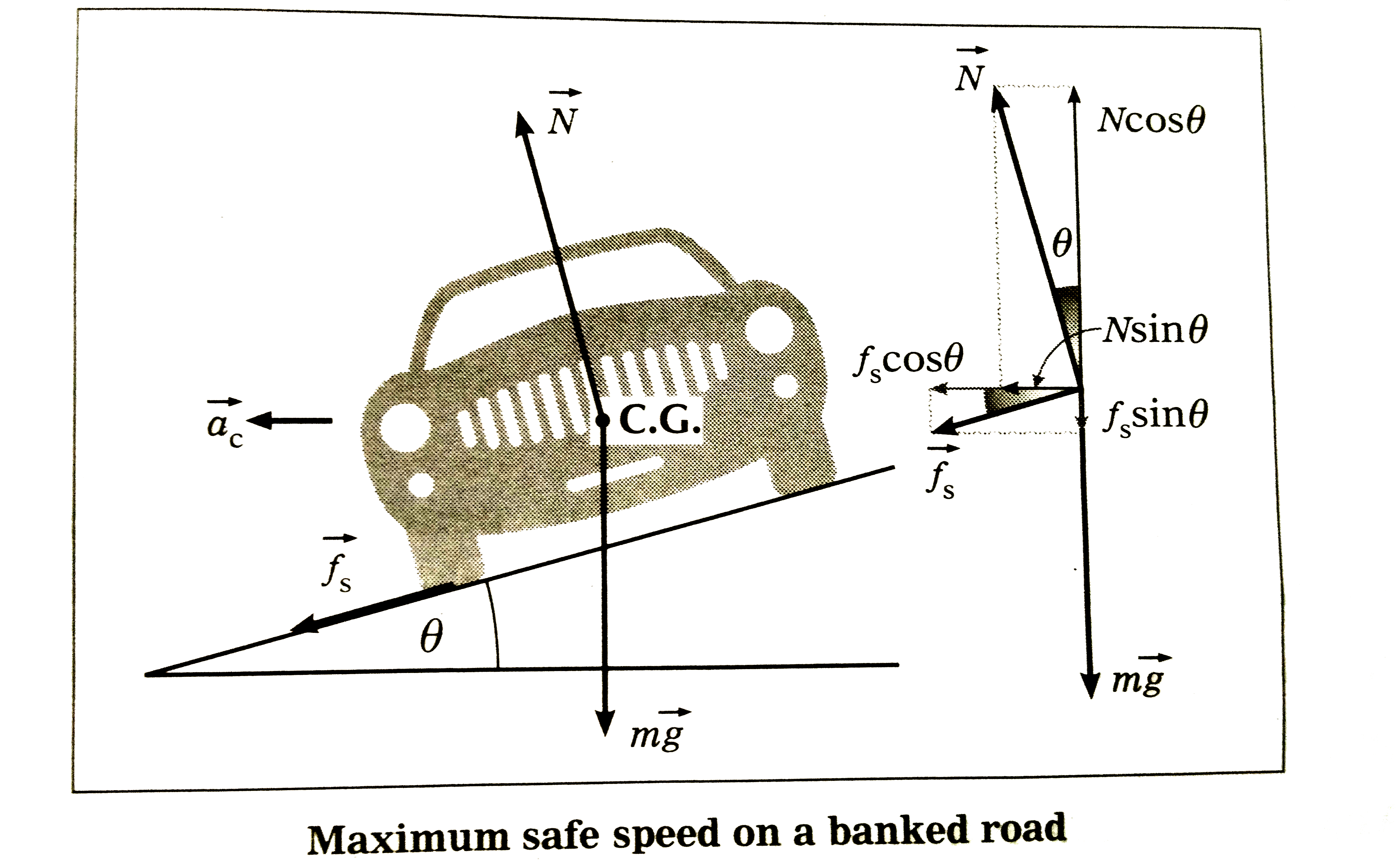
Consider a car taking a left turn along a road of radius r banked at an angle `theta` for a designed optimum speed v. Let m be the mass of the car. In general, the forces acting on the car are
(a) its weight `vec(mg)` , acting vertically down
(b) the normal reaction of the road `vec(N)`, perpendicular to the road surface.
(c ) the frictional force `vecf_(s)` along the inclined surface of the road.

If `mu_(s)` is the coefficient of static friction between the tyres and raod, `f_(s) = mu_(s)N`. If the car is driven fast enough, at a speed greater than the optimum speed v, it may skid up the incline so that `vec(f_(s))` is down the incline.
Resolve `vecN` and `vec(f_(s))` into (i) ` cos theta` vertically up and `f_(s) sin theta` vertically down (ii) `N sin theta` and `f_(s) cos theta` horizontally towards the centre of the circular path. So long as the car takes the turn without skidding off, the horizontal components `N sin theta` and `f_(s) cos theta` together provide the necessary centripetal force, and `N cos theta` balances the sum `mg + f_(s) sin theta`. If `v_(max)` is the maximum safe speed of the car (without skidding),
`(mv_(max)^(2))=N sin theta+f_(s)costheta+mu_(s)N cos theta`
` = N ( sin theta + mu_(s) cos theta) " "`...(1)
and `N cos theta = mg + f_(s) sin theta = mg + mu_(s) N sin theta`
`therefore mg = N(cos theta - mu_(s) sin theta) " "`...(2)
Dividing Eq. (1) by Eq. (2),
`(mv_(max)^(2)//r)/(mg)=(N(sin theta +cos theta))/(N(cos theta-mu_(s)sintheta))`
`therefore (v_(max)^(2))/(rg)=(sin theta+mu_(s) cos theta)/(cos theta-mu_(s) sin theta)=(tan theta +mu_(s))/(1-mu_(s)tan theta)`
`therefore v_(max) = sqrt((rg(tan theta +mu_(s)))/(1-mutantheta))" "...(3)`
At the optimum speed, the friction between the car tyres and the road surface is not called into play. Hence, by setting `mu_(s) 0` in Eq. (3), the optimum speed of a car on a banked circular road is
`v = sqrt(rg tan theta) " "...(4)`
Promotional Banner

Topper's Solved these Questions

  • DERIVATIONS-I

    NAVNEET PUBLICATION - MAHARASHTRA BOARD|Exercise Gravitation|7 Videos
  • DERIVATIONS-I

    NAVNEET PUBLICATION - MAHARASHTRA BOARD|Exercise Rotational Motion|13 Videos
  • DEFINITIONS

    NAVNEET PUBLICATION - MAHARASHTRA BOARD|Exercise COMMUNICATION SYSTEMS|3 Videos
  • DERIVATIONS-II

    NAVNEET PUBLICATION - MAHARASHTRA BOARD|Exercise Assignments|9 Videos

Similar Questions

Explore conceptually related problems

For a curved track of radius R, banked at angle theta

The maximum speed with which a vehicle can negotiate a cuved road, which is banked at the angle theta=tan^-1(0.24) is 54 km//hr . IF the same road is flat and vehicle has to negotiate the curve with same maximum speed, the coefficient of friction between the road and tyres of the vehicle should be

Find the maximum speed with which a car be safely driven along a curve of radius 100 , . If the coefficient of fricition between its tyres and the road is 0.2.

The maximum speed of a car which can be safely driven along a curve of radius 10 m , If the coefficient of friction between the tyres and the road is 0.5, is (g=9.8 m//s^(2))

Keeping the banking angle same , to increase the maximum speed with which a vehicle can traveln on the curve road by 10 % , the radius of curvature of the road has to be changed from 20 m to

What will be the maximum speed of a car when it safely driven along a curved road of radius 100 m ? (mu=0.2)

The maximum speed with which a vehicle can take safely circular turn on a horizontal flat rough road is (where symbols have their usual meanings)

