


Similar Questions
Explore conceptually related problems
Recommended Questions
- A mass M is suspended by two springs of force constants K(1) and K(2) ...
Text Solution
|
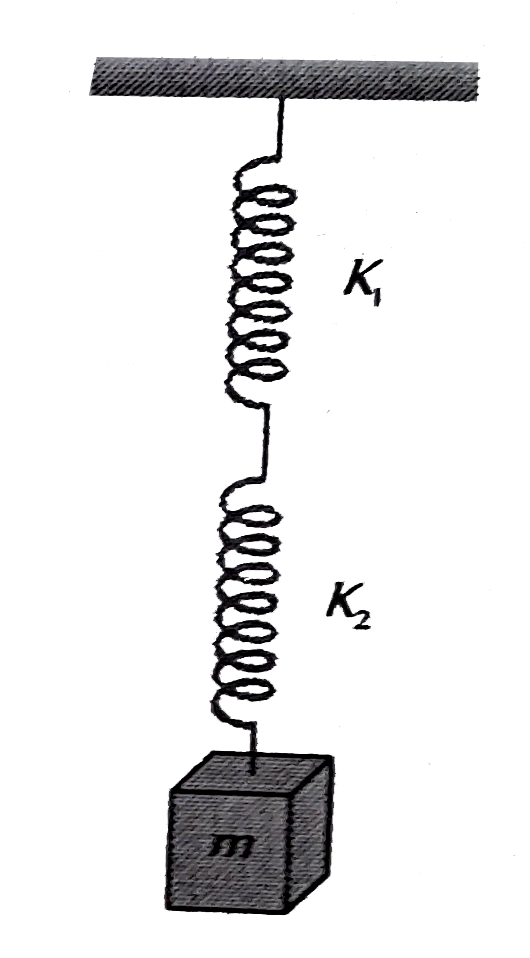
- A mass m is suspended from the two coupled springs connected in series...
Text Solution
|
- A mass M is suspended by two springs of force constants K(1) and K(2) ...
Text Solution
|
- Two springs have force constants k(1) " and " k(2) (k(1) gt k(2)) . On...
Text Solution
|
- Two springs are jonied and connected to a mass m as shown in figure. I...
Text Solution
|
- As shown in the figure, two light springs of force constant k(1) and k...
Text Solution
|
- The spring constants of two springs of same length are k(1) and k(2) a...
Text Solution
|
- Two spring of force constants K(1) and K(2) (K(1)gtK(2)) are stretched...
Text Solution
|
- Two spring of force constants K(1) and K(2) (K(1)gtK(2)) are stretched...
Text Solution
|