Home
Class 12
PHYSICS
Consider the charges q,q and -q placed a...

Consider the charges q,q and -q placed at the vertices of an equilateral triangle of each side l. What is the force on each charge ?

A

`q^(2)/(4sqrt2piepsilon_(0)l^(2))`

B

`(-q^(2))/(4piepsilon_(0)l^(2))`

C

`(q^(2))/(4piepsilon_(0)l^(2))`

D

zero

Text Solution

Verified by Experts

The correct Answer is:
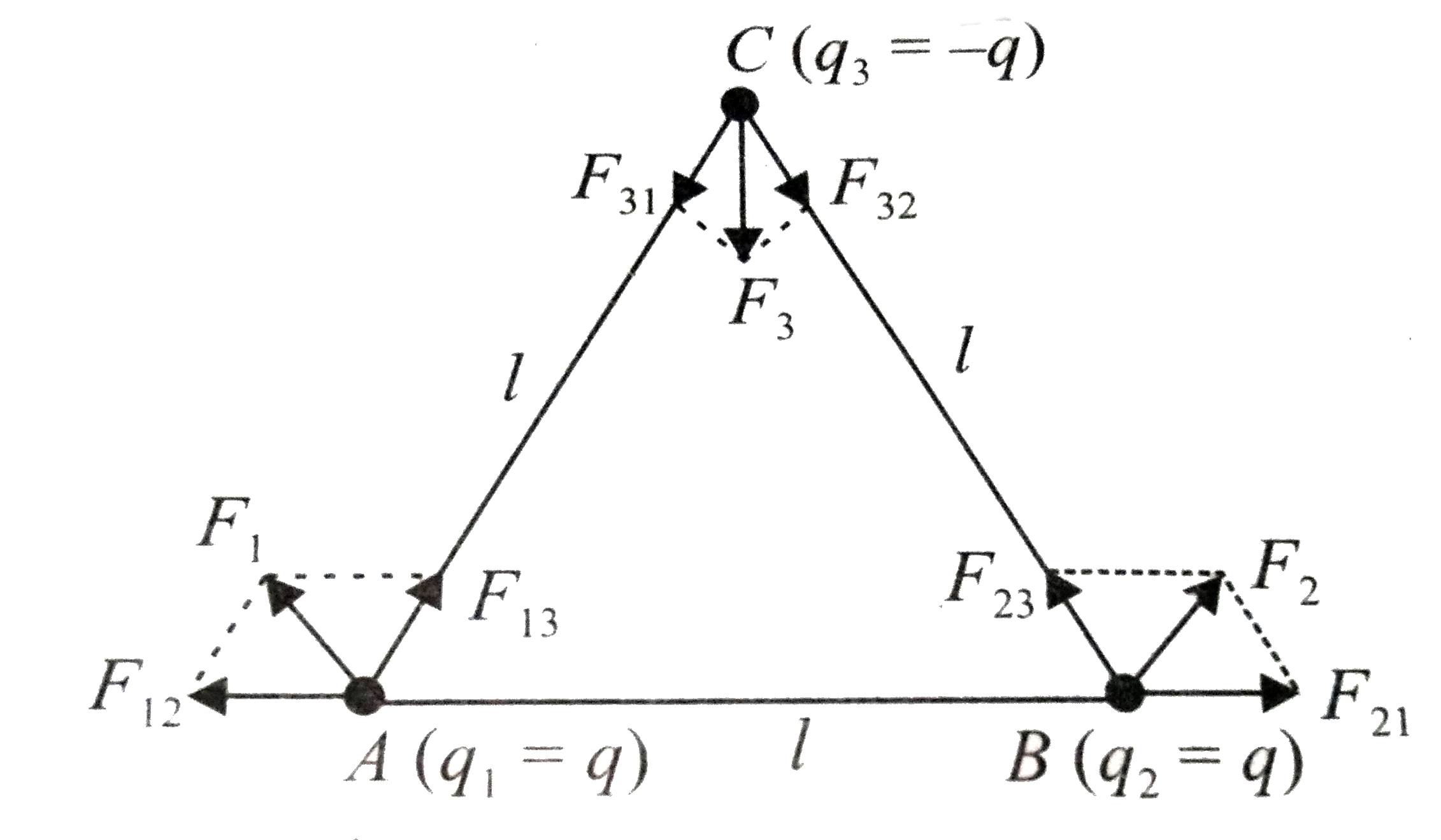
D

From diagram, force on `q_(1)(=q)` at A,

`vecF_(1)=vecF_(12)+vecF_(13)=Foverset(""^^)(r)_(1)`
where `F=q^(2)/(4piepsilon_(0)l^(2))and oversetwedge(r)_(1)`, is the unit vector along BC
Force on `q_(2)(=q)` at B, `vecF_(2)=vecF_(21)+vecF_(23)=Foversetwedge(r)_(2)`
(where `oversetwedge(r)_(2)` is the unit vector along AC)
Force on `q_(2)(=-q)` at C,
`vecF_(3)=vecF_(31)+vecF_(32)=(sqrt(F^(2)+F^(2)+2F Fcos60^(@)))oversetwedge(n)=sqrt3Foversetwedge(n)`
where `oversetwedge(n)` = unit vector along the direction bisecting `angleBCA`
`therefore" "vecF_(1)+vecF_(2)+vecF_(3)=0`
Promotional Banner

Topper's Solved these Questions

  • ELECTRIC CHARGES AND FIELDS

    NCERT FINGERTIPS|Exercise Electric Field|16 Videos
  • ELECTRIC CHARGES AND FIELDS

    NCERT FINGERTIPS|Exercise MCQs|2 Videos
  • ELECTRIC CHARGES AND FIELDS

    NCERT FINGERTIPS|Exercise Coulomb'S Law|13 Videos
  • DUAL NATURE OF RADIATION AND MATTER

    NCERT FINGERTIPS|Exercise Assertion And Reason|15 Videos
  • ELECTROMAGNETIC INDUCTION

    NCERT FINGERTIPS|Exercise Assertion And Reason|15 Videos

Similar Questions

Explore conceptually related problems

Consider three charges q_(1),q_(2) and q_(3) each equal to q at the verticles of an equilateral triangle of side 'l' what is the force on any charge due to remianing charges.

Three point charges q are placed at three vertices of an equilateral triangle of side a. Find magnitude of electric force on any charge due to the other two.

Charge of 5 mu C each are placed at the corners of an equilateral triangle of side 10 cm. Then the force on each charge is :-

(a) Three point charges q,-4q and 2q are placed at the vertices of an equilateral triangle ABC of side 'l' as shown in the figure. Obtain the expression for the magnitude of the resultant electric force acting on the charge q. (b) Find out the amount of the work 4one to separate the charges at infinite distance.

Three positive charges of equal magnitude q are placed at the vertics of and equilatral triangle of side l. How can the system of charges be palced in equilibrium?

Three charges Q, (+q) and (+q) are placed at the vertices of an equilateral triangle of side l as shown in the figure. It the net electrostatic energy of the system is zero, then Q is equal to

Three charge -q,+q and -q are placed at the cornors of an equilateral triangle of side a The resultant electric froce an a charge +q placed at a the centroid O of the triangle is

