Home
Class 12
PHYSICS
An electric dipole consists of charges p...

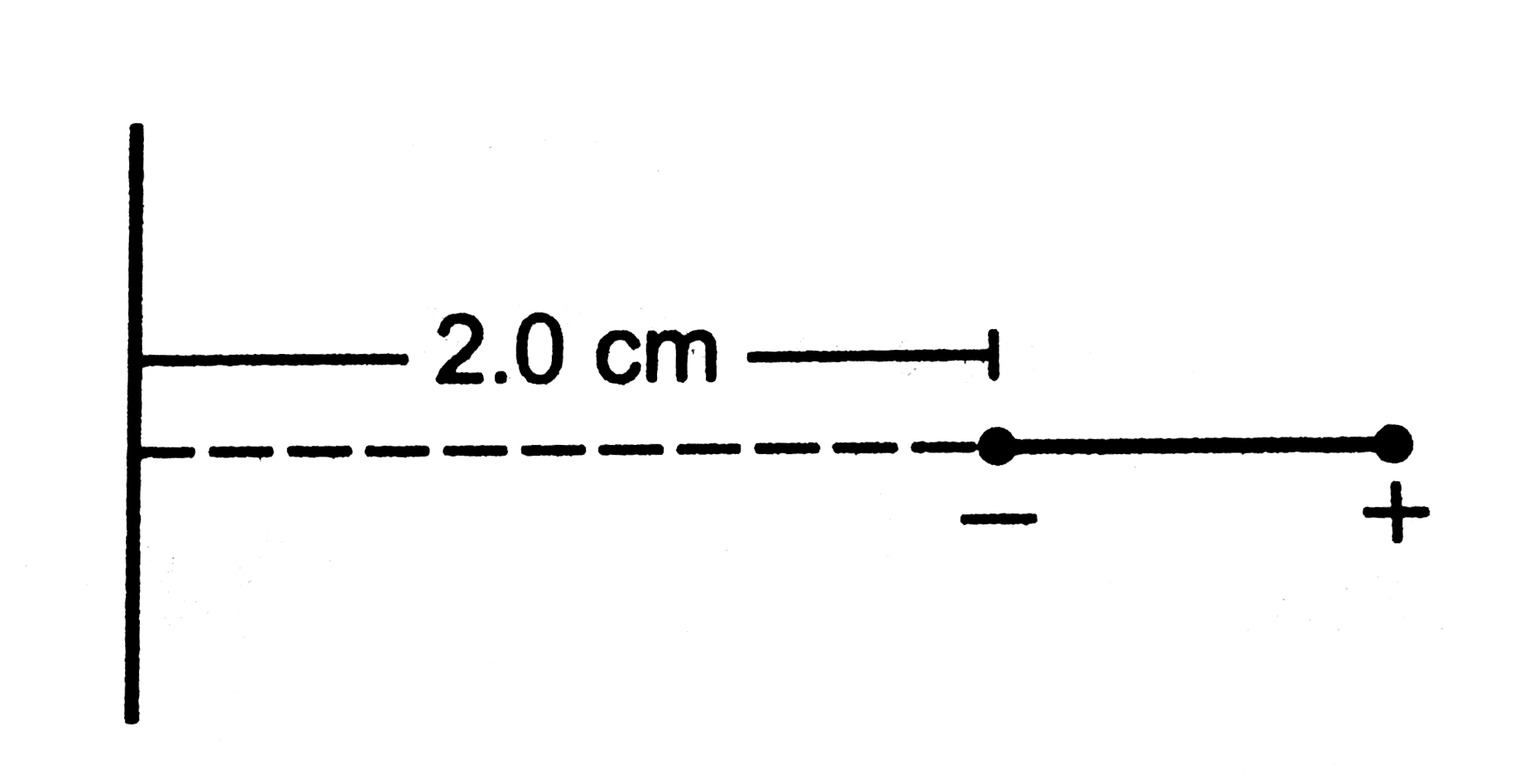
An electric dipole consists of charges `pm 2.0 xx 10^(8) C` separated by a distance of `2.0 xx 10^(-3)` m. It is placed near a long line charge of linear charge density `4.0 xx 10^(-4) C m^(-1)` as shown in figure (30-W4), Such that the negative charge is at a distance of `2.0 cm from the line charge. Find the force acting on the dipole.

A

7.2 N towards the line charge

B

6.6 N away from the line charge

C

0.6 N away from the line charge

D

0.6 N towards the line charge.

Text Solution

Verified by Experts

The correct Answer is:

D

The electric field at a distance r from the line charge of linear density `lamda` is given by
`E=lamda/(2piepsilon_(0)r)`
Hence, the field at the negative charge, `E_(1)=((4.0xx10^(-4))(2xx9xx10^(9)))/0.02=3.6xx10^(8)NC^(-1)`
The force on the negative charge,
`F_(1)=(3.6xx10^(8))(2.0xx10^(-8))=7.2N` towards the line charge
Similarly, the field at the positive charge,
i.e., at r = 0.022 m is `E_(2)=3.3xx10^(8)NC^(-1)`.
The force on the positive charge,
`F_(2)=(3.3xx10^(8))xx(2.0xx10^(-8))=6.6N` away from the line charge.
Hence, the net force on the dipole = 7.2N - 6.6N
=0.6N towards the line charge
Promotional Banner

Topper's Solved these Questions

  • ELECTRIC CHARGES AND FIELDS

    NCERT FINGERTIPS|Exercise HOTS|1 Videos
  • ELECTRIC CHARGES AND FIELDS

    NCERT FINGERTIPS|Exercise Higher Order Thinking Skills|7 Videos
  • ELECTRIC CHARGES AND FIELDS

    NCERT FINGERTIPS|Exercise Gauss Law|9 Videos
  • DUAL NATURE OF RADIATION AND MATTER

    NCERT FINGERTIPS|Exercise Assertion And Reason|15 Videos
  • ELECTROMAGNETIC INDUCTION

    NCERT FINGERTIPS|Exercise Assertion And Reason|15 Videos

Similar Questions

Explore conceptually related problems

An electric dipole consists of charges pm 2.0 xx 10^(8) C separated by a distance of 2.0 xx 10^(-3) m. It is placed near a long ilne charge of linear charge density 4.0 xx 10^(-4) C m^(-1) as shown in figure (30-W4), Such thet the negative charge is at a distance of 2.0 cm from the line charge. Find the force acting on the dipole.

An electric dipole consists of charges +- 2.0 xx 10^(-8) C separated by distance of +- 2.0 xx 10^(-3) m. It is placed at a distance of 6 cm from a line charge of linear charge density 4.0 xx 10^(-4) Cm^(-1) as shown in figure such that the dipole makes an angle of theta = 60^@ with line AB. Find the force acting on the dipole.

An electric dipole consisting of two opposite charges of 2xx10^(-6)C each separated by a distance of 3 cm is placed in an electirc field of 2xx10^(5)N//C . The maximum torque on the dipole is will be

A spherical volume contains a uniformaly distributed charge of density 2.0 xx 10^(4) C m^(3) . Find the electric field at a piont inside the volume at a distance 4.0 cm from the centre.

A line charge having a linear charge density of 3 xx 10^-6 C/m is placed as shown in figure. A dipole is placed on x-axis as shown. Find the charge q if it is subjected to a force of 4N.

A charged partical having a charge of -2.0 xx 10^(-6) C is placed close to a nonconducting plate having a surface charge density 4.0 xx 10^(6) C m^(-2). Fine the force of attraction between the particle and the plate.

Find the magnitude of the electric field at a point 4 cm away from a line charge of density 2 xx 10^(-6) C m^(-1) .

An infinite line charge produces a field of 9xx10^(4) NC^(-1) at a distance of 4 cm . Calculate the linear charge density.

An electric dipole is placed on x-axis in proximity to a line charge of linear charge density 3.0 xx 10^(-6) C/m. Line charge is placed on z-axis and positive and negative charge of dipole is at a distance of 10 mm and 12 mm from the origin respectively. If total force of 4 N is exerted on the dipole, find out the amount of positive or negative charge of the dipole.

An infinite line charge produces a field of 9xx10^(-4)N" "C^(-1) at a distance of 2 cm. calculate the linear charge density.
