Home
Class 12
PHYSICS
A parallel plate capacitor is made of tw...

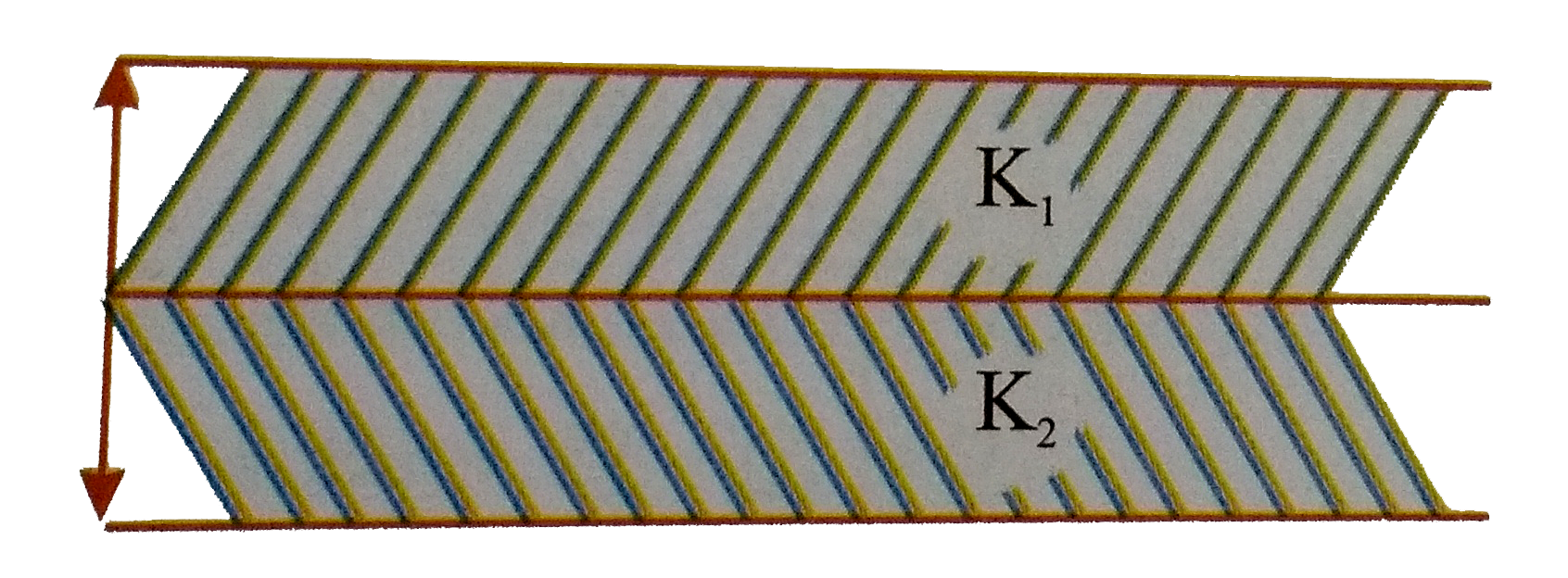
A parallel plate capacitor is made of two dielectric blocks in series. One of the blocks has thickness `d_(1)` and dielectric constant `K_(1)` and the other has thickness `d_(2)` and dielectric constant `K_(2)` as shown in figure. This arrangement can be through as a dielectric slab of thickness `d (= d_(1) + d_(2))` and effective dielectric constant `K`. The `K` is.
.

A

`(K_(1)d_(1)+K_(2)d_(2))/(d_(1)+d_(2))`

B

`(K_(1)d_(1)+K_(2)d_(2))/(K_(1)+K_(2))`

C

`(K_(1)K_(2)(d_(1)+d_(2)))/(K_(2)d_(1)+K_(1)d_(2))`

D

`(2K_(1)K_(2))/(K_(1)+K_(2))`

Text Solution

Verified by Experts

The correct Answer is:

C

The capacities of two individual condensers are `C_(1) = (k_(1) epsi_(0)A)/(d_(1))` and `C_(2)=(K_(2)epsi_(0)A)/(d_(2))`
The arrangement is equaivalent ot tow capacitor joined in series.
`therefore ` Equivalent capacitance `(1)/(C_(eq)) = (1)/(C_(1)) +(1)/(C_(2)) = (d_(1))/(k_(1)epsi_(0)A)+(d_(2))/(k_(2)epsi_(0)A)`
` =(1)/(epsi_(0)A) [(d_(1))/(k_(1))+(d_(2))/(k_(2))] = (1)/(epsi_(0)A)[(k_(2)d_(1)+k_(1)d_(2))/(k_(1)k_(2))]`
`or C_(eq) = epsi_(0)A ((k_(1)k_(2))/(k_(2)d_(1) +k_(1)d_(2))) " ".......(i)`
Also `C_(eq) = (kepsi_(0)A)/(d_(1)+d_(2))`
From(i)and (ii)
`epsi_(0)A((k_(1)k_(2))/(d_(2)k_(1) + d_(1)+k_(2))) = epsi_(0)((k)/(d_(1)+d_(2)))`
`therefore K = (k_(1) K_(2)(d_(1)+d_(2)))/(d_(1)k_(1) + d_(1)k_(2))`
Promotional Banner

Topper's Solved these Questions

  • ELECTROSTATIC POTENTIAL AND CAPACITANCE

    NCERT FINGERTIPS|Exercise Assertion And Reason|15 Videos
  • ELECTROSTATIC POTENTIAL AND CAPACITANCE

    NCERT FINGERTIPS|Exercise Higher Order Thinking Skills|8 Videos
  • ELECTROMAGNETIC WAVES

    NCERT FINGERTIPS|Exercise Assertion And Reason|15 Videos
  • MAGNETISM AND MATTER

    NCERT FINGERTIPS|Exercise Assertion And Reason|15 Videos

Similar Questions

Explore conceptually related problems

Between the plates of a parallel plate condenser, a plate of thickness t_(1) and dielectric constant k_(1) is placed. In the rest of the space, there is another plate of thickness t_(2) and dielectric constant k_(2) . The potential difference across the condenser will be

A parallel plate capacitor has the space between its plates filled by two slabs of thickness (d)/(2) each and dielectric constant K_(1) and K_2 . d is the plate separation of the capacitor. The capacitance of the capacitor is

A parallel plate capacitor with square plates is filed with four dielectrics of dielectric constants K_(1),K_(2),K_(3),K_(4), arranged as shown in the figure. The effective dielectric constant K will be :

A parallel plate capacitor of plate area A and separation d is filled with two materials each of thickness d/2 and dielectric constants in_1 and in_2 respectively. The equivalent capacitance will be

A parallel plate capacitor is charged to a certain voltage. Now if the dielectric material (with dielectric constant k ) is removed then the

A parallel plate capacitor with air as the dielectric has capacitance C. A slab of dielectric constant K and having the same thickness as the separation between plates is introduced so as to fill one-fourth of the capacitor as shown in the figure. The new capacitance will be :

A parallel plate capacitor carries a harge Q. If a dielectric slab with dielectric constant K=2 is dipped between the plates, then

The capacitance of a capacitor, filled with two dielectrics of same dimensions but of dielectric constants K_1 and K_2 respectively as shown will be -

A parallel plate capacitor has plate area A and plate separation d. The space betwwen the plates is filled up to a thickness x (ltd) with a dielectric constant K. Calculate the capacitance of the system.
