Home
Class 11
PHYSICS
Given vecA + vecB + vecC + vecD = vec0, ...

Given `vecA + vecB + vecC + vecD = vec0`, which of the following statements is not correct ?

A

`vecA, vecB, vecC and vecD` must each be a null vector.

B

The magnitude of `(vecA + vecC)` equals the magnitude of `(vecB + vecD)`.

C

The magnitude of `vecA` can never be greater than the sum of the magnitudes of `vecB, vecC and vecD.`

D

`vecB + vecC` must lie in the plane of `vecA and vecD` if `vecA and vecD` are not collinear and in the line of `vecA and vecD`, if they are collinear.

Text Solution

Verified by Experts

The correct Answer is:
A

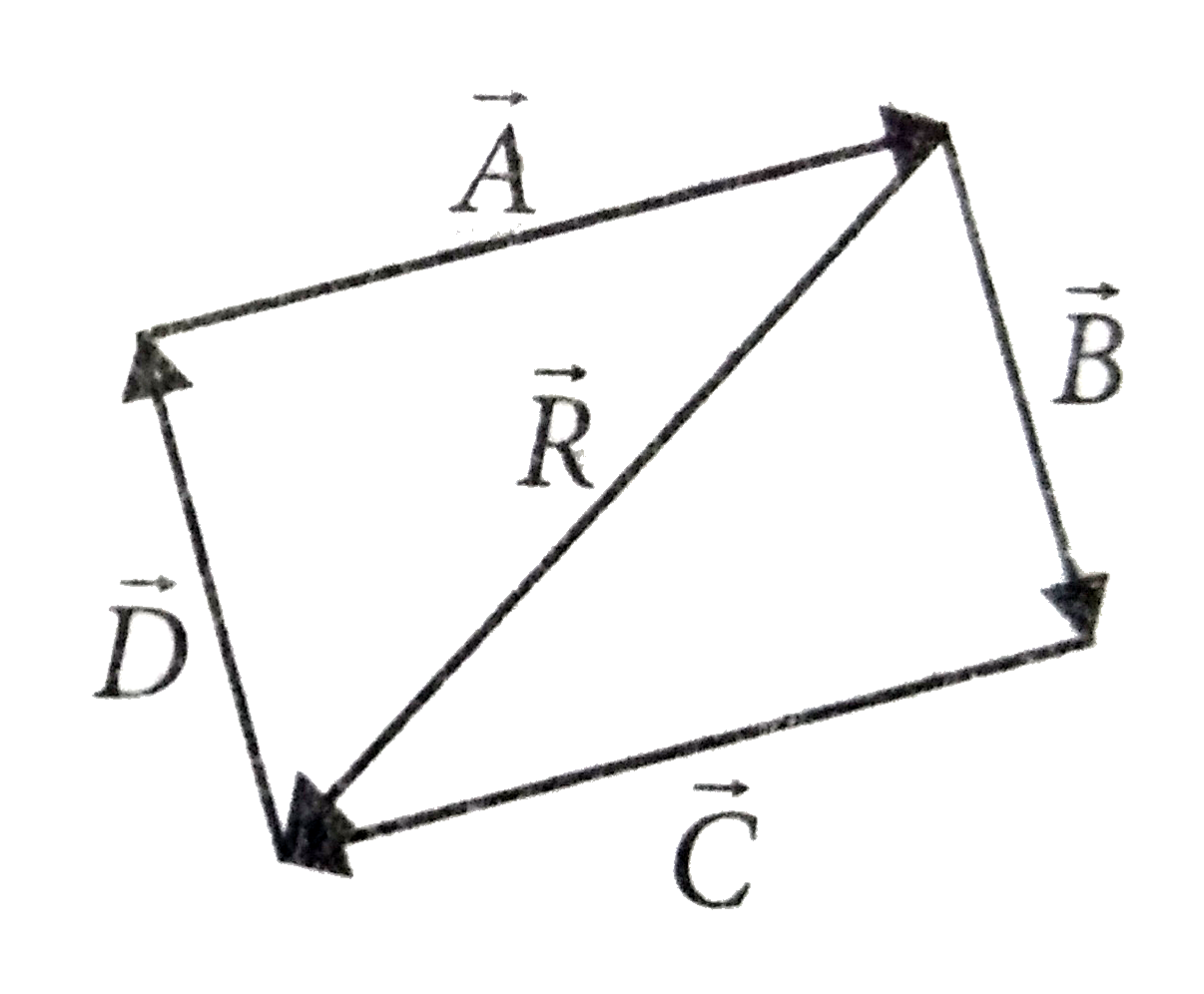
The statement is not correct. It is because `vecA + vecB + vecC + vecD` can be zero in many ways other than `vecA, vecB, vecC and vecD` being each a rull vector.
(b) The statement is correct as proved below
`vecA + vecB + vecC + vecD = vec0 or vecA + vecC = - (vecB + vecD)`
`therefore |vecA + vecC| = |vecB + vecD|`
(c ) The statement is correct and can be proved using triangular inequality.
`|vecB| + |vecC| ge|vecR|" "...(i)`
`|vecR| + |vecD| ge|vecA|" "...(ii)`
Using (i) and (ii), `|vecA| le |vecB| + |vecC| + |vecD|`
(d) THe statement is correct as proved below
`vecA + vecB + vecC + vecD = vec0 or vecA + (vecB + vecC) + vecD = vec0`
The resultant sum of three vectors `vecA, (vecB+vecC)` and `vecD` can be zero only if `(vecB + vecC)` lies in the plane of `vecA and vecD` and these three vectors are represented by the three sides of a triangle taken in one order. IF `vecA and vecD` are collinear, then `(vecB + vecC)` must be in the line of `vecA and vecD`, only then the vector sum of all the vectors will be zero.
Promotional Banner

Topper's Solved these Questions

  • MOTION IN A PLANE

    NCERT FINGERTIPS|Exercise Resolution Of Vectors|5 Videos
  • MOTION IN A PLANE

    NCERT FINGERTIPS|Exercise Vector Addition - Analytical Method|11 Videos
  • MOTION IN A PLANE

    NCERT FINGERTIPS|Exercise Assertion And Reason|15 Videos
  • MECHANICAL PROPERTIES OF SOLIDS

    NCERT FINGERTIPS|Exercise Assertion And Reason|15 Videos
  • MOTION IN A STRAIGHT LINE

    NCERT FINGERTIPS|Exercise Assertion And Reason|15 Videos

Similar Questions

Explore conceptually related problems

Let veca, vecb ,vecc be unit vetors such that veca + vecb + vecc = vec0 , which one of the following is correct ?

Let veca,vecb,vecc be three unit vectors such that 3veca+4vecb+5vecc=vec0 . Then which of the following statements is true? (A) veca is parrallel to vecb (B) veca is perpendicular to vecb (C) veca is neither parralel nor perpendicular to vecb (D) veca,vecb,vecc are copalanar

Two vectors vecA and vecB are such that vecA+vecB=vecC and A^(2)+B^(2)=C^(2) . Which of the following statements, is correct:-

If (veca xxv vecb) xx (vecc xx vecd) . (veca xx vecd) =0 then which of the following may be true ?

Consider the following statements in respect of a vector vecc=veca+vecb ,where abs(veca)=abs(vecb)ne0 : 1. vecc is perpendicular to (veca-vecb) 2. vecc is perpendicular to (vecaxxvecb) Which of the above statements is/are correct?

Let veca,vecb,vecc be unit such that veca+vecb+vecc=vec0 . Which one of the following is correct? (A) vecaxxvecb=vecbxxvecc=veccxxveca=vec0 (B) vecaxxvecb=vecbxxvecc=veccxxveca!=vec0 (C) vecaxxvecb=vecbxxvecc=vecxxvecc!=vec0 (D) vecaxxvecb, vecbxxvecc, veccxxveca are mutually perpendicular

Given vecC = vecA xx vecB and vecD = vecB xx vecA . What is the angle between vecC and vecD ?

Given the following information about the non zero vectors vecA, vecB and vecC (i) (Avec A xx vecB) xx vec A=vec0 (ii) vecB.vecB=4 (iii) vecA.vecB=-6 (iv) vecB.vecC=6 Which one of the following does not hold good ?

If vecA xx vecB = vecC+ vecD , them select the correct alternative:

