Home
Class 11
PHYSICS
Two vectors vecA and vecB inclined at an...

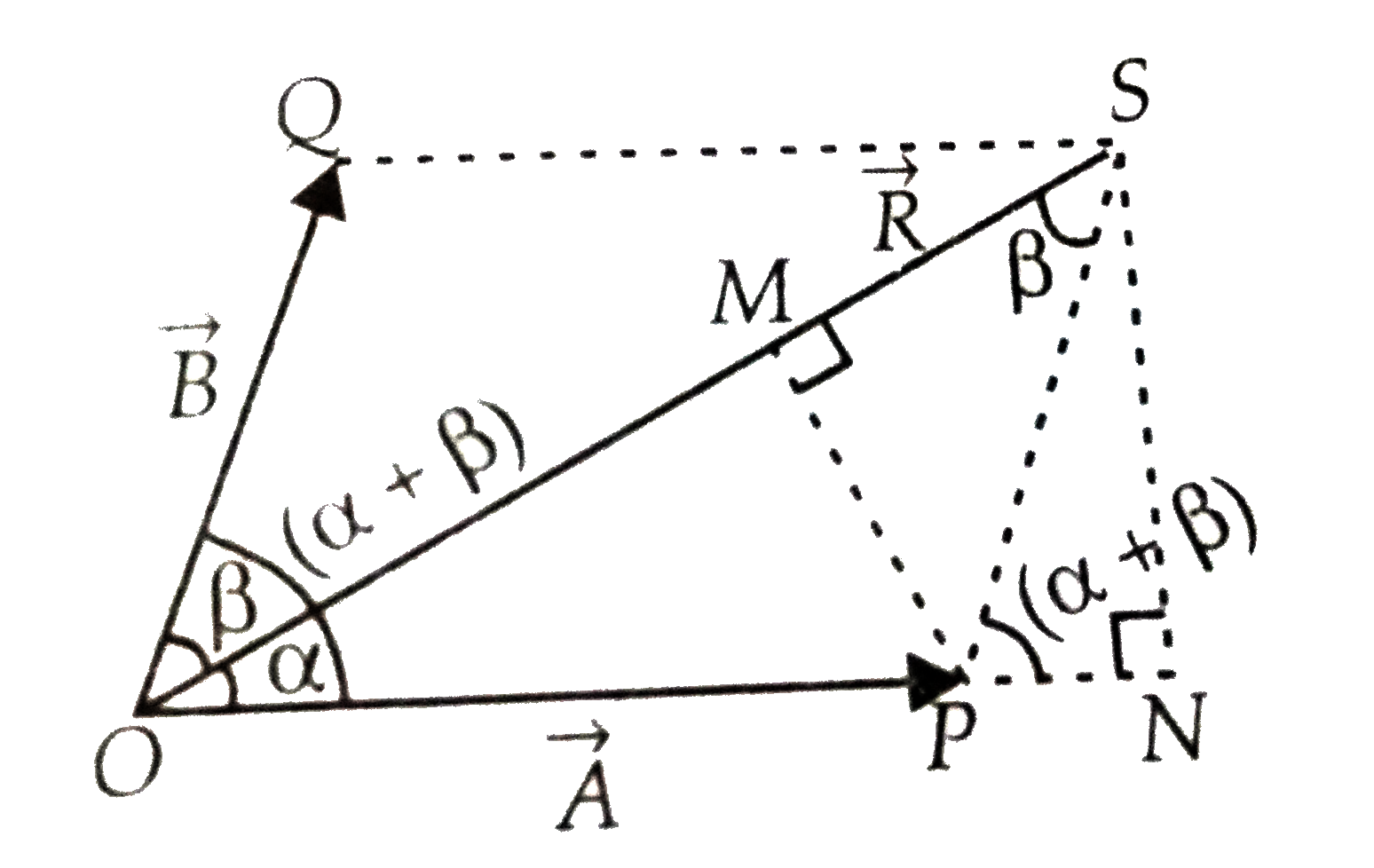
Two vectors `vecA and vecB` inclined at an angle `theta` have a resultant `vecR` which makes an angle `alpha` with `vecA` and angle `beta` with `vecB`. Let the magnitudes of the vectors `vecA, vecB and vecR` be represented by A, B and R respectively. Which of the following relations is not correct ?

A

`(R)/(sin(alpha+beta))=(A)/(sin alpha) = (B)/(sin beta)`

B

`R sin alpha = B sin (alpha + beta)`

C

`A sin alpha = B sin beta`

D

`R sin beta = A sin (alpha + beta)`

Text Solution

Verified by Experts

The correct Answer is:
A

Let `vec(OP)` and `vec(OQ)` represent two vectors `vecA and vecB` making an angle `(alpha + beta)`. Using the parallelogram method of vector addition,
Resultant vector, `vecR = vecA + vecB` SN is normal to OP and PM is normal to OS.
From the geometry of the figure,
`OS^(2) + ON^(2) + SN^(2) = (OP + PN)^(2) + SN^(2)`
` = (A + Bcos(alpha + beta))^(2) + (Bsin(alpha + beta))^(2)`
`R^(2) = A^(2) + B^(2) + 2ABcos (alpha + beta)`
In `triangleOSN, SN = OS sin alpha = R sin alpha `
and in `triangle PSN, SN + pS sin (alpha + beta) = B sin (alpha + beta)`
`therefore R sinalpha = Bsin(alpha + beta) or (R)/(sin(alpha +beta)) = (B)/(sin alpha)" "...(i)`
Similary, PM ` = A sin alpha + B sin beta`
`(A)/(sin beta) = (B)/(sin alpha) " "...(ii)`
Combining (i) and (ii), we get
`(R)/(sin(alpha + beta)) = (A)/(sinbeta) = (B)/(sin alpha) " "...(iii)`
From eqn. (iii), `Rsinbeta = Asin(alpha + beta)`
Promotional Banner

Topper's Solved these Questions

  • MOTION IN A PLANE

    NCERT FINGERTIPS|Exercise Motion In A Plane|10 Videos
  • MOTION IN A PLANE

    NCERT FINGERTIPS|Exercise Motion In A Plane With A Constant Acceleration|2 Videos
  • MOTION IN A PLANE

    NCERT FINGERTIPS|Exercise Resolution Of Vectors|5 Videos
  • MECHANICAL PROPERTIES OF SOLIDS

    NCERT FINGERTIPS|Exercise Assertion And Reason|15 Videos
  • MOTION IN A STRAIGHT LINE

    NCERT FINGERTIPS|Exercise Assertion And Reason|15 Videos

Similar Questions

Explore conceptually related problems

The resultant of vecA and vecB makes an angle alpha with vecA and vec beta with vecB , then -

The resultant of vecA and vecB makes an angle alpha with vecA and beta and vecB ,

If the resultant of vecA and vecB makes angle alpha with vecA and beta with vecB , then

The magnitudes of vectors vecA,vecB and vecC are 3,4 and 5 units respectively. If vecA+vecB= vecC , the angle between vecA and vecB is

Two vectors veca and vecb add to give a resultant vecc=veca+vecb . In which of these cases angle between veca and vecb is maximum: (a,b,c represent the magnitudes of respective vectors )

If veca and vecb are unit vectors inclined at an angle theta , then the value of |veca-vecb| is

Vectors vecA and vecB include an angle theta between them. If (vecA + vecB) and (vecA- vecB) respectively subtend angles alpha and beta with vecA , then (tan alpha + tan beta) is

The magnitudes of vectors vecA.vecB and vecC are respectively 12,5 and 13 unira and vecA+vecB=vecC , then the angle between vecA and vecB is :

Vectors vecà and vecb include an angle theta between them. If (veca+vecb) and (veca-vecb) respectively subtend angles alpha and beta with veca , then (tan alpha+tan beta) is

A magnitude of vector vecA,vecB and vecC are respectively 12, 5 and 13 units and vecA+vecB=vecC then the angle between vecA and vecB is

